
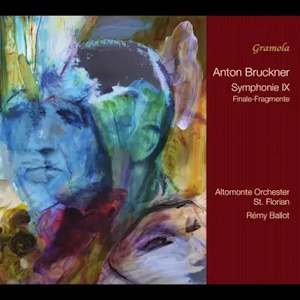
Anton Brucker (1824-1896)
Symphony No. 9 in D Minor, WAB 109
(1894 Original Version. ed. Nowak)
Sketches of the Finale (details beneath review)
Altomonte Orchester St Florian/Rémy Ballot
rec. live 23 & 24 August 2024, Stiftsbasilika St Florian, Upper Austria
Gramola 99378 [89]
Having just reviewed both Gerd Schaller’s studio (review) and live (review) recordings of the four-movement version of this symphony which employ his own completion, I am now largely habituated to listening to it in that form, such that I even view recordings of just the three movements as something of a disappointment – and I am not sure that the provision of seventeen minutes of fragments is much of a compensation, even though that may be of interest to Bruckner scholars and purists who disapprove of their elaboration. For those lay-listeners like me who have become more familiar with Schaller’s or the SMPC completion, it is certainly quite intriguing to hear and recognise what they started with before filling the seven major gaps (or, if you prefer, the 18 missing of the 40 double sheets forming the original score) and that lends a new appreciation of their ingenuity and invention. I am surprised by just how full both the themes and the orchestration in the remnants are, and certainly, hearing them unadorned makes me understand how and why “completionists” felt that they had enough to go on to make a credible job of reconstruction despite the absence of a coda. Nonetheless, I doubt whether many will return to listen to them often. In the live performance for the 2024 jubilee, those fragments were played with a commentary as a kind of appetiser to the symphony which was played after the interval; perhaps inclusion of the commentary would have added appeal but that would have necessitated an additional disc and, presumably, for marketing reasons, the provision in the notes of an English translation from the original German.
I previously reviewed Ballot’s 2015 live performance positively while acknowledging that his approach has always been controversial and divisive; as a Celibidache disciple, he has long advocated slower tempi in Bruckner’s symphonies and the timings of this performance in 2015 were almost identical to Celibidache’s last in Munich in 1995, both at 77 minutes. (Celibidache gradually slowed down over twenty-five years from a starting point of 59 minutes.) Here, however, Ballot has somewhat revised his plan and accelerated a little to reduce the runtime by five minutes – and most of that is in the Adagio.
So to the performance itself: as always, although this orchestra meets only once a year, it is largely a reunion of colleagues and they play with a wonderful sense of purpose, unity and sonority – qualities the slower speeds allow us to appreciate, as per the power of the great climax three minutes into the first movement and the ensuing Gesangsperiode which is so lovingly caressed. As playing per se it is flawless and if you have heard Ballot in Bruckner previously, you will know what to expect; his manner is excoriated in certain quarters, prized elsewhere and given a cautious welcome in others – which is perhaps where I stand, as I thoroughly enjoy it but would issue a caveat to the unwary. There are certainly times around halfway through the first movement in the development section where one could wish for more momentum but on the other hand there is a granitic magnificence about the ensuing climax – shades of Klemperer? – when the rolling timpani echo around the basilica. I appreciate that some conclude that Ballot’s way with the music courts stasis far too readily, but I really enjoy, for example, the three minute coda, which builds inexorably to glorious effect.
The most likely sticking point for some will be the Scherzo – although Ballot here shaves off a minute from 2015, which helps, even if it is still a couple of minutes longer than the mean duration. It undoubtedly plods a bit; we have a stegosaurus on the run as opposed to a T-rex and the result is spookily menacing rather than overtly aggressive. The Trio brings slight relief, of course, and in fact trips along engagingly.
However, as I mention above the Adagio is the main beneficiary of Ballot’s re-think in terms of pace., being over two minutes swifter. It is still stately in the extreme but as Ballot says in his note, “Anton Bruckner was always in search of elevation” and transcendence and one can sense that he sincerely believes that his is the best way to evoke “a luminous world”; certainly, the playing of the Altomonte achieves luminosity even if it at the expense of propulsion. We are always told that proper appreciation of Bruckner in a hectic, sound-bite world demands patience – well, here is our opportunity to practise that and absolute favourite moment in this symphony at 17:46 here when the “sunburst” chord change of key floods that world with light is perfectly managed, and I defy anyone to deny that the apotheosis of coda is sublime.
The acoustic of the Stiftsbasilika is ideally caught by the engineer John Gladney Proffitt here: grand, spacious with just a hint of reverberation.
In many ways this is an alternative preferable to what some might perceive as the excessive leisureliness of the 2015 performance – the one included in Ballot’s set of ten symphonies (review).
Ralph Moore
Buying this recording via the link below generates revenue for MWI, which helps the site remain free
Details of fragments:
Symphony No. 9 in D Minor, WAB 109: IV. Finale (sketches)
Fragment 1 (Beginning, Theme 1) [2:10]
Fragment 2 (Theme 2) [0:47]
Fragment 3 (Theme 2, continued – Theme 3) [5:02]
Fragment 4 (Development – Recapitulation: Theme 1) [2:15]
Fragment 5 (continuation, till Recapitulation: Theme 2) [2:13]
Fragment 6 (Recapitulation continued) [2:08]
Fragment 7 (Recapitulation: Theme 3) [1:13]
Fragment 8 (Transition into the Coda) [0:44]













