
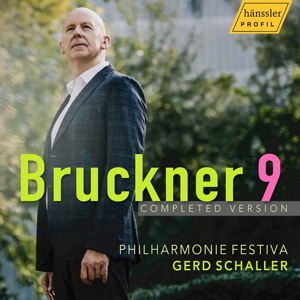
Anton Bruckner (1824-1896)
Symphony No. 9 in D Minor (1887-1896)
Four-movement version, with Finale completed by Gerd Schaller, revised 2024
Philharmonie Festiva/Gerd Schaller
rec. live, 1 September 2024, former Cistercian Abbey, Ebrach, Germany
Hänssler Profil PH25007 [73]
I recently reviewed and recommended Gerd Schaller’s studio recording of this, his completion of Bruckner’s Ninth Symphony, with the LPO. This live recording precedes it by sixteen months, being part of the annual Ebracher Musiksommer festival and is notable for being considerably speedier overall by some seven minutes. I refer you to the review on Seen & Heard of the live performance by my friend and colleague Ken Ward for a more percipient and comprehensive response than I could provide, so I will not belabour my own beyond providing a few supplementary comments.
With the exception of the Scherzo, the running time of which is much as it has been before under Schaller, every movement here is faster than in any of his four previous recordings of the expanded Ninth, going back to 2010 when he performed and recorded the four-movement Carragan edition. The most striking difference is in the Adagio, which is here only 18:20, as opposed to the usual twenty-three or four minutes. This is hardly unprecedented or in some way illicit; no less a conductor than Bruno Walter paced it similarly in 1953 with the VPO, although of course the norm is a far more solemn, serene delivery of around twenty-five minutes (we may perhaps discount Norrington’s farcical assault on the music and likewise, but perhaps more be more tolerant of Celibidache’s one-off, thirty-minute-plus studio recording with the Munich Philharmonic Orchestra in 1995, especially as his tempi were more conventional in more than half a dozen other recordings and his grip was much more convincing than Sir Roger’s…).
The playing from the Philharmonie Festiva, the regular festival orchestra assembled from the best instrumentalists from Munich and beyond, is as magnificent as ever and the Bavarian Radio engineers have long since worked out how to exploit the spacious acoustic of the abbey church to achieve maximum grandeur without losing definition. As my colleague remarks, if tempi are quicker than usual, there is no sense of undue haste, more a kind of heady rapture as Schaller presses forward while still employing rubato to underline the pent-up passion behind the music yet imposing a coherence upon the whole which more ponderous deliveries risk losing. I have in previous reviews expressed admiration for his skill in grading dynamics despite the challenges of such a large performance venue and reverberation is atmospheric without being excessive. As is so often the case with attendance in the abbey, the audience seem bound and gagged, there is so little extraneous noise.
Some great conductors can be relied upon to adhere to fairly predictable timings in certain works regardless of the circumstances; thus both various live and studio performances by Karajan, for example, vary little; here, it seems that Maestro Schaller felt moved to confer more urgency upon this music to enthralling effect and as a result give us something new. Ken Ward and I made much the same observation of his swift and cohesive treatment of the later version of the Eighth Symphony given in the July of the same year. Indeed, why should one expect rigid adherence to the same timings from one performance to another? Hence, when he came to make the studio recording referred to first above, he opted for a slightly more relaxed but equally effective treatment of the Adagio.
The Scherzo is surely Bruckner’s best and most powerful; certainly, it was my gateway into what has since become a grateful obsession with his music. The contrast between the vicious exuberance of the outer sections and the joyful, tripping momentum of the Trio is captivating. The opening of the Adagio is less doom-laden than is often the case, more an affirmation of the beauty of life with, as Ken remarks, the character of a fanfare, a mood enhanced by the flowing, unimpeded confidence of the second subject, while the brass underlying the third subject are almost military in their brash assertiveness, culminating in a massive, almost raucous, climax at 14:52 and a bright, positive coda. Some may miss the serenity and transcendence of a more reflective conclusion but the final sustained top B on the horn is deeply reassuring.
Of course, Schaller has been refining his own realisation of the finale for a decade now and this is as taut and driven an account as I have ever heard, its concision aided by the cut he has made in the original coda. For me, this is the most convincing “re-imagining” and elaboration of the fragments we have; it is replete with grand, leaping, authentically Brucknerian tropes and themes, contrapuntal interest and arresting orchestration, the fugue satisfying filled out and the coda driving inexorably towards the thrilling D major peroration. Increased familiarity with this completion not only burns it into one’s musical consciousness but also establishes it as an indispensable adjunct to the listener’s pleasure in this symphony rather just a curiosity – at least, it has for me.
Ralph Moore
Buying this recording via the link below generates revenue for MWI, which helps the site remain free














