
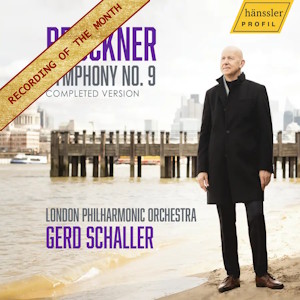
Anton Bruckner (1824-1896)
Symphony No. 9 in D Minor (1887-1896)
Four-movement version, with Finale completed by Gerd Schaller, revised 2024
London Philharmonic Orchestra/Gerd Schaller
rec. 2026, Colosseum, Watford, UK
Profil PH26022 [80]
Gerd Schaller’s BRUCKNER2024 project has been extensively covered by MusicWeb reviewers going back to 2011 and that has included his live recordings of completions of the Ninth Symphony by both the late William Carragan (review 2010) and himself – the 2016 performance reviewed by John Proffitt and me (review) and the revised 2018 completion (review), again reviewed by me.
Here is a further refinement of his completion based on his ongoing study of the material available, including original sources, and his practical experience of having conducted it live in concert. It is the first studio recording, as opposed to the 2018 live recording of the performance in the reverberant acoustic of the Abteikirche, Ebrach, and while his own Philharmonie Festiva orchestra used there was splendid, it is something of a coup for him to be directing of one of the world’s great orchestras in the LPO, recorded in Watford when studio recordings are now increasingly rare.
Bruckner scholars and musicologists who wish to pore over the details of Maestro Schaller’s revision and completion may avail themselves of the detailed forward to the edition of score by Ries & Erler, Berlin, but for the general listener his notes neatly summarise the challenges inherent in such an undertaking, the rationale behind his choices and the ethos motivating them. Essentially, he felt that it would be “desirable to bring Bruckner’s extraordinarily bold and fascinating sketches and drafts into a performable and, above all, musically convincing form.” As ever, he stresses that this is not a “restoration” as often there was nothing extant to be restored, but rather a creation based on as many of the original existing fragments as possible in authentic Brucknerian style, drawing heavily on the example as given in the last three symphonies. Although large sections of the score exist already orchestrated by Bruckner, the five big gaps in the score have been filled and the missing coda constructed by extrapolating from the early sketches, incorporating chorale fragments and motifs from the first movement and Adagio, and providing a suitably radiant apotheosis.
Inevitably much of what has already been said about the performances of the first three movements in the previous three recordings, all employing the Nowak score, will apply here; I particularly refer you to my review of the 2018 version, as I spend some time discussing the reasoning behind Schaller’s reconstruction of the finale and it would be superfluous to repeat those points here. As may be seen from the table below, timings for all four, including this latest one, are similar except that Schaller is now slightly brisker and tauter in the first movement and considerably so in the Adagio – the latter in particular is now over three minutes faster since his last recording in Ebrach:
| 1st mvt | Scherzo | Adagio | Finale | Total | |
| 2010 Carragan | 25:16 | 11:38 | 24:35 | 22:12 | 83:41 |
| 2016 Schaller | 25:54 | 10:58 | 23:00 | 24:40 | 84:32 |
| 2018 Schaller | 26:01 | 11:06 | 24:53 | 25:17 | 87:22 |
| 2026 Schaller | 24:28 | 10:39 | 22:25 | 21:54 | 79:45 |
I know full well from my frequent visits to hear them in the Royal Festival Hall that the LPO is a superb orchestra and this is apparent from the first brooding, minatory bars and the sheer power of the first forte climax at 2:15. As much as I enjoy the atmospheric acoustic of the recordings made in the abbey in Ebrach, it is a real pleasure to hear how well details emerge in a balanced studio recording; the violas really sing like a bevy of contraltos and the horns are so mellifluous, all set against a backdrop of soaring violins – this is a great orchestra caught on the wing, confirming what I so often hear live. Schaller’s long familiarity with the work shines through via his attention to dynamics, the fluidity of his phrasing and the coherence of structure, and the orchestra’s subtly graded responses to his direction lend the music nuance, variety and contrast. A second great climax beginning with the skilfully handled acceleration fourteen minutes in generates huge tension and the brass answers the call heroically. That sense of propulsion is, I think, enhanced by the slightly faster speeds adopted here compared with the last recording. The coda is simply magnificent, the relentless, rolling timpani underscoring its high drama.
The Scherzo is very much as I have heard Schaller deliver it before, both live and recorded: demonic, driven, pounding – again, a little faster than ever without degenerating into a scramble. That lends the movement a kind of macabre glee and again the timpanist – presumably the great Simon Carrington – plays a major role in both the outer sections and the tripping Trio.
The deep, dark sonority of the divided strings opening the Adagio is striking but every section of the orchestra is to be commended for flawless ensemble and intonation. I have no idea how much rehearsal time was available before this recording but even if Bruckner has not been central to the orchestra’s Romantic repertoire, they play this symphony as if to manner born. Highlights such as the “catastrophe” dissonance at the climax of the movement all make their mark and that indefinable “spiritual” sense prevails throughout until the texture thins and the horns breathe their long farewell.
The spiky opening the reconstructed final is certainly more arresting even than that of the 2018 recording, with more aggressive timpani and sharper delineation of the jagged figure; the lyrical Gesangsperiode provides a brief respite from the prevailing drama, then the glorious fugue takes off. There is a well-judged and typically Brucknerian “pregnant pause” before the start of the coda which is of course the most speculative passage, but Schaller’s cunning and tasteful integration of elements we already recognise and remember from the three previous movements without their being too obviously shoe-horned in works remarkably well. The more I hear this movement, the more apt, convincing and memorable I find it as a completion. The brass intone hieratically over the insistent string arpeggios and the whole builds to deeply satisfying peroration.
As much as I was able to endorse and indeed recommend the previous live recording of 2018, this new account is the best yet in terms of sound, playing and performance.
Ralph Moore
Buying this recording via the link below generates revenue for MWI, which helps the site remain free














Dear Mr. Moore,
I came to know and appreciate Bruckner’s symphonies back in my adolescence. I have been following the attempts to complete the finale of the ninth since the year 1985. Then I heard the completion of Carragan for the first time in the Concertgebouw in Amsterdam, the city where I live. That was a sensational event at the time. Since then, I have listened to quite a number of completions, but I do not find any of them entirely convincingly realized. I find the most plausible to be the SPCM version performed by Rattle. I am less pleased with Schaller’s realization. I find his filling of the gaps in the surviving score particularly problematic, as well as his coda. There is an unknown reconstruction by Jacques Roelands, also a Dutchman, who, in my opinion, has filled these gaps in an intelligent and tasteful manner. I have updated the orchestration and added the missing coda. If you like, I can send a computer simulation via WeTransfer, but an email address is required for that.
Kind regards,
Joan Schukking
Thank you very much for those interesting comments. I do indeed find both the SPCM and Gerd Schaller’s completions very satisfying and now prefer to hear the four-movement versions. You will appreciate that on this website we critique published, commercial issues so please do not feel slighted if I say I will not trouble you for the Roelands one, especially as I remain happy with those we have, but should that ever be recorded…