
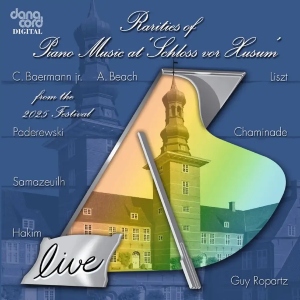
Rarities of Piano Music at Schloss vor Husum 2025
rec. live, 16-23 August 2025, Schloss Husum, Schleswig-Holstein, Germany
Danacord DACOCD1019 [78]
The Rarities of Piano Music Festival, founded by Peter Froundjian, is based in Husum in the north of Germany. It celebrated its fortieth anniversary in August 2026, and appears to show no sign of flagging. Danacord has a long-standing association with the festival. Their annual collections of recordings from that special week of recitals are a treasured part of my collection. A resurgence of rare piano music, on disc at least, means that – for those interested – many rarities are now being recorded by a wealth of pianists worldwide. Still, Husum’s artists manage to uncover delights aplenty.
The present disc has pleased me as much as any in the past few years. It easily maintains the high standard and eager sense of adventure that we have come to expect from the festival. The rarities begin straight away: Chiyan Wong plays works by Lebanese composer Naji Hakim and Ravel’s lifelong friend Gustave Samazeuilh. Hakim’s variations on the old French song Auprès de ma blonde are an absolute delight. The familiarity of the theme was gnawing at me until a friend said she knew it from primary school. The words were I want to be near you, you’re the one, the one for me, and the pupils would do a country dance around the hall. Perhaps I did the same but memory fails, leaving only the melody bouncing around my brain.
The seven variations are a lovely mix of impish humour in the faster sections and rich luxuriance combined with jazz harmonies in the slower variations, all topped off with a virtuosic scherzo to close. A glance at the score shows that Wong cuts a few bars of the opening march and the finale, but that spoils the enjoyment not a jot.
Samazeuilh is represented by two movements of his lovely Suite in G, the flowing and haunting prélude, and the second-movement Française, a song without words that Samazeuilh intended to be played in the sentiment of a popular song. These finely crafted works suggest that the short suite would grace any recital.
Aline Piboule continues with Samazeuilh’s near contemporary Guy Ropartz, a Paris-trained composer. He studied with Massenet and Franck before moving to Nancy where he guided the musical life of the city and its conservatoire. His nocturne, a large-scale piece, opens with a dramatic introduction featuring three motifs, a passacaglia-like bass line, a chordal theme and a playful skipping melody, all infused with whole tone harmonies. What grows from these seeds is an extended fantasy that goes far beyond what we usually hear in a nocturne. There are elements of Fauré in some of the lyrical writing but it is clear that Ropartz has his own voice – and what an outstanding voice that is. This atmospheric performance is prefaced with a much more light-hearted offering: Frank Bridge’s elegant and whimsical valse capricieuse.
The music of Cécile Chaminade has made many appearances at Husum over the years. Here we are gifted three selections – by Roland Pöntinen, and by Mark Viner who has recorded two discs of her music. Pöntinen plays Les Sylvains which is becoming one of her most played piano works. Viner strays into less familiar corners of her output. Sylvains are spirits of the wood but it is the water spirit Ondine that Viner chooses. The piece’s opening bars are redolent of early French keyboard style but are taken over by the playful and dazzling figuration that Chaminade does so well, matched by Viner’s sparkling playing.
Chaminade’s Night fishermen is altogether more serious though equally evocative. It could almost be a barcarolle, suggested by its gently lapping accompaniment, but storms are brewing and waves are soon menacing the poor fisherman. The writing is magnificent, and there are even hints of Debussy as the storm begins to abate.
Viner continues with Liszt’s transcription of Gounod’s Hymne á Sainte Cécile, originally scored for solo violin with either organ and piano or winds, brass, timpani and harp. The main theme is as vocal a line as anything in Gounod’s operas. Liszt’s imagination was obviously fired up by the piece: he nearly doubles its length and brings all his skill to bear. He captures the timbre of the instrumentation around the thread of the melody, and his three-handed effect is very much in evidence.
A contemporary of Liszt is next. Adolph von Henselt was pianist of extraordinary hand stretches and desperate fear of public performance. Daniel Grimwood has done sterling work on his behalf. He recorded the complete études alongside an edition of the score, as well as various other piano works on an earlier disc. Here he plays Henselt’s transcription of a Romance by Comte Wielhorsky. Comte Mikhail Wielhorsky had studied with Luigi Cherubini and wrote many songs, three of which Henselt transcribed in the style of Liszt. This romance, titled Erstwhile, is in the major-key middle section, introduced by a short cadenza; Henselt begins to adorn the melody with increasing amounts of florid decoration to powerful effect.
Carl Baermann Jr. – the son of noted clarinettist Carl Baermann for whom Weber wrote several works – studied with Peter Cornelius and Liszt. He went on to teach at the Royal Music School in his home town of Munich before moving to America. There, he taught at the New England Conservatory for many years while maintaining a career as a pianist. Amy Beach, George Copeland and Lee Pattison (of the Maier/Pattison two-piano duo) were among his pupils.
Grimwood plays two of Baermann’s twelve études op.4. The No.2 in A minor is a delicious study in legato playing, a little gem in its own right. The 12th étude is an agitated study in flowing arpeggios and lyrical playing. Stylistically, they lie alongside Henselt’s and Chopin’s études. On the strength of these two, they all deserve some of the attention that the Henselt études once lacked and are beginning to receive. I hope that Grimwood commits the set to disc.
On to a pupil of Baermann’s, Amy Beach, and her gorgeous little tone poem Hermit thrush at Eve. It was the first of two Hermit Thrush pieces inspired by Walt Whitman and by the famously melodic bird itself. With evocative bird song suggested in the middle, this nocturne has a wonderfully nostalgic melody that has to be spun out of a complex web of notes. That is no problem for Italian-Dutch pianist Saskia Giorgini who creates a magical atmosphere in this haunting work.
Paderewski’s many miniatures have fallen by the wayside somewhat, though the B flat nocturne still gets the occasional outing; even his once ubiquitous minuet in G is seldom heard. The Chant d’amour is a typical example of the high-quality salon music that flowed from his pen. It has a touching folk-like melody over a simple accompaniment, and a dark-hued barcarolle at its heart. His Cracovienne fantastique is a vigorous dance, deservedly popular in the early years of the 20th century. Paderewski himself made four recordings of the work – at least five if you include his piano roll versions. He was doubtless proud of this short virtuosic work that gives this Polish dance real substance.
As a sort of encore, Danacord includes a transcription of Ivor Novello’s We’ll gather lilacs by Scottish composer and pianist Ronald Stevenson. It is played by Kenneth Hamilton, a gifted and highly entertaining speaker and pianist, who included it in his Sunday afternoon lecture at the festival. The song’s title obviously brought Rachmaninov’s song Lilacs to mind. Stevenson weaves the two into an utterly charming, superbly played transcription.
Once again, Danacord have chosen wisely from the festival. There may be many, certainly myself, who would happily have a box set of the festival every year, but we can be grateful to the label for delivering such a treasured collection each year.
Rob Challinor
Previous review: John France
Contents
Naji Hakim (b.1955)
Variations on “Auprès de ma blonde” (2013)
Gustave Samazeuilh (1877-1967)
From Suite in G (publ. c.1911): Prelude; Française
Chiyan Wong (piano)
Frank Bridge (1879-1941)
From Three Sketches: Valse capricieuse (1906)
Guy Ropartz (1864-1955)
Nocturne No.1 (1911)
Aline Piboule (piano)
Cécile Chaminade (1857-1944)
Les Sylvains, op.60 (1892)
Roland Pöntinen (piano)
Cécile Chaminade
L’Ondine, op.101 (1900)
From Poème provençal, op.127 (1908): Pêcheurs de nuit
Franz Liszt (1811-1886)
Hymne à Sainte Cécile de Charles Gounod, S.491 (1865)
Mark Viner (piano)
Adolf Henselt (1814-1889)
Romance du Comte Wielhorsky No.1 (?)
Carl Baermann Jr. (1839-1913)
From Etudes, op.4 (1877): No.2 in A minor; No.12 in C-sharp minor
Daniel Grimwood (piano)
Amy Beach (1867-1944)
A Hermit Thrush at Eve, op.92, No.1 (publ.1922)
Saskia Giorgini (piano)
Ignaz Paderewski (1860-1941)
From Album de Mai, op.10 (publ.1884): No.2 Chant d’amour
From Humoresques de concert, op.14, Cahier II, (1887-1888) No.6 Cracovienne fantastique
Illia Ovcharenko (piano)
Ronald Stevenson (1928-2015)
“We’ll Gather Lilacs”by Ivor Novello (1893-1951) (1980)
Kenneth Hamilton (piano)
Buying this recording via the link below generates revenue for MWI, which helps the site remain free













