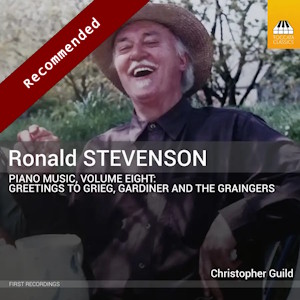
Ronald Stevenson (1928–2015)
Piano Music Volume 8: Greetings to Grieg, Gardiner and the Graingers
Christopher Guild (piano)
rec. 2023/25, Wyastone Hall, Monmouth, UK
Toccata Classics TOCC0787 [74]
Christopher Guild continues his massive survey of Ronald Stevenson’s piano music with more examples of the works and influence of the Australian composer and pianistPercy Grainger (1882-1961). This builds on Volumes Three and Seven (review ~ review). As nearly all these pieces are premiere recordings, I am beholden to the author of the scholarly liner notes for information largely unavailable elsewhere.
The recital opens with an arrangement of the Northern March from Grainger’s orchestral Youthful Suite, begun in 1898 and finished in 1945. The March may have all the hallmarks of a North Country or Scottish tune, but seemingly this was a Grainger invention. Stevenson has ‘Scottified’ it by introducing a Scotch Snap in the main theme. The notes suggest that the melody may have occurred to Grainger whilst hiking. I must confess that this eight-minute number often does not seem very march-like: it is thoughtful and melancholy in places.
Edvard Grieg’s Den Bergtekne (The Mountain Thrall) was devised for baritone, strings and two horns. It was a setting of a Norwegian folk ballad. The tragic poem is a story of “temptation, deception and treachery”; a man is lured away from his home by a troll daughter. Unlike Rip Van Winkle or Tam Lin, he never returns. Stevenson replicates Grieg’s unusually austere music in his piano transcription that echoes the dark and intense mood of the original.
Stevenson wrote the Norse Elegy for Ella Nygaard in memory of the late wife of Percy Grainger’s doctor and friend, Kaare K. Nygaard. The notes explain that Stevenson completed this piece “on the veranda of the Grainger House, White Plains, N.Y., June 15, 1979”. The Elegy uses a cipher based on a notational representation of E-L-L-A , with ‘L’ transliterated to ‘A’. There are allusions to other music: Grieg’s Piano Concerto, the Norse Dirge from Grainger’s Youthful Suite and a theme from Mozart’s Symphony No.40. The piece has an overall lugubrious solemnity.
The charming Love at First Sight was initially a tune by Grainger’s wife, Ella Ström (1889-1979). Grainger harmonised it for chorus, and published this setting. Ronald Stevenson created the present piano transcription as a gift for Ella on her 87th birthday. He also prepared a simpler arrangement heard here alongside the more expansive concert version.
Stevenson writes that the miniature Cambrian Canto is “in memory of my Welsh Gran who worked as a pit-child truck pusher in the 1860s”. His Scots and Welsh heritage deeply affected his creativity. Originally devised in 1965 for pedal harp, the piece is infused with Welsh musical figures. His widow Marjorie noted its kinship with the traditional air David of the White Rock (Dafydd y Garreg Wen). The adaptation heard on this disc is based on the composer’s arrangement for clarsach, which seems to transfer well to piano. It is a lovely evocation of the Welsh character and landscape. Tantalisingly, there is another Canto which recalls “memories of a childhood holiday in Wales”. I look forward to hearing this on a subsequent disc.
Eileen O’Malley’s Jig and Air was penned for an old friend from Stevenson’s Blackburn youth. The liner notes say that he had acted as répétiteur at the local Ballet Club, where they first met. Eileen O’Malley (whose father Ernest O’Malley was a leader of the Hallé Orchestra) remained a lifelong friend. She often drove from Blackburn to visit the Stevensons in West Linton, Peeblesshire. During one such visit, he learned from her the story of Grace O’Malley (Gráinne Ní Mháille), the formidable 16th‑century Irish “pirate queen” who succeeded her father as chieftain and defended her people against Tudor encroachment. Stevenson casts this short piece in rounded binary form. Its vibrant “swashbuckling” jig yields to a numinous air that evokes the legendary landscape of Ireland.
In 1950, Grainger made several “rescorings” of his music for the legendary conductor Leopold Stokowski. One of these was a newly inventive Country Gardens, which featured “interruptions, ‘gauche’ melodic lines elbowing their way into the texture and some wilful wrong notes blowing raspberries at the [original] Morris Dance tune”. Stevenson’s transcription is equally mischievous – with his tongue well and truly in his cheek.
Sneaky on Sixth: Rag Blues carries the dedication “For Dr Don Gillespie’s moggy [cat]” with the ‘sixth’ referring to Sixth Avenue in New York. The liner notes tell the full story. Suffice to say, Gillespie at that time was the Vice-President of C.F. Peters’s music publishers. Stevenson completed the piece in a couple of hours, with boogie-woogie and ragtime tropes. Barry Ould (now Director of Music at Bardic Edition and an authority on Percy Grainger), Gillespie again and American pianist Eubie Blake were the dedicatees of Ragmaster. Strangely, the score notes that “The A flat and D major sections were written in April 1980; the C minor and C major sections were finished in February 1984.” The title says it all, but there are a few twists and turns that set it apart from Scott Joplin. The final ‘jazzy’ piece is Rigolet Rag, dedicated to Stevenson’s neighbours in West Linton. It was named after their house.
The longest, and most challenging, work on this disc is Percy Grainger’s The Power of Rome and the Christian Heart. He scored it for wind band, strings and organ. Its gestation lasted for thirty years; it came to fruition in 1948 to commemorate the 25th anniversary of the League of Composers. A précis of Grainger’s programme note explains that it is a meditation on the eternal struggle between individual conscience and coercive authority. Prompted by the First World War, especially the sight of unwilling young recruits drilled for killing, Stevenson reflects on how war forces people into roles that violate their deepest instincts. It is notprogrammatic, but an abstract “unfoldment” of emotions is born from this conflict: the solitary soul resists the overwhelming pressure of institutional power, just as the Early Christians once confronted imperial Rome.
Stevenson captures this monumental struggle in his bold and sympathetic arrangement. I have not heard the original score, but the present version surely complements Grainger’s vivid imagination and provides a well-structured exploration of its tensions and dualities. Christopher Guild correctly suggests that it is “a major contribution to solo-piano literature”.
Grainger left Gardineriana Rhapsody unfinished. Begun as a sketch for piano and orchestra, it was intended as a tribute to fellow composer and friend, H. Balfour Gardiner. What we have on this disc is Stevenson’s realisation of this piece for solo piano, although according to the liner notes it remains “a work in progress” with potential for contributions from performers.
The Rhapsody makes use of some themes by Gardiner, including Shenandoah and Jesmond, and a “flowing melody” that Gardiner had gifted to Grainger decades earlier. Stevenson has made a major contribution to these fragmentary sketches. He added modulatory links between sections and adapted unpianistic passages for better playability. The overall effect is of a “written-out improvisation” which blends traditional folksong idioms and grand Lisztian technical pyrotechnics. It is not my favourite work on this disc, but I am conscious that it is a considerable achievement to link composition, transcription and performance. The work remains unpublished.
This is yet another outstanding contribution to Ronald Stevenson’s discography. Christopher Guild’s brilliant and sympathetic playing fuses the music of two great composers, innovators and larger-than-life characters. The recording is excellent, and the booklet once again is a masterclass of analysis, history and description.
John France
Previous review: Rob Barnett
Buying this recording via the link below generates revenue for MWI, which helps the site remain free
Contents
Grainger arr. Stevenson
Youthful Suite: Northern March (1898-99, arr. 1985)*
Grieg arr. Stevenson
Den Bergtekne (1878. arr. 1990)*
Ella Grainger arr. Stevenson Norse Elegy for Ella Nygaard (1979) (11:03)
Grainger arr. Stevenson Love at First Sight (publ. 1946, arr. 1975)*
Simple Version
Concert Version
Stevenson Cambrian Canto (1965, arr. 1981)*
Stevenson Eileen O’Malley’s Jig and Air (1975)*
Grainger arr. Stevenson Country Gardens (‘Stokowski’ version; 1908, arr. c. 1990)*
Stevenson Sneaky on Sixth (1987)*
Stevenson Ragmaster (1980-84)*
Stevenson Rigolet Rag (1973)*
Grainger arr. Stevenson The Power of Rome and the Christian Heart (1918–43, arr. 1981–82)
Grainger arr. Stevenson Gardineriana Rhapsody (1947, arr. 1984)*
Earlier MWI reviews of the Stevenson-Guild-Toccata project
Volume 1
Volume 2
Volume 3
Volume 4
Volume 5
Volume 6
Volume 7