
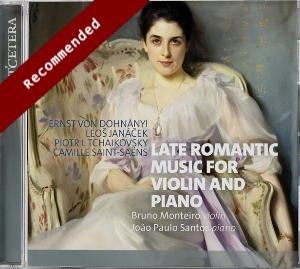
Late Romantic Music for Violin and Piano
Ernő Dohnányi (1877-1960)
Violin Sonata in C sharp minor, Op. 21 (1912)
Leoš Janáček (1854-1928)
Violin Sonata, JW VII/7 (1914, rev. 1916, 1921-22)
Pyotr Ilyich Tchaikovsky (1840-1893)
Souvenir d’un lieu cher, Op. 42 (1878)
Camille Saint-Saëns (1835-1921)
Introduction et Rondo capriccioso, Op. 28 (1863, arr. Bizet)
Bruno Monteiro (violin)
João Paulo Santos (piano)
rec. 2025, Auditório Caixa Geral de Depósitos, ISEG, Lisbon
Reviewed from a WAV download: 44.1 kHz/16-bit
Et’cetera KTC 1877 [65]
Allow me a moment of critical pedantry before we get to the music. Late Romantic, says the front of the booklet. Saint-Saëns’s Introduction et Rondo capriccioso, composed in 1863, would be surprised to find itself thus described — most reasonable chronologies place it in the middle of the Romantic century, not its late afternoon. As for Janáček, whose sonata was put into something like its final shape in 1922, the label seems even more strained: this is a piece whose terse, splintered idiom sits no more comfortably under the Romantic banner than Bartók’s early quartets would. Two of the four works on the disc, then, are misfiled by any reckoning that takes the term seriously. Happily, the music is wholly indifferent to such taxonomic inaccuracies, and so, in the end, am I.
There is, however, a more interesting thread running through the programme. Every work here is in some sense a reassignment. The Dohnányi sonata famously omits a conventional slow movement, redistributing its lyrical weight into the central Allegro ma con tenerezza; the Janáček is the survivor of years of structural reshuffling, with movements promoted, demoted, and replaced before settling into the form we know; the Tchaikovsky Méditation began life as the discarded slow movement of the Violin Concerto, repurposed when the Canzonetta took its place; and the Saint-Saëns reaches us here in Bizet’s piano reduction of what was conceived as the finale of the First Violin Concerto before being detached, fitted with a new introduction, and sent off into the world as a standalone showpiece. Four works, four acts of compositional reassignment. That, more than any period label, is what binds the recital.
The Dohnányi was, I confess, new to me, and Monteiro and Santos make a powerful case for it to be better known. The opening Allegro appassionato carries an unmistakably Brahmsian heft when the music demands it — Santos in particular drawing a richly weighted sound from the piano — but what arrests me is the affectless poise with which Monteiro shapes the principal material, as though declining to make Romantic capital out of music that already speaks plainly enough for itself. The central movement, where Dohnányi quietly relocates the slow music into a song-like Allegro, emerges here as the emotional fulcrum the composer surely intended: tender without becoming sentimental, intimate without losing forward motion. The finale crackles. It is a sonata that ought to be heard more often, and this is the kind of performance that will help it happen.
The Janáček, whatever the marketing department insists, belongs in a different aesthetic universe. Monteiro and Santos play it with the idiomatic certainty that only comes from real conviction. The opening Con moto‘s nervous energy is delivered without overstatement; the Ballada sings with an unforced lyricism that does not press its luck; the brief Allegretto has the right glancing, vernacular quality; and the closing Adagio builds with patience to its great chorale-like resolution, the violin riding high above Santos’s tremolos. It is fervent playing, but the fervour is always organised. This is no small achievement in a piece that can easily fly apart at the seams.
Tchaikovsky’s Souvenir d’un lieu cher finds Monteiro at his most beautifully restrained. The Méditation — that orphaned concerto movement — has often invited a saccharine treatment which it cannot really bear. Monteiro keeps a transparency of tone throughout, refusing to thicken his vibrato or to indulge the rubato beyond what the line genuinely asks for. The result is more affecting, not less. The Scherzo dances without hectoring, and the Mélodie is delivered with the kind of cantabile that knows when to stop. It is a model of how to play music of this temperament without succumbing to it.
And so, to the Saint-Saëns, where the question of period categorisation seems to me, finally, beside the point. This is virtuosity of the most rewarding sort: present, communicative, full of personality. One returns to particular details — Monteiro’s wonderfully placed syncopation about six minutes in, light as a wink — and to the larger architecture, which Bizet’s piano reduction supports with surprising completeness. I never missed the orchestra or even thought about it.
The last disc of Monteiro’s I heard was of Prokofiev (Etcetera KTC1864). His performances of the two violin sonatas with Santos were, to my ear, as fine an account of that knotty pair as has appeared in recent memory. This new disc, in a wholly different register, confirms what was already clear — that this is a violinist of unusual versatility, who plays each set of repertoire as if it were the one he had been waiting for years to record. I have not so much listened to this album over the past few days as kept finding reasons to put it back on; few recitals of recent vintage have given me such consistent pleasure. The recording quality is first class, and Monteiro’s own booklet notes are genuinely informative.
Dominic Hartley
Buying this recording via the link below generates revenue for MWI, which helps the site remain free













