
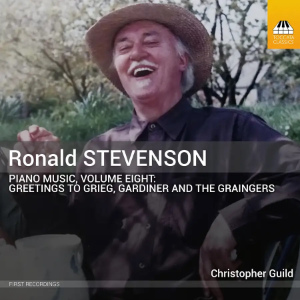
Ronald Stevenson (1928–2015)
Piano Music Volume Eight: Greetings to Grieg, Gardiner and the Graingers
Christopher Guild (piano)
rec. 2023/2025, Wyastone Hall, Monmouth, UK
Toccata Classics TOCC0787 [74]
The gifted Christopher Guild and Toccata are sturdy and steady in their seeming intention to give us Ronald Stevenson’s musical legacy complete.
Grainger’s Northern March is put through its noble affirmative paces by Stevenson and Guild. The music emerges in endearing clangour. You won’t begrudge that it’s a pleasantly obsessive rut of a piece. It races to emotionally successful heights with a fearlessly slashing skirl along the way.
It’s but a small step from Grainger to Grieg and for that matter onwards to Delius. We needn’t go that extra step here. The Norwegian’s Den Bergtekne (Mountain Spell) was originally for baritone, strings and two horns and can be heard in that form on Unicorn-Kanchana UKCD2019; by the way, all those Unicorn-Dreier orchestral Griegs should be swept up into one magnificent boxed set – perhaps by Alto who do these things so well. In any event, Stevenson’s ‘take’ renders Grieg’s colours in obsessive and grandiloquent colours with due obeisance to folk-song and to the Mountain entities. The Norse Elegy for Ella Nygaard (1979) I only know through this recording and arrangement. It too is pensive, to which Stevenson adds some well-pondered and slowly paid out discords. It seems to stir dark pools in another world yet looks back to folk atmospherics. Love at First Sight is heard in two versions; one paying tribute to more basic piano playing skills. The music is modest in tone yet feels sincere. The full concert version is more highly upholstered and is fully in step with Stevenson’s eloquently lofty pianist skills.
Pure Stevenson now: The Cambrian Canto is diminutive – noble again – and tender, proving that such a range is not dependent on largeness of scale. Eileen O’Malley’s Jig and Air is another brevity, but this time a thing of half lights, veiled expression and explosive farewells. Next some psychedelic ragtime: Sneaky on Sixth (1987) is a work in which Stevenson applies a surreal salve. It strangely brought to mind the Jonathan Miller Alice film recently re-shown on TPTV: disturbing and charming all in one. Ragmaster struts purposefully. In these pieces and in Rigolet Rag, Stevenson to my mind, pays an affectionate tribute to that king of ragtime, Scott Joplin and also to the man who did so much to bring Joplin out of the dusty backtracks, Joshua Rifkin (on Nonesuch LPs in the 1970s).
The Grainger/Stevenson/Stokowski version of Country Gardens puts this little charmer through the deconstruction grinder. It gives this 1908 work that would otherwise succumb to hackneyed queasiness a dose of unruly ozone. Apart from everything else I liked the way that the last note was sustained into silence; a luxury touch.
The Power of Rome and the Christian Heart is a large and complexly stimulating piece by Grainger’s ‘lights’. It was written and rewritten over some thirty years and is best known, or least unknown, in its form as a piece for massed wind-bands etc. Stevenson made the arrangement, here played by Guild with such aplomb and brilliance, in the early 1980s. Several episodes suggest that he must have known of Bax’s Winter Legends. Hearing this palatial piece had me wondering whether the tumultuously creative Stevenson had ever given thought to a transcription of Balakirev’s Islamey or Lyapunov’s Hashish. If Godowsky had the ‘effrontery’ to transcribe Chopin then why not Stevenson, a toweringly confident and sanguine figure?
The Gardineriana Rhapsody is another magnificent and towering piece. It surely reflects in some measure Grainger’s regard for Balfour Gardiner whom he had first met when the two composers had studied in Frankfurt with Ivan Knorr. Stevenson completed the Rhapsody which Grainger had left in sketch form. Its tortuous route to Stevenson’s realisation is recounted in Christopher Guild’s typically thorough, readable and extended liner essay. Gardiner was a wealthy man and after his work as a composer dried up he became a practical Maecenas to many British composers.
The piano – as heard on this CD – sounds realistic and might even astonish, such is its forwardness and splendour. The awed drama of the instrument and the acoustic no doubt have much to do with the Wyastone Hall venue which was also used for volume 7 of this Guild-Toccata series.
Rob Barnett
Other review: John France
Buying this recording via the link below generates revenue for MWI, which helps the site remain free

Contents
Grainger arr. Stevenson
Youthful Suite: Northern March (1898-99, arr. 1985)*
Grieg arr. Stevenson
Den Bergtekne (1878. arr. 1990)*
Ella Grainger arr. Stevenson Norse Elegy for Ella Nygaard (1979) (11:03)
Grainger arr. Stevenson Love at First Sight (publ. 1946, arr. 1975)*
Simple Version
Concert Version
Stevenson Cambrian Canto (1965, arr. 1981)*
Stevenson Eileen O’Malley’s Jig and Air (1975)*
Grainger arr. Stevenson Country Gardens (‘Stokowski’ version; 1908, arr. c. 1990)*
Stevenson Sneaky on Sixth (1987)*
Stevenson Ragmaster (1980-84)*
Stevenson Rigolet Rag (1973)*
Grainger arr. Stevenson The Power of Rome and the Christian Heart (1918–43, arr. 1981–82)
Grainger arr. Stevenson Gardineriana Rhapsody (1947, arr. 1984)*
Earlier MWI reviews of the Stevenson-Guild-Toccata project
Volume 1
Volume 2
Volume 3
Volume 4
Volume 5
Volume 6
Volume 7













