
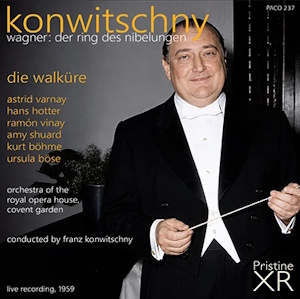
Richard Wagner (1813-1883)
Die Walküre, Opera in 3 Acts
Brünnhilde: Astrid Varnay (soprano)
Wotan: Hans Hotter (bass-baritone)
Siegmund: Ramón Vinay (tenor)
Sieglinde: Amy Shuard (soprano)
Hunding: Kurt Böhme (bass)
Fricka: Ursula Boese (contralto)
Orchestra of the Royal Opera House Covent Garden/Franz Konwitschny
rec. live, 23 September 1959, BBC radio broadcast from the Royal Opera House, Covent Garden, London, UK
Pristine Audio PACO237 [3 CDs: 219]
This new Pristine release of a live radio transmission of Die Walküre comes from the stage of the Royal Opera House in 1959, as part of an ongoing Ring cycle that Pristine is undertaking. You can find a review of Das Rheingold here (review). After hearing this Die Walküre for the first time I am struck by how riveting some of the performance is without entirely being blind to some of its failings.
Franz Konwitschny has long had a formidable reputation as a Wagner interpreter. It has been almost two years since I reviewed his standout recording of the Dresden version of Tannhäuser (review). On this occasion, Konwitschny often seems alive to the shifting moods in the score, revealing expressive details that had passed by unnoticed on other hearings of this opera. However, just as often he seems to revert to an autopilot approach that reveals nothing. I come away from this with the feeling that I have spent three and a half hours on a musical seesaw. The Covent Garden Orchestra do many fine things with Konwitschny; the massed cellos sound glorious and the woodwind solos come across really clearly in Pristine’s excellently refurbished sound. Yet the Brass section do not cover themselves with glory on this occasion, as they are rather tentative in the entrance of Donner’s Theme during the Prelude to Act One. There are several instances where the orchestral ensemble is distinctly scrappy; for example; something quite dreadful goes awry in the closing bars of Act Two.
In terms of the vocal abilities of the cast it is a fairly accomplished group, although not everyone is in their finest vocal states. The three principals who have Act One to themselves are a riveting group of humans. Ramón Vinay sounds craggy and rough-hewn as Siegmund. This Wälsung sounds as if he has survived some very trying times indeed. His cries of “Wälse” in Act One are almost unbearably powerful. It is really only in the gently rocking lyricism of the “Winterstürme” that he truly disappoints. By the end of the First Act, he sounds tired but by the time he enters again in Act Two he sounds fully restored.
Sieglinde is the very young Amy Shuard. Her firm tone is certainly quite impressive in the role. Her voice is larger than many a Sieglinde – Janowitz or Studer for example – yet she manages to exude more seductive femininity than Varnay, Nilsson and Mödl, when they essayed the role. She matches Vinay’s power decibel for decibel when required to.
Kurt Böhme is a downright exciting Hunding. His vocal prowess is even more impressive here than it is six years later on Karl Böhm’s complete Ring Cycle, recorded live at Bayreuth, originally for Philips Classics (review).
First among the Gods is Hans Hotter’s legendary Wotan, which is captured towards the end of his finest years. His Lieder-like intensity of expression runs the full gamut of emotions in one of the most deeply communicative performances of Wotan around. On this occasion his tone occasionally displays a fraction of the unsteadiness that would show up regularly in his recordings made during the 1960s. The manner in which he responds “Nimm den eid” to Fricka at the end of their scene together is truly moving and unforgettable.
Fricka is sung by Ursula Boese with great vibrancy and she sounds unusually sensual while she chips away at Wotan’s conscience during her long scene with him. There are times when her voice is very reminiscent of Kathleen Ferrier. This is a really outstanding portrayal of Fricka and among the finest I’ve encountered.
Astrid Varnay is heard to better advantage on the Testament Ring cycle from Bayreuth under Joseph Keilberth. Here (three year later) she sounds just a bit screechy on the highest notes of her “Hojotoho!”, yet she remains a Brünnhilde to be reckoned with and provides much singing that is firm-toned and rewarding. One curious lapse is that she is strangely out of tune for her first lines of the Death Announcement scene.
So all in all, a far from perfect recording Die Walküre and yet I find much that is really worth hearing in spite of the flaws. On the whole I am quite grateful to the team at Pristine Audio for making it generally available.
Mike Parr
Other review: Steve Gladwin
Availability: Pristine ClassicalOther cast
Gerhilde – Joyce Barker
Ortlinde – Una Hale
Waltraute – Margareta Elkins
Schwertleite – Jean Watson
Helmwige – Judith Pierce
Siegrune – Noreen Berry
Grimgerde – Heather Begg
Rossweise – Josephine Veasey
Orchestra of the Royal Opera/Leader – Charles Taylor













