
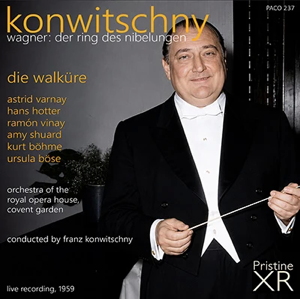
Richard Wagner (1813-1883)
Die Walküre, Opera in 3 Acts
Brünnhilde: Astrid Varnay (soprano)
Wotan: Hans Hotter (bass-baritone)
Siegmund: Ramon Vinay (tenor)
Sieglinde: Amy Shuard (soprano)
Hunding: Kurt Böhme (bass)
Fricka: Ursula Boese (contralto)
Orchestra of the Royal Opera House Covent Garden/Franz Konwitschny
rec. live, 23 September 1959, BBC radio broadcast from the Royal Opera House, Covent Garden, London, UK
Pristine Audio PACO237 [3 CDs: 219]
If one of Wagner’s quartet of operas, Der Ring Des Nibelungen, were to be turned into a soap opera then it would have to be Die Walküre, the most human of all the tales in the cycle. Its themes would be all too familiar to the general public; domestic violence, incest, heartbreak, marital disputes, pregnancy out of wedlock, (see incest) ending with a ring of fire surrounding this particular version of Sleeping Beauty. Even in the confrontations involving the Gods, such as that between estranged husband and wife, Wotan and Fricka, and especially the final showdown between Wotan and his disobedient daughter Brünnhilde, you experience a human anxiety and pity for the characters that is absent in the remaining operas. In Das Rheingold the plot and villain are exciting, but there is little real engagement or empathy, unless it be for the unfortunate Fasolt, the giant brother to Fafner, who murders him in order to possess the ring that Alberich has forged. Siegfried, the third opera, broods, cackles and twitters and only at the very end does the flaming energy we left at the end of Die Walküre return – and in Göttedämmerung, that final twilight of the gods, we seem to move further and further away from the human drama as both Siegfried and most notably Brünnhilde become characters we can no longer recognise and a villain, Hagen, who makes his father Alberich look like a part-timer. Thank the gods then for Die Walküre.
You don’t need to have any more than a cursory knowledge of the plot to enjoy this opera, but as a reviewer these things matter because it’s within those encounters and significant moments that you look for a recording’s strengths and weaknesses, the moment when the star soprano soars, the bass roars and the tenor needs to be at his most heroic. In this 1959 live recording from The Royal Opera House under the baton of the German conductor Franz Konwischny – whose Wagner performances, many feel, have been under-rated – there are established Wagnerian stars in three of the principal roles: Astrid Varnay as Brünnhilde, Hans Hotter as Wotan and Ramon Vinay as Siegmund. To that add the reliability of the black-voiced Kurt Böhme as Hunding, who would later play the giant Fafner in Solti’s Ring, and another seasoned Wagnerian, Ursula Boese in the role of Fricka. These CDs are a reissue from Pristine Audio. Having not heard the original recording, I cannot comment on the improvements, but what I will say is that sound problems remain and although there is probably little that can be done to improve it further, the sound dips at various points do remain a problem and there are some points where the voices are lost, especially towards the end of Act Two where they most matter.
This is all a great shame because, with a couple of reservations, I consider this a performance well worth having. The orchestra gives a fine performance, notwithstanding the odd intonation problems with the brass in particular. We are given the real sense of a drama unfolding, the right moments of yearning and tenderness, a powerful first cry of “Wälse!”, and the frenzy which follows the drawing of the spear from the tree. Later that tenderness is even more moving when the lovers pause, exhausted and Siegmund’s dream of a beautiful warrior woman telling him he is about to die becomes his reality.
To judge these encounters and moments, we need to talk about the singers. However, in order to do so more fairly we need to compare this with other recordings. I have chosen three: Solti’s from 1965, (review) the Karajan version of 1966, and Zubin Mehta’s live Vienna performance from 2002, to assess the singers in 1959.
For me it is impossible to out-do Karajan’s cast, who, bit by bit, critics have come to appreciate more – and Solti’s cast would be pretty faultless, were it not for the fact that the great Hans Hotter’s Wotan was caught a bit too late. Mehta’s well conducted performance with Vienna forces has some interesting casting, with Waltraud Meier, a famous mezzo exponent of Kundry, Isolde and Waltraute amongst others, in the role of Sieglinde. At Covent Garden this role is sung by Amy Shuard, an English singer who premiered the roles of both Sieglinde and Brünnhilde at the house. She is the undoubted star of this performance, fully committed and intelligent, appealing and empathetic in all the right places and I can’t recall having heard anyone better in her Act Two nightmare which precedes the scene where Brunnhilde brings Siegmund the announcement of his coming death. In contrast Waltraud Meier for Mehta, although the voice is perhaps never lovely enough for the character, gathers all her resources to give us a Sieglinde of stronger character than normal, added to all the biting intensity we have come to expect from her in other roles. Karajan has Gundula Janowitz, but for all the beauty of her soaring angelic soprano, it can sometimes seem lost against the needs of the text. She is heard far better as Eva in Kubelik’s marvellous Die Meistersinger, where her tenderness is an asset. Solti’s Sieglinde is the great French soprano Régine Crespin, who is very convincing for the most part, but soars even higher in her unforgettable Brünnhilde in the Karajan set.
Hans Hotter’s rivals as Wotan are Thomas Stewart, (Karajan) young and passionate, John Tomlinson, (Mehta), a tower of fury, grief and frustration and more focussed than for Barenboim, and Hotter himself, (Solti), whose voice was definitely beginning to fray. He shows slight signs of it at Covent Garden, but it is still recognisably the Hotter who dominated as Wotan for so many years.
Also with some vocal problems here and there is the great Chilean tenor Ramon Vinay, a great baritonal Heldentenor. He can be off the note now and then and does seem to get lost a couple of times, but I prefer him to Jon Vickers for Karajan, with his huge, legendary, bell of a voice. James King for Solti, gives an exemplary and intelligent Siegmund, giving a performance anticipating his Lohengrin and Parsifal for Kubelik. Peter Seiffert, who died very recently, was Barenboim’s go-to tenor for the roles that weren’t being sung by Siegfried Jerusalem and often rescued the opera in doing so. His Siegmund is simply lovely, in the same way as Siegfried Jerusalem’s is for Janowski. Anyone would settle for the sound both make, but if you want excitement and are willing to forego a bit of accuracy, Ramon Vinay was still one of the best.
Which leads us nicely to Brünnhilde and a case of my trying to avoid my pet peeve, which is some famous sopranos and tenors, (Rene Kollo is a very clear example) approaching the notes using an unnecessarily gymnastic approach. Astrid Varnay does it less here than she often does and you can forgive it when she does it because it never makes her out of tune. Some of the most renowned Wagner sopranos were swoopers and that includes the most famous of them all, Kirsten Flagstad. Nor were mezzos immune. The great Christa Ludwiig, a Fricka who can probably never be bettered, had her moments, too. With Varnay it matters less and she also seems to do it less than she does in the Clemens Krauss Ring. It’s the power and clarity of the voice, certainly, but it is also about the intelligence, the measured and careful approach, the warmth, the empathy. Astrid Varnay has the lot. Her greatest rival in the other three test recordings is of course Birgit Nilsson, but although I appreciate Nilsson’s laser-like brilliance and attack, there remains something of the ice-flow. Gabriele Schnaut for Mehta can be a bit of curate’s egg, a Kunst diva like Hildegard Behrens, and like her, lacking beauty of voice, but with all the smarts of a singing actress.
Two characters appear for only a scene each, with Hunding really singing only in Act One and Fricka having the single scene with Wotan at the beginning of Act Two. I wasn’t too taken with Ursula Bose in this recording, although she has the requisite authority. This is probably due to the memories of both Ludwig and Josephine Veasey, (who appears here as the Valkyrie Rossweise) being too clear in my mind. Those first favourite recording earworms can be so difficult to shift. As Hunding, Karajan has the mighty, black voiced Finn, Matti Talvela, whose first entrance sends chills down your spine. However, here, Kurt Böhme as the giant Fafner is pretty much as good as you can get. He delivers chills in spades, but it is that aural picture of pitiless intransigence which Hunding possesses and Böhme resolutely delivers.
I have to confess to never having been a fan of either the Valkyries or their music, which therefore makes it difficult to pick out individual character and voice. This is doubtless my issue, but there is an awful lot more here to talk about.
In conclusion, this is a vintage recording still with one or two sound issues, but the singing, by Amy Shuard in particular, and the enthusiasm of the orchestra and that palpable feeling of a live performance, make it a fine addition to the shelves of any enthusiast.
Steve Gladwin
Other review: Mike Parr
Availability: Pristine Classical
Other cast
Gerhilde – Joyce Barker
Ortlinde – Una Hale
Waltraute – Margareta Elkins
Schwertleite – Jean Watson
Helmwige – Judith Pierce
Siegrune – Noreen Berry
Grimgerde – Heather Begg
Rossweise – Josephine Veasey
Orchestra of the Royal Opera/Leader – Charles Taylor














I agree about the merits of the Karajan recording and the post-prime Hans Hotter’s Wotan as the main weakness of the otherwise great Solti/Vienna complete Ring cycle.
One other recording is worth considering, especially in the High Definition Tape Transfers remastering: Erich Leinsdorf’s from 1961, with Birgit Nilsson as Brunnhilde, Jon Vickers as Siegmund, and George London as Wotan. Leinsdorf, like Konwitschny, was a fine conductor somewhat underrated in his day. I notice that Ralph Moore cited this version in his survey of complete Ring recordings as a favorite stand-alone performance, preferable to the Walküre recordings in any of the complete Ring cycles.