
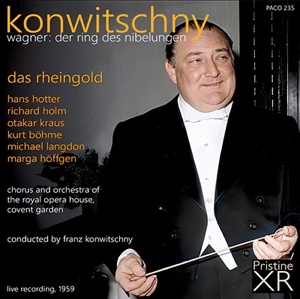
Richard Wagner (1813-1883)
Das Rheingold
Wotan – Hans Hotter (bass-baritone)
Fricka – Ursula Böse (mezzo-soprano)
Alberich – Otakar Kraus (baritone)
Loge – Richard Holm (tenor)
Chorus and Orchestra of the Royal Opera House, Covent Garden / Franz Konwitschny
rec. live broadcast, 18 September 1959, Royal Opera House, Covent Garden, London, UK
Reviewed as download
XR Remastered Ambient Stereo
Pristine Audio PACO235 [151]
Many of the cast here were Bayreuth regulars who decamped to London for the run of the Ring which extended over a fortnight beginning mid-September 1959. However, for this Das Rheingold at least, quite a few excellent local singers were employed in the supporting roles, hence we hear Czech-British baritone Otokar Kraus as Alberich, great bass Michael Langdon as Fafner and a trio of first-rate British singers as the Rhinemaidens. I was unfamiliar with Scottish baritone David Kelly, too, who sings an admirable Donner; apparently, he was a “company regular” at Covent Garden for about fourteen years from 1955 onwards, singing fifty different comprimario roles in over 700 performances. Although Rudolf Kempe was a frequent guest conductor at the Royal Opera (never officially their Music Director despite what the Pristine note asserts) and had conducted the Ring there in 1957, he yielded the baton to the flamboyant Franz Konwitschny and all looked set fair for another great tetralogy in London.
The recorded sound as treated by Pristine is now immediately impressive for a live broadcast of this age and provenance. Hiss is still present but minimised, and it is a little “boomy” in the bass, but it is generally remarkably clear and vivid, allowing us, unfortunately, to hear several quite severe horn bobbles in the first couple of minutes and an unsettling degree of rhythmic uncertainty. The Rhinemaidens are fine but I am not at all happy with Otakar Kraus’ Alberich; perhaps I am too habituated to the peerless Gustav Neidlinger but Kraus’ voice is too light and noble for the role, lacking the black bite and snarl it demands, and he occasionally resorts to shouting. As a result, the opening scene is rather too cheerful, without the menace and panic the theft of the Rhinegold should evoke. The next scene is much more successful: Ursula Böse is excellent as Fricka, dark and voluminous, and Hans Hotter is as ever immense if sometimes a little rocky – but of course we may hear his Wotan in a whole series of recordings from Bayreuth from 1953 onwards. We hear two sturdy, solid giants, a pleasing Freia and above all, a vivid, subtle but strong-voiced Loge from Richard Holm.
The transitional music for the journey from Valhall down to Nibelheim is excitingly managed and Peter Klein is a strongly characterised, if rather throaty, Mime. Kraus finds a little more edge in his tone for Alberich’s threats but despite his prolonged scream of despair when Wotan rips the remaining gold ring from his finger, he is still too mild and his curse is rather weak.
Konwitschny keeps a firm grip on proceedings and there are certainly moments of high drama such as Fafner murder of Fasolt, but I am a little surprised by the relative staidness of his direction, as I generally think of him as a very energised conductor. The final scene seems to lose momentum around the gold-piling and even drag and there are some nasty intonational lapses among the cellos. Marga Höffgen’s Erda is trenchant but she is far back in the aural perspective. In compensation, as mentioned above, Donner’s hammer-blow creation of the rainbow bridge is a highlight- despite another blatt in the horns.
Perhaps I am a little spoiled by having access to so many other great recordings of Das Rheingold, both live from Bayreuth and studio-made, and should be more grateful that this performance has been preserved and so well enhanced, but in the context of so much competition, this is merely good with a number of drawbacks, some in the form of the accidents tolerable in a live performance – but more pertinently, I require a more menacing Alberich and also more animated direction than we get here.
Ralph Moore
Other cast
Erda – Marga Höffgen (contralto)
Donner – David Kelly (baritone)
Froh – Edgar Evans (tenor)
Mime – Peter Klein (tenor)
Fasolt – Kurt Böhme (bass)
Fafner – Michael Langdon (bass)
Freia – Una Hale (soprano)
Woglinde – Joan Carlyle (soprano)
Wellgunde – Josephine Veasey (mezzo-soprano)
Flosshilde – Marjorie Thomas (contralto)













