
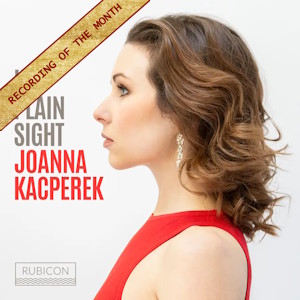
In Plain Sight
Joanna Kacperek (piano)
rec. 2025, Wyastone Concert Hall, Monmouth, UK
Reviewed as a lossless download
Rubicon Classics RCD1228 [86]
The email containing the press review link for this album sat in my inbox for more than two months while I contemplated whether I would review it. I was hoping that one of the actual piano experts in our reviewing team might have picked it up, but as time went by and no review appeared, I decided to take the plunge, and share my less-than-expert impressions. I am so glad that I did, as the music on what would be a very well-filled CD (I listened to the download) is at the least thoroughly enjoyable, and at best quite wonderful, and is all very well performed.
The title refers to the fact that each of the seven women, whose works are presented here, was publicly active in their lifetime, and mixed with some of the great (male) composers. I had not heard of Marianna Martines, who socialised and performed with Haydn and Mozart, until earlier this year when Onyx released a set of her complete keyboard works (review). There I described the G major Sonata as the showiest of the three surviving ones, and while I was quite happy with the playing of Idith Korman, Joanna Kacperek has a crispness and playfulness to her performance that surpasses the Onyx reading.
Louise Farrenc was definitely in plain sight during her lifetime: she co-ran a music publishing house with her husband, and was the first female Professor of Music at the Paris Conservatoire. Her two Études, from a set of thirty, are contrasting in their moods: No. 21 is wistful, while No. 22 is a virtuosic showpiece. Kacperek deals superbly with the differing demands.
Two generations after Farrenc, Cécile Chaminade made a career as a concert pianist and composer, especially of salon pieces for piano. For those used to her frothy salon pieces, the introspective four-movement Poèmes provençaux with a dramatic Brahmsian finale will come as something of a surprise. I know her music from her two piano trios, the second of which is an underappreciated masterpiece, so this work is very welcome. Kacperek imparts poetry and power.
Chaminade’s contemporary, Mélanie Bonis, was much less prominent in professional music circles during her lifetime, and indeed her inclusion in this programme is somewhat pushing the boundaries of “in plain sight”. She was a pupil of César Franck, and classmate of Debussy and Pierné, but her compositional career was rather less well-connected. I was underwhelmed by her orchestral music in a recent recording (review); this Barcarolle is better, though still the least impressive work on the album.
I didn’t expect to like the Bacewicz sonata, as nothing I’d heard of her music to this point had greatly enthused me. I’m pleased to say that I was wrong. I’d expected a lot of dissonance and harshness, but while there was some, particularly in the first movement, it seemed totally appropriate. The Largo movement is quite beautiful – totally unexpected – and the work finishes with a wild Toccata inspired by Polish folk dances. Kacperek shows her versatility here, as the work has quite different demands to the others on the album.
I have left the two Scandinavian composers, neither of whom I’d encountered before, until last. All three works are first recordings. Agathe Backer Grøndahl was a concert pianist, and friend and colleague of Grieg, accompanying him on tour. Her Humoreske begins lightly, tripping merrily along, but builds up a head of steam. Finally, the grandly-named Ingeborg Bronsart von Schellendorf, a surname that might be familiar to you from her husband Hans, whose concerto has been recorded a few times, most recently by Paul Wee on BIS (review). Bronsart was also a concert pianist, and numbered Auber, Berlioz, Rossini and Wagner among her friends. That her Fantasie has not been recorded before seems a terrible oversight, as it is quite stunning. The four Klavierstücke are not quite at the same exalted level but still very fine.
This is Polish pianist Joanna Kacperek’s second album, both for Rubicon, the first being a programme of variations. As you will have gathered, I have been very impressed by her playing, as well as her selection of the music. The recording quality is very good, as are the notes contributed by Kacperek.
This has been a delightful surprise, full of excellent music, none of which I’d heard before, new composers (to me), and excellent performances.
David Barker
Buying this recording via the link below generates revenue for MWI, which helps the site remain free
Contents
Marianna Martines (1744–1812)
Keyboard Sonata in G
Louise Farrenc (1804–1875)
Études Op.26 (Book II) Nos 21 & 22
Ingeborg Bronsart von Schellendorf (1840–1913)
Fantasie in G sharp minor Op.18*
Vier Klavierstücke WoO *
Agathe Backer Grøndahl (1847–1907)
Humoreske *
Mel Bonis (1858–1937)
Barcarolle in E flat Op.71
Cécile Chaminade (1857–1944)
Poèmes provençaux Op.127
Grażyna Bacewicz (1909–1969)
Piano Sonata No.2
* first recordings














Yes — a very fine programme!