
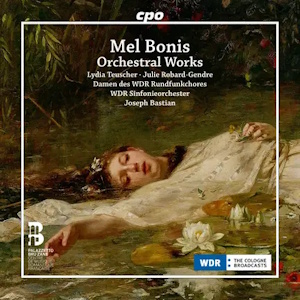
Mélanie Bonis (1858-1937)
Orchestral Works
WDR Sinfonieorchester/Joseph Bastian
rec. 2024, Kölner Philharmonie, Cologne, Germany
Texts and translation supplied
Reviewed as lossless download
cpo 5557522 [61]
The booklet notes suggest that the life of Mélanie Bonis would be an ideal subject of a film or TV mini-series. Given her relative obscurity, this is unlikely to happen, but it would make for a more dramatic storyline than that of Bolero, the (very good) film made recently about Maurice Ravel. Bonis came from humble origins – her father was a watchmaker – and her parents tried to prevent her teaching herself how to play the piano (perhaps they shouldn’t have had a piano in the parlour). A friend of the family introduced her to Cesar Franck and he was so impressed, he took her on as a private pupil and then arranged for her to enter the Paris Conservatoire. There she was taught by Massenet among others, and won numerous prizes. She also met the love of her life, Amédée Hettich, a singer, but her parents would not accept his offer to marry her, and she was removed from the Conservatoire. A marriage to a much older man, with five children from two previous marriages, was arranged. That wasn’t the end of her story – Hettich re-enters it – but rather than occupy more space here, I will let you find it if you so desire. Sadly she is probably best known for having her music published under the gender-neutral name of Mel.
The booklet makes the claim that “almost all of Mel Bonis’ orchestral pieces and songs are collected here for the first time on one album”, which is accurate(ish). I have a 2012 release from Le chant de Linos (nla) which has the same purely orchestral works, but not the three songs. There is also a Chandos recording with Rumon Gamba conducting the Scottish Symphony due for release this June, that has exactly the same program as this cpo one. Talk about waiting ages for a bus, then two come along together. In case you are wondering why it is only “almost all” of her orchestral works, two of the three absent works are actually lost, and the third was written for a children’s orchestra – does that mean it is considered beneath an adult orchestra to play it, I wonder?
All of the thirteen purely orchestral works here were originally published as piano pieces, hence the disparate opus numbers. Not all were orchestrated by Bonis, and it is thought that she never heard any of her music performed in its orchestral form. The majority are dances, and they are all relatively short – Le Songe de Cléopâtre at eight minutes is the longest by some way. None of them has much depth – Cléopâtre goes closest – and the result is a series of pretty works that don’t really grab the attention.
Over the period of almost twenty years, Bonis wrote a set of piano pieces titled Femmes de légende, and from these, she chose three to orchestrate, under the banner of Trois femmes de légende. Each is relatively brief and contrasting: Le Songe de Cléopâtre has a Tchaikovskyian feel to it, Ophélie has obvious impressionistic sensibilities and Salomé, written two years after Strauss’s opera premiered in Paris, has an oriental feel, and made me think of Rimsky-Korsakov’s Scheherazade. Unfortunately, comparisons with the great composers mentioned do not do Bonis any favours.
Les Gitanos is subtitled almost unnecessarily Valse espagnole; it is as though one of the Strausses had adapted one of their lesser waltzes for a Spanish audience by simply adding castanets. Apparently the original piano version won a competition prize; I’m not familiar with it, but I can only think the other works entered must have been pretty ordinary.
For me the best of the works are the Trois danses and Danse sacrée: the orchestration is more imaginative than elsewhere. The writing for woodwinds is particularly effective in these works.
The two songs for solo voice (and orchestra) could not be more different, one about a cat on a roof escaping from its home is comical and arch, the other about the Virgin Mary at Christmas, sombre and reverential, but what they do have in common is they didn’t appeal to me (but that is more the genre than the songs themselves). The final work on the album is for women’s choir and orchestra, and is sweet but lacking variety; not the best way to finish the album. Indeed, I think it would have been better to intersperse the three songs among the instrumental works, rather than group them at the end.
How does this new recording compare with the older one already in my collection, featuring the Bucharest Symphony? Tempo-wise, there is not much difference, but I hear a little more characterisation in the German orchestra’s performances. Sound quality is good, and the booklet notes are among the best I’ve seen from the cpo label.
I have reviewed some of the chamber music of Mélanie Bonis, and it is of a higher standard than these pretty, but ultimately rather shallow, works. Logically, I would be planning to review the upcoming Chandos release, but frankly I have better things to do with my time. I’m sure, given the pedigree of the orchestra and conductor, it will be very well played, but it is, after all, the same music.
David Barker
Other review: John Quinn
Buying this recording via the link below generates revenue for MWI, which helps the site remain free
Contents
Trois femmes de légende
I. Le Songe de Cléopâtre op. 180
II. Ophélie op. 165
III. Salomé op. 100 / 2
Suite orientale op. 48/2
Les Gitanos, Valse éspagnole op. 15/3
Suite en forme de valses
I. Ballabile op. 37/3
II. Interlude et Valse lente op. 38/3
III. Scherzo-valse op. 35/3
Trois danses pour orchestre
I. Bourée op. 62/2
II. Pavane op. 81/3
III. Sarabande op. 82/2
Danse sacrée op. 36/2
Le Chat sur le toit (Les Amours du chat) op. 93/2
Lydia Teuscher (soprano)
Noël de la Vierge Marie op. 54/2
Julie Robard-Gendre (mezzo-soprano)
Le Ruisseau op. 21/2
Damen des WDR Rundfunkchores













