
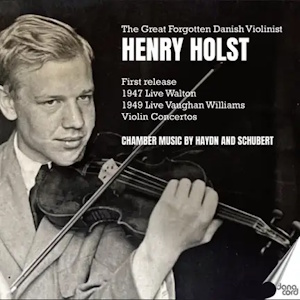
The Great Forgotten Danish Violinist Henry Holst
Danacord DACOCD 1009 [66 + 78]
This is a most valuable twofer from Danacord which presents two live concerto performances from the 1940s preserved on acetates, adds a couple of commercial 78s, a previously unissued 78 from 1929 and then, on the second disc, restores two trio recordings on 78s, a major string quartet undertaking from 1946 and adds the sole example of a chamber recording on LP made by the focus of the release, the Danish violinist Henry Holst (1899-1991).
I’ve written about Holst before when reviewing Nimbus’ restorations of his recordings with Frank Merrick, which constitute the large majority of his extant discography. What we lacked from that body of recordings were examples of Holst’s way with the concertos with which he was so long associated, among them the Walton and Sibelius. Well, we get the Walton here in a live broadcast from November 1947 where he’s partnered by the BBC Northern Orchestra and Charles Groves. Holst had been in Britain since 1931 having left Furtwängler’s Berlin Philharmonic, where he’d been one of its concertmasters, to take up a position at the Royal Manchester College of Music (now the Royal Northern College of Music). He gave the first British performance of the Walton, the composer conducting, in 1941 and gave the premiere of the revision in 1944. This 1947 broadcast was his 25th performance of the concerto and it’s been preserved in private acetates. The sound is perfectly acceptable though obviously inferior to studio conditions and can get somewhat congested. I suspect that the concerto is introduced by Charles Groves himself though he only says a few words. Holst proves a worthy ambassador for the work, having long since assimilated its brand of Mediterranean sensuality and an admixture of virtuoso panache. His tight sweet tone is well caught but the orchestra occasionally less well so and the close of the concerto is briefly fallible. From the period in question Zino Francescatti comes closest to Holst’s tempi though he is more virtuosically engaged in the finale, though not necessarily to Holst’s disadvantage. Strangely, for the first time, I noticed some Elgarian figuration in the finale.
The other concerto is Vaughan Williams’ neo-Bachian Violin Concerto in D minor, ‘Concerto Accademico’, broadcast on 2 February 1949 with the BBC Welsh Orchestra under Mansel Thomas and preserved on fine sounding BBC acetates. Holst and Thomas ensure the music emerges crisply and the folkloric melancholy of the central Adagio is beautifully played, with great refinement and clarity, by Holst. By contemporary standards Holst and Thomas take the finale a shade under tempo but it works well.
These are major reclamations and should be exciting to British Music lovers. However, there is more. Delius’ Légende in E flat major with Gerald Moore (August 1942) has been reissued before on Dutton but here it is again. The recording of Sarasate’s Zigeunerweisen takes us back to Weimar Berlin and the ensemble includes a prominent cimbalon. It’s a little cut and could be more scintillating. Kreisler’s Liebesleid, recorded at around the same time, was never issued and only survives via Holst’s own test pressing, a fortunate survivor.
I reviewed the Schubert Trio when it appeared in a release devoted to pianist Victor Schiøler. That was on an HMV LP but Haydn’s ‘Gypsy’ Piano Trio was recorded in 1941 with Anthony Pini and Eileen Joyce – delightfully deft and assured. The final item is Schubert’s ‘Death and the Maiden’ Quartet, recorded in 1946 for English Columbia at a time when Holst led the Philharmonia Quartet, which had been established, along with the Philharmonia Orchestra, by Walter Legge, initially as a recording outfit. The complete Philharmonia Quartet recordings would make an excellent restoration project but it shows no sign of happening so transfers such as this should be savoured. The group led by Holst included second violin Ernest Element, violist Herbert Downes and cellist Anthony Pini – originally back in the early 30s Holst’s own quartet had comprised Jean Pougnet, Frederick Riddle and Pini. The Schubert receives a sane, sonorous and beautiful performance, finely recorded, though for my tastes noise suppression has been a little too freely used.
This is an admirable and surprising addition to the ranks, not least for the two concertos. The big lacuna now in the Holst discography is the Sibelius. It was something of a calling card concerto for him and it’s perplexing that a performance hasn’t surfaced. Might compiler and editor Claus Byrith (excellent notes once again) and executive producer Jesper Buhl know of a surviving source?
Jonathan Woolf
Buying this recording via the link below generates revenue for MWI, which helps the site remain free
Contents
Ralph Vaughan Williams (1872-1958)
Violin Concerto in D minor, ‘Concerto Accademico’ (1924-25)
BBC Welsh Orchestra/Mansel Thomas
rec. 2 February 1949, live broadcast from BBC Acetates
Frederick Delius (1862-1934)
Légende in E flat major (1895)
Gerald Moore (piano)
rec. 7 August 1942, Columbia 78rpm
William Walton (1902-1983)
Violin Concerto (1938-39)
BBC Northern Orchestra/Charles Groves
rec. 17 November 1947, live broadcast from private acetates
Pablo de Sarasate (1844-1908)
Zigeunerweisen, Op.20 (1878)
Unnamed ensemble
rec. c.1929, Berlin, Clangor 78rpm
Fritz Kreisler (1875-1962)
Liebesleid
Unnamed ensemble
rec. c.1929, Berlin, unissued Ultraphon 78rpm
Franz Schubert (1797-1828)
Piano Trio No.1 in B flat major, D898 (1827-28)
Erling Blöndal Bengtsson (cello): Victor Schiøler (piano)
rec. 1955, HMV LP
String Quartet No.14 in D minor, D810 ‘Death and the Maiden’ (1824)
Philharmonia Quartet
rec. 1946, Columbia 78rpm set
Joseph Haydn (1732-1809)
Piano Trio No.39 in G major, Hob. XV:25 ‘Gypsy’ (1795)
Anthony Pini (cello): Eileen Joyce (piano)
rec. 1941, Columbia 78rpm set













