
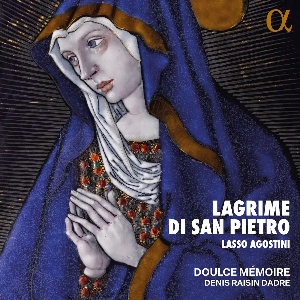
Lagrime di San Pietro – Lasso, Agostini
Doulce Mémoire/Denis Raisin Dadre
rec. 2025, Abbaye de Noirlac, Bruère-Allichamps, France
Texts and translations included
Reviewed as a download
Alpha Classics 1209 [68]
Those who see the cover of this disc will immediately recognize its title. Lagrime di San Pietro was Orlandus Lassus’ last work and is part of the standard repertoire of Passiontide. It is already well represented on disc but a closer look at the cover of this disc reveals the names of two composers: Lasso and Agostini, which indicates that we don’t get Lassus’ complete cycle here. Lodovico Agostini, was Lassus’s almost exact contemporary; he was born two years later and died four years earlier. The title suggests that the two composers set the same texts, but that is not the case, despite what Iain Fenlon states in his article on Agostini in New Grove.
Orlandus Lassus was the most famous composer of the second half of the 16th century. The publication of the Lagrime di San Pietro is a testimony of his fame. It is a splendid edition, prepared with utmost care by Adam Berg in Munich, who had been publishing Lassus’ works since 1567. Lassus himself never saw the edition as it appeared in 1595, a year after his death. The last five years of his life were difficult. From 1587 onwards he suffered from melancholia and hallucinations. Shortly before his death he was able to compose again, and he decided to select twenty sacred madrigals from the collection Lagrime di San Pietro by the Italian poet Luigi Tansillo (1510 – 1568). In the edition Lassus knew, dating from 1560, it consisted of forty-two stanzas (at Tansillo’s death in 1568, the still unfinished poem comprised over 900 stanzas) of eight lines (ottave rime). They are about the grief and the repentance of St Peter after his denial of Christ. To these twenty madrigals Lassus added a Latin motet.
Lassus’ settings belong to the genre of the sacred madrigal (madrigale spirituale). In them the numbers three and seven play a crucial role. The number of parts is seven, the Lagrime can be divided into three large sections, and if the total number of pieces – 21 – is divided by three the result is seven. But there is no unanimity as to what exactly these numbers are symbolizing. The number seven is mostly associated with the seven sorrows of Mary (this is also the explanation of Denis Raisin Dadre in his liner-notes), and in the liner-notes to his recording of the Lagrime (Sony, 1993) Paul Van Nevel also mentions the episode in the gospels where Peter asks Jesus if he has to forgive his brother up to seven times. Another commentator connects the number three to the Holy Trinity, but that doesn’t seem relevant here. It is much more likely that it refers to the three times Peter denied Jesus. After all, that is the central subject of this cycle.
There are different theories regarding why Lassus composed this work. Some believe that since Lassus felt his end was near, he thought it necessary to do penance for his sins – for instance, his composition of secular works on morally dubious texts – and a composition like this was the best way to do so. Whether or not this is true, this work certainly had a private meaning for Lassus, as in the dedication he called it “a personal devotion at this difficult age”. He dedicated the work to the Pope Clemens VIII, with these words: “I hope that you will take pleasure in listening to my music, not for itself, but for the subject of which it speaks, Saint Peter, the foremost among the apostles of whom you are the true and lawful successor.” This way he marked his support for the Counter Reformation.
In the Renaissance the connection between text and music was rather loose, in comparison with the music of the 17th century, but in Lassus’ work the link is much stronger link. He was not only famous for his sacred music but for his madrigals as well – and the Lagrime are full of so-called madrigalisms to express the text. Lassus uses various tools to emphasize the content of specific lines, like the split between high and low voices, contrasts in tempo and rhythm, the difference in note values as well as harmony.
Whereas Lassus is one of the giants of the 16th century, both with regard to his reputation and the size and versatility of his oeuvre, Lodovico Agostini is a little-known composer. As far as I know, no disc has been wholly devoted to his music, and compositions by him only appear now and then in anthologies.
Agostini was born in Ferrara, where he worked all his life, although he may have received his early training in Rome. From 1572 onwards he seems to have been in the service of Ferrara Cathedral, and in 1577 his name first appears in the payment records of the court of Duke Alfonso II d’Este. He remained in the service of the court until his death. He also made a career in the church. He did notwrite any sacred music; ten collections of secular works were published between 1567 and 1586. The latter year saw the publication of the work that on this disc is the counterpart of Lassus’s Lagrime.
Its title, Le lagrime del peccatore (The tears of the sinner) is almost the same, but – as already mentioned in the first paragraph – the texts of this cycle are not taken from Tansillo’s poem, but come from various sources. “A few of them have been identified as the work of two poets from Ferrara, Giovanni Battista Guarini (L’anima mia, Signore) and Bernardo Tasso (Svegliati omai da questo and Chiudi gli orecchi). Others may have been written by Agostini himself, who was furthermore the author of a collection of sermons published in 1589, a year before his death.” (booklet)
The texts are also different in content. Tansillo focuses on the character of Peter: the first fourteen stanzas of Lassus’ cycle are an account of Peter’s role in the story of Good Friday, whereas in the last six Peter speaks himself of his remorse and repentance. Agostini’s cycle, on the other hand, consists of poems of a more general nature, “a meditation on suffering, repentance and hope”. They refer to the Cross of Christ, which obviously could not be mentioned in Lassus’ work. Raisin Dadre also points out that Agostini’s work includes the element of hope, which is absent in Lassus’ cycle. The latter ends with a text in Latin, “whose harsh and cruel words – ‘Behold, Man, the sufferings I endure for you’ – are spoken by Jesus with no mention of forgiveness, thus plunging Peter into despair without the slightest hope of consolation. In contrast, the final piece in Agostini’s Lagrime brings the work to an end with a message of hope: after his death, Peter will receive everlasting life: ‘Whosoever will tread the true path of life will follow him who, before his death, said: «I am the way, the truth, and the life»’.”
Although both composers are representatives of the stile antico, the settings are different, as Raisin Dadre puts it: “the restraint and interiority of the Lagrime di San Pietro [vs] the expressiveness, the effusion, of Le Lagrime del peccatore.” This may be due to the different personalities and the different aims. In his youth Steffani had been active as an actor; this may well explain the more dramatic character of his Lagrime. Moreover, Lassus did not compose his Lagrime for the public at large: like his cycle of penitential psalms, it was musica reservata – music for his employer and for anyone the latter invited to listen to it. In contrast, Steffani’s work was intended for publication.
As one may understand and can see in the track-list, neither cycle is performed here complete. That is understandable, given the goal of this recording: a comparison between two kindred works. In the case of Lassus, there are several complete recordings available. Steffani’s Lagrime have never been recorded. It is to be hoped that this recording may inspire some ensemble to make a complete recording. This work could well become part of the Passion repertoire. It would be a nice addition. It has also made me curious about other parts of Steffani’s oeuvre.
There are different ways of performing this kind of repertoire, demonstrated in the various recordings of Lassus’ Lagrime. Some performers opt for an a capella performance, such as Christopher Jackson with the Studio de Musique Ancienne de Montréal (Atma, 2010) and Gabriel Crouch with his ensemble Gallicantus (Signum Classics, 2013). Paul Van Nevel, in his recording mentioned above, added instruments to the voices, and so does Raisin Dadre. I am not saying that this is the wrong option, but it seems to me that the character of these works points in the direction of a purely vocal performance. It is certainly my preference, also because the text is more clearly intelligible than with instruments. The latter also depends on which instruments are employed. In this recording, the use of winds, and especially the loud specimens such as cornett, sackbut and dulcian, makes it not easy to follow the text. A consort of viols may be a better option.
That said, I am happy with this recording, because of the excellent level of singing and playing, the expressive interpretation, and the acquaintance with such a fine work as the Lagrime by Steffani. This disc is a most welcome addition to the discography of Passiontide. It is also a testimony of the art of Denis Raisin Dadre, who, with his ensemble, has given us so many fine recordings and whom I have had the pleasure to hear live several times. His sudden death in September 2025 was a great loss to the music world.
Johan van Veen
www.musica-dei-donum.org
twitter.com/johanvanveen
https://bsky.app/profile/musicadeidonum.bsky.social
Contents
Orlandus Lassus (1532-1594)
Deficiat in dolore (instr)
anon
Al pie del duro sasso
Orlandus Lassus
Lagrime di San Pietro:
Il magnanimo Pietro
Ma gli archi
Lodovico Agostini (1534-1590)
Le lagrime del peccatore:
Vergine, se pietate
Le lagrime, i sospiri
Orlandus Lassus
Lagrime di San Pietro:
Tre volte haveva a l’importuna
Qual a l’incontro di quegli occhi santi
Queste opre e più
Lodovico Agostini
Le lagrime del peccatore:
La morte è morta
La vita è breve
Svegliati omai
Chiudi gli orecchi
Orlandus Lassus
Lagrime di San Pietro:
Come falda di neve
Quel volto, ch’era poco inanzi stato
Chi ad una ad una (instr)
Lodovico Agostini
Le lagrime del peccatore:
L’anima mia, Signore
Hor che’l ciel e la terra
La morte di colui
La croce già fù
Orlandus Lassus
Lagrime di San Pietro:
Vide homo, quae pro te patior
anon
O sacro santo legno
Buying this recording via the link below generates revenue for MWI, which helps the site remain free














Thankyou Johan for another enlightening review. How apt that it appears on this of all days, as we begin our annual remembrance of our Lord’s Passion and Resurrection. Although I can add nothing to the musical pointers and insights this review provides, may I direct readers to perhaps some alternative cover art:
https://www.metmuseum.org/art/collection/search/441971
In this magnificent painting by Jusepe de Ribera, we can see The real Tears of Saint Peter and perhaps meditate on what made him stand apart from Judas. Both betrayed Jesus, but their fundamental difference was that whilst Judas in his regret turned to despair and ultimately death, Peter chose hope, and acknowledging his weakness, sin, frailty and failure, ran to the forgiving arms of the risen Christ.