
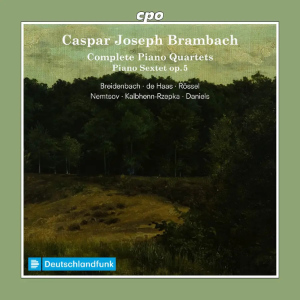
Caspar Joseph Brambach (1833-1902)
Piano Sextet in C minor, op. 5
Piano Quartet in E flat major, op. 13
Piano Quartet in A minor, op. 43
Piano Quartet in G minor, op. 110
Ernst Breidenbach (piano)
Ingo de Haas (violin), Thomas Rössel (viola), Mikhail Nemtsov (cello)
Gesine Kalbhenn-Rzepka (violin II), Marie Daniels (viola II)
rec. 2023/24, Deutschlandfunk Kammermusiksaal, Köln, Germany
Reviewed as lossless download
cpo 5556532 [143]
Caspar Brambach was a new name to me, and some searching suggested that he would be a new name to almost everybody. He did write the music for a work titled Bergisches Heimatlied, the unofficial anthem for the Bergische region of northwest Germany, and I suspect recordings of this exist. However, he has no recordings, other than this cpo one, listed on Presto or Discogs or Allmusic. Hats off to cpo then.
Some biographical notes are certainly in order. He was born in the Rhineland the same year as Brahms. He entered the conservatorium in Cologne as an 18 year-old, where he was taught by Hiller and Reinecke. He gained attention both as pianist and composer (with two operas) before being appointed as Bonn’s musical director at the age of twenty-eight. He enjoyed eight years in this position, but found financial support increasingly hard to secure. In his last year, he was even denied access to the concert hall. Details of his endeavours after this – the remaining thirty years of his life – are sketchy, but it is known that he directed most of his attention during this period towards choral work, even winning a prize in the United States for a cantata about Columbus.
Let me say up front that the influence of Schumann is very strong in each work. No definite dates of composition are known, but performance and publication dates suggest that the pieces cover the majority of Brambach’s career, from his late twenties to the last decade of his life.
A string quartet and piano trio predate his first published chamber work, the Piano Sextet, a somewhat surprising choice of ensemble, given its rarity. The very informative notes mention sextets by Kalkbrenner, Ries and Sterndale Bennett as possible models, but surprisingly overlooks Mendelssohn’s 1824 work. Each of these uses a double bass, the first three with a second violin, the latter with another viola. Brambach’s combination – two violins, two violas and cello – seems to be one of a kind. I described the Ries as more of a piano concerto with an “orchestra” of five strings in a review of the Nash Ensemble’s recording on Hyperion, and a quick sampling of the Kalkbrenner suggests it is similar. I don’t see either as especially relevant to Brambach’s, which is much more equitable in its allocation of the music. At almost half an hour – still the shortest work of the four on this recording – it certainly doesn’t lack ambition, but it is short on inspiration in places. He was not the most gifted when it came to memorable melodies, though they are enjoyable enough in the moment. The pick of the four movements is the Andante, with some lovely melodies. Indeed the slow movements in each of the four works have considerable charm.
Perhaps Brambach realised that the challenge of writing for the five strings was a bit much, and thus decided to follow his “betters”, Schumann and Brahms, by reducing forces back to the piano quartet format. What he might also have done is cut back the manuscript pages: each work runs to more than 35 minutes, and there simply isn’t enough material to fill the time. While the three show similar characteristics, Brambach’s compositional skills certainly improved as he got older: the G minor Quartet is clearly the pick of the three. While the Finale of the A minor, with its strong stylistic connections to Schumann’s Piano Quintet, is marvellously entertaining, the opening movement of the G minor is unquestionably the pick of the bunch, filling its eleven minutes-plus with drama and passion, and little sense of padding.
The performers acquit themselves very well, and they, along with cpo, are to be congratulated for their enterprise. I’ve already mentioned the booklet notes, and the sound quality, while not demonstration quality, is perfectly fine.
Sometimes the journey into the unsung reveals a composer whose absence from the public’s attention is warranted, but I’m pleased to have made the acquaintance of Brambach. Yes, masterpieces have not been hiding in the archives for more than a century, but they are well-crafted works, and the latter two quartets definitely deserve further attention.
David Barker
Other review: Dominy Clements
Buying this recording via the link below generates revenue for MWI, which helps the site remain free













