
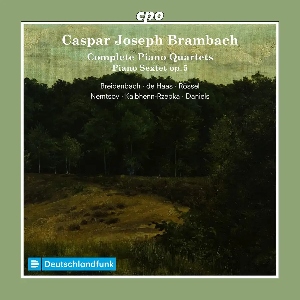
Caspar Joseph Brambach (1833-1902)
Piano Sextet in C minor, op. 5
Piano Quartet in E flat major, op. 13
Piano Quartet in A minor, op. 43
Piano Quartet in G minor, op. 110
Ernst Breidenbach (piano)
Ingo de Haas (violin), Thomas Rössel (viola), Mikhail Nemtsov (cello)
Gesine Kalbhenn-Rzepka (violin II), Marie Daniels (viola II)
rec. 2023/24, Deutschlandfunk Kammermusiksaal, Köln, Germany
cpo 5556532 [2 CDs: 143]
Caspar Joseph Brambach is one of those 19th century figures who was acclaimed in his day, but who has now become almost entirely forgotten. This is accounted for in Marcus Imbsweiler’s useful booklet notes with the fact that Brambach’s more successful work was largely choral, and we can add to this his relatively conservative idiom in its post-Mendelssohnian character, a lyrical style which ensured his music would have been hopelessly out of fashion by the turn of the 20th century.
David Barker’s review of this recording pointed out that “that the influence of Schumann is very strong in each work”. Indeed, if like me you are a fan of Schumann’s lively chamber works then you will be delighted to discover this programme, which covers most of Brambach’s instrumental chamber music beyond a couple of violin sonatas. I hope we will be able to hear these via the enterprising cpo label in the future. The unusually scored Piano Sextet Op. 5 is a large-scale early piece filled with youthful energy, and clearly a work that Brambach would have seen as a calling-card for his skills as a composer and as a pianist, with everything thrown into the mix including an impassioned Andante third movement that takes us way beyond mere repose with its ‘big tune’ climax. This comes after two energetic previous movements, the spark in which is anchored by a homeward-bound finale with tender contrasts and spectacular pianism that both echo Schumann quite closely in mood and gesture.
The Piano Quartet Op. 13 is modelled on examples by Schumann and Brahms, a characteristic noted in a contemporary review that hinted somewhat heavily at its lack of originality. The work is dedicated to Clara Schumann, who knew Brambach as a conductor and who performed her late husband’s Piano Concerto under his baton in 1866. This is an enjoyable work but lacks thematic distinctiveness, or at least the heights of thematic invention as the motifs in the first movement are worked through in swathes of imitative passagework. The Adagio second movement has a set of alarmingly animated variations, but at least settles down into the solemn mood of its opening in order to grant us the contrast into the busy counterpoint that opens a Molto allegro vivace quasi presto that has our musicians on the edge of their seats. CD 1 ends with a firmer hand at the tiller in an Allegro vivace which derives its rhythmic power from emphasis on the weaker beats of the bar. This is one of those late Romantic works that has fine qualities, but we can probably agree ‘goes on a bit’ at just over 40 minutes.
The Piano Quartet Op. 43 gives a more purposeful impression than Op. 13, still with plenty or bravura piano writing but with greater clarity of thought and transparency of instrumentation. Once again, contemporary critics were unimpressed by the thematic ideas in this piece, but Brambach throws in more playful contrasts here, and the musical discourse is full of conviction and honest expressiveness, though we’re unlikely to end up humming memorable tunes. Having said that, the Andante con moto second movement has an almost salon music heart-on-sleeve melody from which some lovely variations emerge, developing into a restrained climax and a conclusion of refined poignancy. The Allegro vivace third movement reflects the power and good humoured contrasts of the first movement, while the final Allegro is notable for its dance elements and quirky interruptions, keeping us on our toes with stops and starts and some intriguing quick-change twists and turns.
The Piano Quartet Op. 110 opens with a dark eloquence and has a late-work sense of turbulence despite being stylistically connected with its predecessors. The booklet notes however point out a new element here, in that “the main themes of all four movements clearly emerge from a single motivic core… The small melodic gesture of the cello in the very first bars of the quartet not only sets forth the tonal range of the main themes, but also very specifically the space in which they move.” This is not cyclical form to the extent that it was explored by the likes of César Franck, but this music inhabits a similar artistic atmosphere and one can assume that Brambach was aware of the potential in these kinds of techniques. The resulting common ground between movements makes this the sort of work you could imagine being orchestrated to make a respectable Romantic symphony. The piano part is not so soloistic to make it into a piano concerto and the Schumann/Brahms/Mendelssohn influences are still very much in evidence, but Brambach uses plenty of octave doublings here and to my ears this piece has a more ‘orchestral’ feel compared to the others.
As initially stated, listeners keen on Schumann’s chamber music and the period qualities of Brahms and Mendelssohn will find much to enjoy here. These works don’t have Brahms’ intensity, but they avoid his occasional over-wrought opaqueness. There is an argument to be made that Brambach’s musical ideas are too thin to carry works of 30-40 minute duration, but all of that working-out of material is part and parcel of this era and this kind of chamber music, and it’s harder to argue that these pieces are lacking in entertainment value. With good performances and a fine recorded balance, this is a corner of the late-Romantic German music world that deserves its moment in the spotlight.
Dominy Clements
Previous review: David Barker
Buying this recording via the link below generates revenue for MWI, which helps the site remain free













