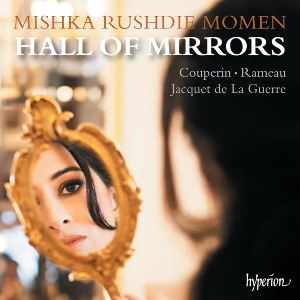
Hall of Mirrors
Mishka Rushdie Momen (piano)
rec. 2025, St Silas the Martyr, Kentish Town, London
Reviewed as lossless download
Hyperion CDA68484 [64]
I will nail my colours to the mast at the start. Baroque keyboard music on the modern piano is one of my great loves in classical music. I find it intellectually stimulating, but at the same time, emotionally relaxing. I’ve never had any affection, however, for the same music played on the harpsichord. Angela Hewitt’s four volumes of Rameau and Couperin, following on from her wonderful Bach recordings, were eye-openers and I lapped up each new recording. Hewitt plays with a crispness and lightness that gives a sense of the original pieces on a harpsichord, but with the richness of the modern piano. More than a decade later, Víkingur Ólafsson released an album with Rameau mixed in with Debussy, totally different to Hewitt’s approach, but equally entrancing. His readings are much more personalised and less “authentic”, unsurprising if you know his style. Despite the prominence of these two pianists, Rameau and Couperin on the piano have not caught on, unlike performances of Bach and Scarlatti.
Now the young British pianist Mishka Rushdie Momen has taken up the baton, following on from a 2024 release, Reformation, which covered an even more obscure area on the piano, that of English keyboard music from the era of Byrd and Gibbons.
Rushdie Momen has put together a well thought-out program with individual works from various of Couperin’s Books of Pièces de clavecin opening and closing the recording, sandwiching suites by Rameau and the relatively unknown (now) Élisabeth Jacquet de La Guerre, child prodigy of the Sun King’s court.
From the outset, it is clear that Rushdie Momen is closer in style to Hewitt than Ólafsson, though there is more of the Romantic spirit in her tempos and use of the soft pedal, and the harpsichord origins of the music are much less obvious.
Without doubt, the best-known work on the programme is Couperin’s Le Tic-Toc-Choc ou les Maillotins, and Momen is slower than Hewitt, but some research made it clear that just about everyone is slower than Hewitt. More importantly, Rushdie Momen is less clockwork-like than Hewitt, and the piece loses a little of its magic. In the melancholic Les ombres errantes, where Rushdie Momen is almost a minute slower than Hewitt, there is a sense of Romanticism present, but even here, Hewitt is able to conjure up more tonal colouring.
Similar thoughts arise in the Rameau Suite: Hewitt is quicker in most movements, but also a little more characterful, Rushdie Momen more rounded and gentle; the adjective “burnished” comes to mind. In Le Rappel des Oiseaux, Hewitt is actually slightly slower, but sounds quicker, and the chirruping of the birds is much more evident.
The big selling point for this release is undoubtedly the Suite by Élisabeth Jacquet de La Guerre. I can only find one other recording where some of her keyboard music (but not from Suite No. 2) has been played on the modern piano, by Spanish pianist Antonio Oyarzabal on IBS Classical. Jacquet de La Guerre almost makes Mozart seem like a late starter. She made her debut before Louis XIV at the age of five, and played both harpsichord and the organ of the Royal Chapel. She maintained a presence in the royal court, being taken under the wing of the King’s mistress, Madame de Montespan. Jacquet de La Guerre wrote four suites for keyboard, in the typical French style comprising a series of courtly dances. Suite No. 2 is attractive, though not as individual as Rameau’s Suite. Again I had the sense that Rushdie Momen was holding something back, that the Gigues, at the very least, should have been a little more sprightly.
Hyperion continues to provide booklet notes, very often contributed by the artist as here, that are incredibly comprehensive and totally readable at all levels of musical knowledge. The Yamaha piano is recorded very naturally.
I did enjoy this, but not as much as I’d hoped. There was a sameness of toning that pervaded many of the pieces that detracted from the experience. In case you were wondering, her uncle is Sir Salman Rushdie.
David Barker
Contents
François Couperin (1668–1733)
Le Réveil-matin, Pièces de clavecin, Book 1, 4e Ordre No 4
Premier Prélude from L’art de Toucher le Clavecin
Le Tic-Toc-Choc ou les Maillotins, Pièces de clavecin, Book 3, 18e Ordre No 6
Les ombres errantes Pièces de clavecin, Book 4, 25e Ordre No 5
Huitième, Prélude from L’art de Toucher le Clavecin
Jean-Philippe Rameau (1683–1764)
Suite in E minor from Pièces de clavecin, Book 2
Élisabeth Jacquet de La Guerre (1665–1729)
Suite No 2 in G minor from Pièces de clavecin, Book 1
François Couperin
Les tours de passe-passe, Pièces de clavecin, Book 4, 22e Ordre No 6
Sixième Prélude from L’art de Toucher le Clavecin
Le carillon de Cithère, Pièces de clavecin, Book 3, 14e Ordre No 6
Forlane Concerts royaux, Quatrième Concert, No 7
Buying this recording via the link below generates revenue for MWI, which helps the site remain free