
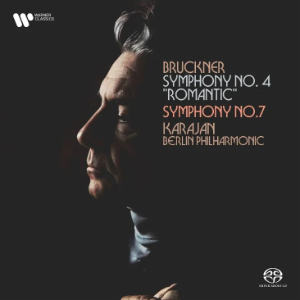
Anton Bruckner (1824-1896)
Symphony No. 4 in E-flat Major ‘Romantic’ (1880 version, ed. Robert Haas)
Symphony No. 7 in E Major, WAB 107 (1881-83, ed. Robert Haas)
Berlin Philharmonic/Herbert von Karajan
rec. 1970/71, Jesus-Christus-Kirche, Berlin
Booklet with notes in English, French, and German
Warner Classics 2685465518 SACD [2 discs: 138]
There is no paucity of recordings of Anton Bruckner’s Fourth and Seventh Symphonies, yet classic Berlin Philharmonic performances conducted by Herbert von Karajan reissued in DSD high-resolution digital mastering enrich the catalogue. Originally released by EMI in 1971, the present recordings benefit from a church acoustic with an expansive, atmospheric bloom; the same conductor and orchestra’s 1975 remakes for Deutsche Grammophon in the Berlin Philharmonie have a tight sound that provides detail for individual instruments. Another characteristic of these performances, now available on Warner Classics, is that Karajan permitted these vast symphonies to unfold at slightly slower tempi than he did subsequently, so there is no urgency in these bucolic works.
Karajan chose the Robert Haas editions, which often combined different versions into a single performing score. Leopold Nowak subsequently published each draft separately to present what Bruckner actually wrote. Karajan’s choice, particularly in the Fourth Symphony which Bruckner revised extensively, reveals that he preferred an ‘idealised’ basis for his interpretations that amalgamated what Haas deemed the finest options that Bruckner left for posterity.
The producer, Michel Glotz, and the engineering team created an entirely different sound world for the Bruckner symphonies than they did for Karajan’s Mozart symphonies recorded in the same venue around the same time (review). Whereas the Jesus-Christus-Kirche sounds intimate in the Mozart sessions, it becomes resonant in Bruckner to enhance the monumentality inherent in the music and add emotional depth. I found myself comparing these readings with those by Eugen Jochum with the same orchestra and the same venue in 1964 and 1965 for Deutsche Grammophon. The Jochum recordings sound dry and boxy, a sonic stage that matches the conductor’s brisk, literalist view of the works. Karajan and Jochum, both justly famous for their Bruckner symphony cycles, complement each other. Whereas Jochum excels in the Fourth Symphony, also based on the Haas edition, Karajan’s resplendent reading of the Seventh Symphony is unmatched.
Karajan’s view of the Fourth Symphony in E-flat Major (‘Romantic’) is broad and sweeping with refined playing that makes the work feel epic and architectural. Jochum, on the other hand, conveyed the music’s pastoral character, especially in the third movement Scherzo: Bewegt – Trio: Nicht zu schnell. I recently reviewed a performance by Nikolaus Harnoncourt, based on the Nowak edition, that approaches the work in a manner not far removed from Jochum’s, albeit with greater overall transparency and festivity in the Scherzo. Karajan took the outer movements expansively, each of which is about three minutes longer than Jochum’s equivalents. The opening Bewegt, nicht zu schnell in Karajan’s interpretation unfolds unhurriedly with long melodic lines and massive climaxes. Blended, string dominated sound masks the rustic dance rhythms. Benefitting most from the burnished sonority, the Andante quasi allegretto emerges with transcendental emotional weight. The finale, Bewegt, doch nicht zu schnell, seems planned and controlled to the last detail by Karajan, so that the melodies soar and congeal into a spellbinding, continuous line with awe inspiring crescendi. Jochum makes all the orchestral voices audible and the brass outbursts sound brusque.
If there is anything to criticise about Karajan’s Bruckner 4, its sophistication undermines the symphony’s naive, unpretentious charm. I appreciate Karajan’s long view, Jochum’s elasticity and propulsion, and Harnoncourt’s agility, crisp articulation, and dynamism. My overall favourite is a recording by the Vienna Philharmonic conducted by Karl Böhm in the Musikverein during 1973. Also using the Haas edition, Böhm imparts structural clarity, steady momentum, lyricism, and orchestral warmth. The blocks of sound flow together logically, and the graceful dynamic contrasts eliminate the risk of bombastic climaxes. Even though Böhm remains my top choice, Karajan’s compelling interpretation feels like a journey through an imaginary landscape.
A parallel between Karajan’s approaches to Bruckner’s Fourth Symphony and Ludwig van Beethoven’s Symphony No. 6 in F major, Op. 68, (‘Pastorale’) is his focus on nature’s beauty. Böhm brought circumspection to both works (nature can nurture and threaten us) and, thereby, arguably excelled where Karajan seemed less comfortable. Karajan, who enjoyed hiking, mountain climbing, skiing, sailing, and other activities, portrayed nature musically in ways that could have been accurate from his perspective. Perhaps he understood that the natural world is best experienced first-hand rather than viewed through art, which captures only aspects of its myriad complexity.
Immaculate precision, ethereal mystery, and a polished orchestral blend are salient features of how Karajan directed Bruckner’s Seventh Symphony in E Major. Masterly phrasing gives this version a dreamlike, suspended sense of time. Karajan infused the massive Adagio: Sehr feierlich und sehr langsam movement with incredible, slow burning intensity.His interpretation of the opening Allegro moderato is hypnotic and mysterious: the soft violin tremolos at the beginning emerge from silence, creating a gorgeous, otherworldly atmosphere. Taut pacing and seamless transitions lead a grand sonic voyage. Roughness and nervous energy in the Scherzo, Sehr schnell – Trio: Etwas langsamer, suggest a wild peasant dance. Karajan’s tight, precise articulation maintains tension and lends sweetness to the Trio section. His refusal to exaggerate the frantic undertone rewards repeated listening. Karajan unifies the seemingly fragmented fast and slow sections in the finale, Bewegt, doch nicht schnell, and brings the journey to a rousing, but not pompous, conclusion.
In the current remastering from the original tapes in HD 192 kHz/24 bit by Warner Classics, the reverberant acoustic is not an obstacle to hearing the full musical range captured on the analogue tapes, at least not on the CD layer of the SACDs. The recessed brass may have been Karajan’s artistic decision to enhance the misty, phantasmagorical aura of his interpretations. Atmospheric and redolent of a real performance describe the sound quality of recordings made, as the dates at the top of this review suggest, during five days, albeit not consecutive ones. This valuable release offers two Bruckner symphonies performed by a top-tier orchestra in convincing and riveting interpretations.
Daniel Floyd
Buying this recording via the link below generates revenue for MWI, which helps the site remain free














