
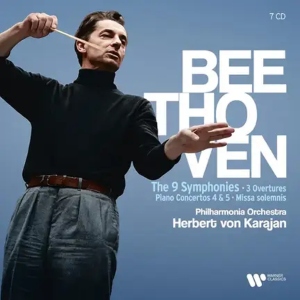
Ludwig van Beethoven (1770-1827)
Symphonies Nos. 1-9
Piano Concertos 4 and 5
Missa solemnis
Philharmonia Orchestra/Herbert von Karajan
rec. 1951-1958
Warner Classics 2685427670 [7 CDs: 545]
Herbert von Karajan’s cycle of the nine canonical symphonies by Ludwig van Beethoven with the Berlin Philharmonic, released in 1963, receives most of the attention among his numerous recordings of these protean works. During the previous decade, Karajan conducted all nine symphonies with the Philharmonia Orchestra in Kingsway Hall, London, and, in the case of No. 9, the Musikverein, Vienna. Issued in instalments, the records that Walter Legge produced for EMI garnered praise from critics who rated some of them even higher than contemporaneous ones by Arturo Toscanini. With the reissue of these recordings in April 2026 in a boxed set along with the Missa solemnis, Op. 123, and two piano concertos, Warner Classics invites reassessment of these legendary traversals, which are arguably among his finest Beethoven interpretations.
After having reviewed Nikolaus Harnoncourt’s cycle with the Chamber Orchestra of Europe, it is fascinating to discover that Karajan sometimes had ideas regarding tempos and dynamics that differed less than expected from historically-informed readings. Harnoncourt, of course, had access to modern critical editions of the scores, and he used a combination of modern and period instruments. Like other recordings of similar vintage, Karajan’s featured a modern orchestra that, as far as I can assess, was not interested in recreating an early nineteenth-century sound world. Apart from the omission of nearly all the exposition repeats, the playing is exceptional and artistically compelling.
The readings of all nine symphonies are superlative, and there is no weakness in the entire set. Even if Karajan’s interpretation of the Symphony No. 6 in F major, Op. 68, does not equal the truly ‘Pastoral’-sounding recordings by Bruno Walter, Otto Klemperer, and Karl Böhm, his 1953 performance gives the music more room to breathe than his subsequent ones in Berlin did. Symphony No. 1 in C major, Op. 21, and Symphony No. 2 in D major, Op. 36, have a sparkling transparency that Karajan, unfortunately, did not carry forward when he revisited them. There is mystery in the introduction to Symphony No. 4 in B-flat major, Op. 60, followed by the most effective dramatic outburst in all his recordings and invigorating rhythmic drive for the rest of the opening ‘Adagio – Allegro vivace’.
Praised upon its release, the recording of Symphony No. 3 in E-flat major, Op. 55, remains one of the finest ‘Eroica’ accounts, whose stature is especially impressive given the formidable competition. My personal choices for electrifying heroism are Felix Weingartner’s 1935 and Arturo Tosacanini’s 1939 readings. Kinetic energy and coherent red thread from the beginning to the end make this performance of the Symphony No. 7 in A major, Op. 92, galvanising.
Boasting a team of soloists as fine as those in Karajan’s illustrious 1962 recording, the 1955 stereo edition of Symphony No. 9 in D minor, Op. 125, is less than two minutes faster and, yet, has greater forward propulsion. The recapitulation in the opening ‘Allegro ma non troppo, un poco maestoso’ is terrifying, and the ‘Molto vivace – Presto’ second movement (shorn of its repeats) is intense. The ‘Adagio molto e cantabile – Andante moderato’ is leisurely without dragging, and the Finale captures the full range of emotions from despair and struggle to hope and joy. The sound quality is clear, and the music is divided sufficiently between the two channels, albeit with a narrow soundstage by today’s standards. The Chor der Gesellschaft der Musikfreunde in Wien is recessed, but the diction is intelligible; the soloists are placed forward in the mix, yet not to an extent that overwhelms the rest of the performers.
The recordings of Piano Concerto No. 4 in G major, Op. 58, and Piano Concerto No. 5 in E-flat major, Op. 73, with Walter Gieseking have astonishing momentum. Gieseking and Karajan delivered an enthralling performance of Piano Concerto No. 5 in E-flat major, Op. 73, framed by a hair-raising ‘Allegro’ and a gripping ‘Rondo. Allegro’. If this team had documented their renditions of the remaining three concertos, this might have been one of the great cycles.
The stereo recording of the Missa solemnis, recorded in 1958, is stylistically similar to his 1965 remake for Deutsche Grammophon, but the vocal quartet in the latter makes it the top choice among Karajan’s accounts of this work. All of the positive elements that defined the latter version are already in evidence: celestial beauty, drama, consolation, and sharply delineated interjections of horrifying war music in the ‘Agnus Dei’.
Warner Classics has provided marvellous transfers of these vintage recordings for eminently satisfying aural enjoyment. This issue is valuable not only for Karajan collectors, but anyone interested in Beethoven’s symphonies and top-notch historic orchestral recordings.
Daniel Floyd
Contents
Symphony No. 1 in C major, op. 21
Symphony No. 2 in D major, op. 36
Symphony No. 3 in E-flat major, op. 55
Symphony No. 4 in B-flat major, op. 60
Symphony No. 5 in C minor, op. 67
Symphony No. 6 in F major, op. 68
Symphony No. 7 in A major, op. 92
Symphony No. 8 in F major, op. 93
Symphony No. 9 in D minor, op. 125
Elisabeth Schwarzkopf (soprano), Marga Höffgen (contralto), Ernst Haefliger (tenor), Otto Edelmann (bass)
Chor der Gesellschaft der Musikfreunde in Wien
Overtures: Leonore No. 3, op. 72b, Coriolan, op. 62, Egmont, op. 84
Concert Aria “Ah! Perfido “, Op. 65
Elisabeth Schwarzkopf (soprano)
Two Arias from Fidelio, Op. 72
Elisabeth Schwarzkopf (soprano)
Piano Concerto No. 4 in G major, Op. 58 (Walter Gieseking, piano)
Piano Concerto No. 5 in E-flat major, Op. 73 (Walter Gieseking, piano)
Missa solemnis, Op. 123
Elisabeth Schwarzkopf (soprano), Christa Ludwig (mezzo-soprano), Nicolai Gedda (tenor), Nicola Zaccaria (bass); Singverein der Gesellschaft der Musikfreunde,
Buying this recording via a link below generates revenue for MWI, which helps the site remain free















Thanks for this review – I didn’t even know this had been released, so have wasted no time in acquiring my copy, as I’m a Karajan fan and a Beethoven nut. (I won’t be jettisoning the 1963 cycle just yet.)
Just one point, that might interest prospective buyers – four of the seven discs are well over 80 minutes each, so some older players (as the saying goes) may experience playback issues.
80+ minutes isn’t so rare as it used to be, perhaps, but both the first two discs in the set are a little over 87 minutes each – is this some kind of record? (Pun intended.)