
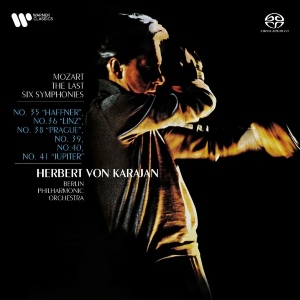
Wolfgang Amadeus Mozart (1756-1791)
Symphony No. 35 in D Major, K. 385 ‘Haffner’
Symphony No. 36 in C Major, K. 425 ‘Linz’
Symphony No. 38 in D Major, K. 504 ‘Prague’
Symphony No. 39 in E-flat Major, K. 543
Symphony No. 40 in G minor, K. 550
Symphony No. 41 in C Major, K. 551 ‘Jupiter’
Berlin Philharmonic Orchestra/Herbert von Karajan
rec. 21-25 September 1970, Jesus-Christus-Kirche, Berlin
Warner Classics 2685465517 SACD [2 discs: 147]
Among 20th century conductors of symphonic works by Wolfgang Amadeus Mozart with modern orchestras, Karl Böhm rightly stands out for his consistent dedication to the composer, especially his cycle of all the then-known symphonies with the Berlin Philharmonic. Böhm’s mentor, Bruno Walter, recorded many Mozart symphonies with the Columbia Symphony Orchestra; Otto Klemperer did a generous number with the Philharmonia Orchestra, and Josef Krips led the Concertgebouw Orchestra in around half of the symphonies attributed to Mozart in the mid-20th century. Böhm was generally straight forward with steady tempi and transparent orchestral textures; Walter exuded lyrical warmth; Klemperer focused on structure and made every detail audible in spite of the large ensemble he used; Krips was theatrical and passionate. There were of course many other conductors who made distinguished Mozart recordings, including George Szell, Sándor Végh, and Ferenc Fricsay. Nikolaus Harnoncourt and Charles Mackerras subsequently introduced historically informed practices, while Christopher Hogwood and Jaap Schröder directed a monumental survey of Mozart’s orchestral output on period instruments in the late 1970s and early 1980s.
One major conductor not usually cited as a Mozartian was the Salzburg-born Herbert von Karajan, whose set of the final six symphonies with the Berlin Philharmonic in September 1970 for EMI is the subject of the present review. These recordings demonstrate that Karajan applied his smooth, silken, and polished style with seamless phrasing and blended sonorities to these works. From the same orchestra a few years earlier, Böhm evoked crisp articulation, rhythmic buoyancy, prominent woodwinds, transparency, and poise. Karajan, in contrast, produced seamless legato, lush textures, rubato, and dramatic sweeps. Both conductors omitted most of the repeats, an unfortunate decision that rules out both as unqualified first choices.
Given the repetition in Karajan’s vast catalogue, it is inevitable that he competes with himself. A few years after the present set, he set down these six symphonies with the same orchestra in the Berlin Philharmonie for Deutsche Grammophon. In my opinion, the EMI set is preferable because of the warm, intimate acoustic of the Jesus-Christus-Kirche in Berlin-Dahlem and the degree of spontaneity and discovery inspired by the orchestra’s first traversal of these works with its principal conductor. Even though it seems that Karajan used a substantial number of the Berlin Philharmonic’s string players, these performances do not sound overwhelmingly ‘heavy’ or ‘bloated’; they accord with certain early- to mid-20th-century aesthetic norms. In many respects, these readings absolutely sparkle and, with the exception of the stodgy Menuetto-Trio in K. 425, radiate energy tempered by a light touch that Karajan is often alleged not to possess.
The performance of the D Major symphony, K. 385, (‘Haffner’), which opens the first disc, reveals a great deal about Karajan’s approach to these symphonies. The Allegro con spirito begins powerfully, and the whole movement is dramatic; the Andante sounds luxuriant with rich strings; the Menuetto: Allegretto – Trio is weighty, yet retains a dance-like character; and the Presto finale is thrilling and propulsive to a degree most performances cannot match.
With a grand, majestic Adagio introduction that leads to Allegro spiritoso, the performance of the C Major symphony, K. 425, (‘Linz’) sounds almost Beethovenian. Karajan revels in the Poco adagio as if he wants the music to go on indefinitely, which makes his omission of the repeats surprising. As noted above the Menuetto-Trio drags and does not seem like a dance, but Karajan redeems himself in the finale, which he takes at a true Presto tempo.
The first disc ends with the C Major, K. 551, (‘Jupiter’) symphony in a performance that follows a pattern similar to the previous two: a bold, steady Allegro vivace, which could use a little more vivacity, a meditative Andante cantabile, a Menuetto: Allegretto-Trio that would enable dancers to move deliberately without making mistakes, and a Molto allegro finale with blazing fire and drive.
The second disc begins with the D Major symphony, K. 504, (‘Prague’), which features a particularly solemn Adagio introduction that leads into a swift Allegro (the contrast between the introduction and exposition is strong). The Andante is spacious, while the finale Presto is articulated cleanly by the large string section at Karajan’s swift tempo.
The E-flat Major symphony, K. 543, might be the best test of whether prospective buyers will enjoy this style of Mozart playing. This performance feels ceremonial because of the rich, polished texture that Karajan draws from the strings. A stately Adagio leads smoothly into an Allegro that maintains graceful elegance rather than rushing forward; the Andante con moto is relaxed enough to savour the tender atmosphere; the Menuetto-Trio is the most successful in this set because it sounds like a sensual dance which draws lovers together; the Allegro finale is wild and ecstatic.
Karajan emphasises dark drama in the G minor symphony, K. 550, with a passionate Molto allegro that causes the music to unfold demonically; the following Andante is taken slower than the tempo marking implies but conveys the intended eeriness; the Menuetto: Allegretto-Trio feels stormy and enhances the sinister feel of the work; the finale moves forward at an Allegro assai tempo and makes for a spooky, unsettling conclusion.
One consequence of the gorgeous (and, at times, homogenous) large string section that Karajan employed is that the woodwinds are submerged and require concentration to hear. What some might deem a fault could equally be an artistic choice in which Karajan sought to bring Mozart’s orchestration into line with music from later periods of which he was a respected interpreter. Although I am accustomed to readings by Walter, Klemperer, and, above all, Böhm for large-orchestra Mozart, I enjoyed these performances because they are neither astringent nor emotionally reserved.
Warner Classics remastered this set from the original tapes in 2026 in high-resolution DSD on two dual-layer SACDs. The sound quality, at least on the CD layer that I heard, gives the impression of hearing the master tapes played back, which may be the highest level of fidelity that a digital transcription of a historic analogue recording can offer. The booklet reproduces one of the original album covers and contains notes in English, French, and German. This reissue rescues these recordings from the dim recesses of massive boxed sets from which they rarely emerge. Warner Classics should continue this series with the instrumental concerti by Mozart that Karajan and these forces recorded around the same time as the symphonies. It would be a cause for celebration if Warner Classics would remaster some of Karajan’s EMI opera recordings and issue them with full libretti and liner notes from the original releases.
Mozart is too mercurial and complex for any single view, which is why a variety of approaches provides continual insight. Karajan interpreted these works according to his own urbane sensibility and showed little regard for historic context, the instruments used, musical syntax, or articulation. Harnoncourt criticised Karajan for these reasons and, yet, unwittingly validated the older conductor by sometimes using modern orchestras and imposing his own interpretive choices on the scores, including unmarked tempo fluctuations, pauses, and harsh accents.
Since this is not an academic essay, I will introduce an idea at the end without intending to develop it: this is an invitation for readers to ruminate and draw their own conclusions. Given that Mozart wrote music for immediate performance with the instruments and singers that happened to be available, can we condemn interpreters who use what they consider the best tools for bringing these works to life? Mozart wrote many arias for specific singers, concerti for particular soloists, and sundry instrumental works for ensembles of his time. Did Mozart expect his music to be restricted to the initial performers and instruments? If so, shall we conclude that subsequent generations have no ground to revive his works at all?
Anyone who has read this far likely appreciates this music even though Mozart did not compose it with us in mind. The circumstances in which Mozart worked are historical facts rather than parameters for how the music must be played. We can only speculate about how Mozart might have written if the Berlin Philharmonic had been at his disposal. Would he have preferred Karajan’s precision and refinement, Harnoncourt’s abrasiveness and raw energy, or an approach unlike anything we know?
Daniel Floyd
Buying this recording via the link below generates revenue for MWI, which helps the site remain free















Thanks Daniel for a perceptive review. As a Karajan groupie I do want the DG recordings too, though I agree these EMI ones are first port of call. Regarding varying performance styles, all I can say is this: whatever brings you as close as possible to the meaning and emotional heart of any piece of music must be regarded as “authentic”, whether it’s HIP or old-school big-band traditional readings. So to each his own!