
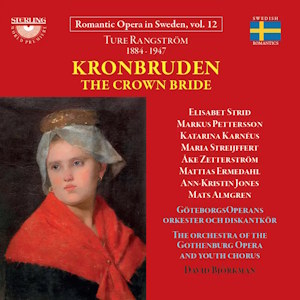
Ture Rangström (1884-1947)
Kronbruden (The Crown Bride) (1915)
Opera in four acts after August Strindberg’s drama of the same title
Mats (tenor): Markus Pettersson
Kersti (soprano): Elisabet Strid
Mother of Kersti (contralto): Maria Streijffert
Grandfather of Mats (bass): Mats Almgren
Brita, sister of Mats (mezzosoprano): Katarina Karnéus
Sheriff (baritone): Åke Zetterström
Neck (baritone): Mattias Ermedahl
Midwife (mezzosoprano): Ann-Kristin Jones
Orchestra of the Gothenburg Opera and Youth Chorus/David Björkman
rec. live concert performance, February 2017, Gothenburg Opera, Gothenburg, Sweden
Sterling CDO1136-7 [2 CDs: 137]
Sterling have now reached volume 12 of “Romantic Opera in Sweden”. For people outside Sweden, these recordings must often have been revelatory. I am not sure that any opera in the series has impressed me as much as this release – the work and the execution. The recording draws on two concert performances of the opera close together in February 2017. The format eliminates stage-production noises and issues of wandering microphone placement for the singers; the second performance allows the elimination of fluffs or minor errors. The result is genuinely compelling and impressive, with all the dynamism and energy of a live event and very few technical flaws (none of any great concern). The audience is very well-behaved; applause retained at the end of the opera is the only time one feels their presence.
I had greatly enjoyed the sheer sweep and brilliance of Rangström’s music, especially as demonstrated in his symphonies. So, I was pleased to hear similar qualities in Kronbruden, a substantial four-act opera. Since its 1922 Swedish premiere, it seems to have maintained a toe-hold in the repertoire there, understandably so. The story is drawn from August Strindberg’s 1903 play of the same title. I have no idea how closely the opera follows the original text or plot, but there is a comment that the composer does follow the original script, only omitting the final scene. This set includes a full libretto in Swedish and English.
The story has been likened to a Scandinavian Jenůfa or possibly Delius’s A Village Romeo and Juliet. In brief, young lovers Kersti and Mats belong to opposing families. They have a “forest wedding”, unknown to their families. That leads to the birth of a child whose existence is kept secret. If the couple wish to be formally wed, Kersti must wear the traditional wedding crown that symbolises purity. Mats believes they can reconcile the families to their love but Kersti is willing for the child to be killed to allow her the pretence of wearing the crown. A character called the Midwife helps her with this plan, while the Neck, a mysterious “Spirit of the River”, warns her of the consequences. The wedding goes ahead. During a wedding dance, the crown falls from Kersti’s head into the river. The Neck’s voice is heard, and the ghost of the slain child appears dressed in a baptismal gown. The guests look for the crown but instead find the body of the child. Kersti confesses to the crime of which Mats had been ignorant – that sends him mad. The now-arrested Kersti finds redemption in a final vision of her dead child.
The kinship with Jenůfa goes beyond any passing narrative similarities. Both operas are prose settings, and the vocal writing is a series of scenas and ariosos rather than set-piece arias. Both also use the rhythmic flow and shape of the languages they were written in to determine much of the vocal writing. That said, the liner notes make the point that little if any of Janáček’s music could have been known in Sweden even a decade after it was composed. So, the parallels would seem to be coincidental. Interestingly, the notes also say that some of the melodic fragments come from Strindberg himself – presumably as they occurred in the original play. Rangström uses a form of leit-motif; characters and emotions are clearly and recognisably defined. In line with an element of symbolism, the character of the Midwife is meant to embody Kersti’s evil spirit, the Neck – her conscience.
If, like me, you are more familiar with Rangström through his orchestral scores, there is much to admire here. The orchestra carries much of the emotional and illustrative drama of the work. The playing of the Gothenburg Opera Orchestra of this very demanding score is technically secure and musically exciting. The same applies to the work of all of the soloists who sing their often difficult lines with total dramatic conviction. There is quite a long roster of named solo roles, which could be confusing without the benefit of any visuals. Yet the style and sound of the voices is clearly delineated.
Tenor Markus Pettersson as Mats has a bright, ringing, perhaps slightly edgy sound which seems well-suited to the ardent young lover. Soprano Elisabet Strid as Kersti also finds a believable balance between the young woman in love and someone who could sanction infanticide. I am not at all familiar with Scandinavian opera singers. The only name I recognised was mezzo-soprano Katarina Karnéus who sings the role of Mats’s sister Brita. She suspects Kersti of the terrible crime before it as been discovered. She sings with thrilling attack the denouncement of Kersti in Act II (which begins the second disc); it one of the most dramatic sections of the score.
As mentioned, the work has held onto a place in the active repertoire over the last century. I do not know if that means the cast here were familiar with the work as a whole or just choice excerpts. A handful of excerpts recorded across a wide period are listed on discogs.com but nothing else complete. So, any recording such as this would be welcome even if it were not as accomplished as this most certainly is. For those interested in the work of this composer or in Romantic Swedish Opera in general, there is considerable value and interest here. The actual narrative feels a little contrived: it tries to steer a path between folktale, symbolist fable and modernist drama. Perhaps that is where the unflinching Jenůfa is more coherently successful. But then no-one said opera’s great strength was gritty realism…
Nick Barnard
Other review: Jim Westhead and William Kreindler
Buying this recording via the link below generates revenue for MWI, which helps the site remain free
Previous review: Jim Westhead
Other cast
Pastor (bass-baritone): Mats Persson
Soldier, father of Kersti (bass-baritone): Karl Peter Eriksson
Verger, grandfather of Kersti (baritone): Caspar Engdahl
Father of Mats (tenor): Ingemar Andersson
Mother of Mats (mezzosoprano): Hannah Körner
Grandmother of Mats (soprano): Åsa Thyllman
Anna, sister of Mats (soprano): Frida Engström
Lit-Karen, sister of Mats (treble): My Wegnelius Jarlstedt
Lit-Mats, brother of Mats (treble): Philip Engström
Voice of a child (soprano): Elisa Svedberg (act 2), Inez Carlsson (act 4)
Relative of Mats (tenor): Daniel Ralphsson
Relatives of Kersti (soprano, contralto, tenor): Frida Hagman, Tiina, Markkanen, Mari Lindbäck, Petter Reingardt
Male Choristers from The Chorus of The Gothenburg Opera
Tenors: Erik Enqvist, Nikolaj Giljov, Reima Killström, Olof Söderberg
Basses: Karl Johan Nordensten, Thomas Sonefors, Herbjörn Thorardson, Sven Törnell














I’m glad you gave this a positive review, Nick! I happen to love all of those imagist/modernist experiments in opera, all of the Maeterlinck settings and post-Wagner romanticism, so this was an incredibly valuable find and I’ve been trying to get my other opera friends to give it a spin.
Reviewers have mentioned the lack of arioso moments, and the fact that Rangstrom stuck possibly too-closely to Strindberg’s script, which leads to a lot of ‘conversation’ between characters. This is true, of course, but I think the way Rangstrom compensates for it is with all of these lovely orchestral passages. Compare Kronbruden with another ‘conversation’ opera, like R. Strauss’s Intermezzo, and this feels like a very fresh way of ‘doing-theatre-in-music’. I kind of wish there were more out there like it!