
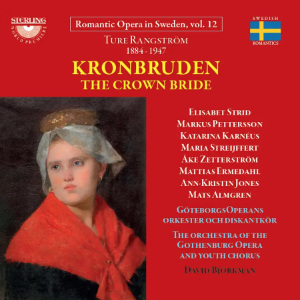
Ture Rangström (1884-1947)
Kronbruden (The Crown Bride) (1915)
Opera in four acts after August Strindberg’s drama of the same title
Mats (tenor): Markus Pettersson
Kersti (soprano): Elisabet Strid
Mother of Kersti (contralto): Maria Streijffert
Grandfather of Mats (bass): Mats Almgren
Brita, sister of Mats (mezzosoprano): Katarina Karnéus
Sheriff (baritone): Åke Zetterström
Neck (baritone): Mattias Ermedahl
Midwife (mezzosoprano): Ann-Kristin Jones
Orchestra of the Gothenburg Opera and Youth Chorus/David Björkman
rec. live concert performance, February 2017, Gothenburg Opera, Gothenburg, Sweden
Reviewed as a 44.1 kHz 16 bit (CD-quality) download
Sterling CDO1136-7 [137]
Jean Sibelius considered Ture Rangström to be “head and shoulders above any other Swedish composer”. His works have seldom been recorded, but a box of his symphonies has received an enthusiastic review on MWI.
Here we have the first recording of his opera Kronbruden (The Crown Bride). This refers to a Swedish tradition: a virginal bride wears a crown during the wedding ceremony. The work, based on August Strindberg’s drama, is considered to be important in the history of Swedish opera. It has been performed in Sweden at the very least some 55 times since its premiere. This recording was made with the support of King Gustaf VI Adolf ’s fund for Swedish culture. The Swedes are lucky to have such highest-level support the for recordings of important national works of art.
The opera is barely known outside Sweden, there seem to be no online libretti or synopses in English, and Strindberg’s drama is not easy to sum up. Here is a précis: Kersti and Mats, lovers from feuding families, have a son in secret. The families make peace so Mats can marry Kersti, but the bride is expected to wear a crown. Kersti, not allowed to, becomes resentful of the baby. She kills him, aided by supernatural forces. On the wedding day, her crime is revealed.
If you would like a full description of the story, please read the narrative that I have prepared, which follows the review.
Readers familiar with Leoš Janáček’s Jenůfa may have noticed parallels. Both operas centre on a trapped young woman. Jealousy, honour and social pressure lead to violence, a hidden crime and final forgiveness. Both story lines unfold in tightly knit rural communities where reputation is everything. Jenůfa is set in a Moravian village with strict expectations around female chastity and family honour. Kronbruden also tales place in a village with strong community morals and symbolic rituals such as the crown bride tradition. Each village itself acts almost as a character, pressuring and leading the protagonists to their fates. The most striking parallel is a hidden or suppressed crime committed “for the woman’s good”.
In Jenůfa, the Kostelnička kills her stepdaughter’s newborn child, believing this will save her from shame and secure her future. In Kronbruden, the plot revolves around a murder committed by the mother, under the pressure of her emotions and social desires, and the societal moral codes contribute to the crime’s inevitability.
Another parallel lies in the heroine’s suffering as a path to transformation. Both Jenůfa and Rangström’s bride endure public shame, physical or emotional violence and betrayal by those closest to them. Both operas move towards a final-act reconciliation. Jenůfa forgives both Laca and the Kostelnička. The ending in Kronbruden is more symbolic and psychological, but still moves toward atonement and release.
Janáček is credited with developing a speech-melody technique, justified by his notating of thousands of “speech-melodies” from everyday Czech speech. Rangstrom did not delve anywhere as deeply into the speech structures of his language, but in Kronbruden he does use a declamatory, text-driven rhythm, so is forced into a parlando operatic style.
I should admit that I did not much enjoy Kronbruden until the final act. I asked to review it because I admire Rangström’s orchestral song cycle Häxorna (review), and I had hoped for something of a similar character. I also came to the work without any real familiarity with Strindberg, and I did not initially appreciate the depth of Rangström’s personal and artistic commitment to him. (It appears that Strindberg wished Kronbruden to be set as an opera.)
Rangström’s devotion to Strindberg’s oeuvre was so strong that he set the play almost verbatim, so the libretto is dominated by short, conversational lines. Dramatically, this leaves little room for the usual operatic architecture. The love interest is established from the outset, but there is no scope for a love duet or for any meaningful conflict between rivals. The only extended monologue is Brita’s bitter denunciation at the height of the revelation of Kersti’s crime – and it is in this passage that Rangström finally receives the sustained text he needs to deploy his musical‑dramatic powers to full effect. He might well have benefited from working with a dramatist experienced in shaping material for opera, someone who could have re‑cast the play into a more effective operatic form. Yet I suspect that his loyalty to Strindberg made such an approach unthinkable.
The release comes from a live concert performance. There are no usual pitfalls of recording an opera staged in a theatre – no thuds, bangs, heavy footsteps, or singers drifting away from their microphones. The result is a clean, clear recording, with the voices placed slightly forward in the balance. This means that the brief orchestral interludes in the first three acts have less effect than they might otherwise have had. The cast, however, is uniformly excellent. Only Elisabet Strid shows the slightest strain at the very top of her range, and even then only for a moment or two.
The accompanying first-rate booklet offers Swedish and English texts and a synopsis written by the composer. A full libretto is also available, with Swedish and English presented side by side. I found it indispensable whilst listening to the performance.
If you are interested in well-crafted post-Romantic opera, or if you treasure Jenůfa, this release may be for you.
Jim Westhead
Other review: Nick Barnard and William Kreindler
Buying this recording via the link below generates revenue for MWI, which helps the site remain free

Other cast
Pastor (bass-baritone): Mats Persson
Soldier, father of Kersti (bass-baritone): Karl Peter Eriksson
Verger, grandfather of Kersti (baritone): Caspar Engdahl
Father of Mats (tenor): Ingemar Andersson
Mother of Mats (mezzosoprano): Hannah Körner
Grandmother of Mats (soprano): Åsa Thyllman
Anna, sister of Mats (soprano): Frida Engström
Lit-Karen, sister of Mats (treble): My Wegnelius Jarlstedt
Lit-Mats, brother of Mats (treble): Philip Engström
Voice of a child (soprano): Elisa Svedberg (act 2), Inez Carlsson (act 4)
Relative of Mats (tenor): Daniel Ralphsson
Relatives of Kersti (soprano, contralto, tenor): Frida Hagman, Tiina, Markkanen, Mari Lindbäck, Petter Reingardt
Male Choristers from The Chorus of The Gothenburg Opera
Tenors: Erik Enqvist, Nikolaj Giljov, Reima Killström, Olof Söderberg
Basses: Karl Johan Nordensten, Thomas Sonefors, Herbjörn Thorardson, Sven Törnell
The story
The first act opens with the “crown” motif, developed in an atmospheric orchestral prelude. Kersti’s mother, suspicious of her behaviour, demands to know where she has been. Kersti – who has just returned from the woods with Mats – evades questions. She summons Mats, anxiously asking after the baby; Mats reassures her. We hear three of the principal soloists together: Maria Streijffert, Elisabet Strid and Markus Pettersson sing a parlando ensemble that suits the scene’s nervous intimacy. The contrast between the contralto’s mature timbre and the soprano’s lighter tone is especially effective.
An orchestral interlude blends the crown motif with the sound of wind‑tossed branches. Hunting horns echo through the forest, alarming Kersti. When the noise subsides, she arranges green branches around a red carpet and fashions a wreath of white water‑lilies. Mats brings the baby in a cradle. They enact a private dedication ceremony, a symbolic imitation of a wedding. Just before they exchange vows, Rangström offers a strikingly romantic orchestral flourish, frustratingly short but undeniably beautiful.
They speak of their future. Kersti fears the judgement of the village; Mats tries to reassure her. When he asks what they should name their son, she bursts out – shrill and increasingly distraught – that he should be called “crown‑stealer”. She tells the bewildered Mats that she cannot wear the bridal crown because the child was conceived out of wedlock. Her mother approaches. Mats calms Kersti as best he can and slips away, urging her to guard the baby. There follows is a furious confrontation. The mother hurls accusations and seizes her daughter’s hair. Kersti raises her hand in anger, to be met with the stinging rebuke: Is that what Mats has taught you? His father drove us from house and home, and now you take the son in your arms!
The generational hatred between the two families is laid bare. The mother demands to know what lies in the cradle. Kersti swears by the water spirit Neck that she is pure and will wear the crown. The music remains in Rangström’s parlando style – tense, speech‑inflected, but rarely erupting into full dramatic force. Even at the height of the quarrel, the orchestral writing stays relatively restrained; this perhaps deliberate choice risks undercutting the emotional violence of the moment.
A ninety‑second orchestral interlude, built from sombre repetitions of the crown motif, conveys the bleakness of the rift between mother and daughter. The Neck appears, singing I hope that my Redeemer still lives. Kersti mocks him, promising that if he keeps quiet she will let him play at her wedding. He looks at her sadly, nods and vanishes. In Mattias Ermedahl’s brief appearance, his firm, clear tone hints at the importance of the Neck’s later interventions. The accompanying music’s rippling texture evokes the mill‑stream.
The Midwife enters. Kersti snippily reminds her that the birth must remain secret. The Midwife, scolding her tone, asks to be invited to the wedding; Kersti’s curt refusal provokes a threat of blackmail, with pointed references to the Sheriff. Kersti raises a stick which the fleeing Midwife breaks into pieces with magic. Her back takes on the shape of a fox with a sweeping tail. Rangström’s jerky, angular orchestral writing mirrors the animal gait and the sharp, speech‑driven exchanges. The Midwife says she will be at the wedding, invited or not, as will be the Sheriff.
Another short interlude underscores Kersti’s increasingly unsettled state as she paces before the cradle, removes her red jacket and lays it over the baby. The orchestra builds in urgency and reaches a sudden climax, although one might wish for more Straussian weight in the scoring, given the emotional stakes. The Neck reappears, repeating his lament I hope that my Redeemer still lives. Kersti freezes in horror. A clarinet line seems to rise from the depths of the tarn. Unseen by her, the Child in White emerges from among the water‑lilies and approaches the cradle. The music falls silent. The Child listens for signs of life and, hearing none, bursts into tears. He scatters water‑lilies over the cradle, kisses it and sinks back into the tarn.
The Midwife offers Kersti a bridal crown in exchange for the baby’s corpse, if she is invited to the wedding. Kersti agrees. She easily persuades the besotted Mats to leave everything in her hands. She prevents him from seeing the baby, and insists she will entrust its care to the Midwife, the only other person who knows of the birth. Mats leaves reluctantly. Kersti drops the cradle into the tarn. The Child in White rises again, pointing at her in accusation. She recoils in terror and retreats into the hut. Rangström punctuates this with a brief but threatening orchestral gesture as the Neck appears once more, singing mournfully:
Gone is the light,
Conquered by night.
Deep is my sin,
Black as the tarn.
Joy there is none;
Plenty of woe.
Kersti emerges from the hut and walks across the stage with a strangely proud, composed bearing. The act ends with the orchestra repeating the Neck’s sorrowful melody, a bleak reminder of the tragedy now set in motion.
The second act takes place in the mill. The two feuding families gather to pledge an end to their quarrel and to agree to the marriage of Kersti and Mats. Brita, Mats’s sister, appears. Her manner makes it clear that she knows about Kersti’s “unacceptable” behaviour with Mats. The orchestra offers the lightest of accompaniment to the dialogue: Brita’s barbed double meanings and her younger siblings’ innocent replies.
Most of the vocal weight falls to the excellent bass Mats Almgren as Mats’s grandfather, reflective and warm‑voiced. Seeking guidance, he opens the Bible at random. The family sing the hymn verse he finds: a meditation on the newborn child who cannot foresee its fate, and on the equality of rich and poor in death. Another random opening yields this line: The soul of my son Shechem longeth for your daughter: I pray you give her him to wife. The family take this as divine sanction for the marriage.
The Sheriff is summoned to witness the burning of documents relating to past disputes. Kersti’s family is invited in. At one point, the Sheriff calls Kersti “child”; she recoils, misunderstanding his intent, but the moment passes. Mats’s grandfather proposes to leave the young couple alone. Brita spits a final scornful remark, and Mats answers in kind.
Rangström introduces the lovers’ scene with twelve seconds of music that swells in intensity before breaking in a cymbal crash. In calmer circumstances, this might herald a love duet. Mats offers a gentle I hope you’ll feel content at home with me, Kersti. She answers With you, yes! but is in no mood for tenderness. She turns on the mill where they are to live: damp from the stream, dusted with flour, cold. She demands that Mats stop the relentless noise of the wheel, and asks if she must live beneath the water. Mats is stung but offers to halt the wheel. He cannot stop it, and it begins to turn in the wrong direction. Panic-stricken, he rushes out.
Rangström’s music mirrors the tension, rising as Kersti’s complaints mount. She will not be allowed to sweep up the flour dust because the mill depends on it; the furniture will not be new; nothing will be as she imagined. Elisabet Strid conveys with great skill Kersti’s escalating distress, as she realises that life with Mats will not be wine and roses – and recognises the terrible price she has paid to reach this point.
Mats tries to soothe Kersti, but Markus Pettersson shades his voice with increasing impatience, reaching a peak when he sees the wheel reversing. As the wheel’s noise becomes deafening, one might expect Rangström to unleash the full force of the orchestra. There is a subdued tam‑tam stroke when Mats cannot stop the wheel, and another when Kersti bitterly declares that she has got what she wanted and he retorts And it was not worth having? Yet the orchestral climax feels oddly muted. The voices are so prominent that the limited effect of the orchestra in such a pivotal moment is disappointing. Whether this is a shortcoming of the recording or a deliberate restraint on Rangström’s part is difficult to judge.
Kersti begins to feel that the room itself has turned hostile. The fireplace glow seems to split into three fiery eyes that pursue her. Rangström underscores this hallucination with about a minute of unexpectedly sprightly orchestral writing. The Neck reappears to sings his brief lament. Kersti flees the room, calling for Mats.
The Midwife dropps a leather bag through a hole in the floor that opens onto the mill‑stream. She sings that she will dance at the wedding – Rangström indulges her with a few bars of waltz – and leaves. Kersti returns with her grandfather, the church verger. He senses her distress; even the news that the wedding crown is being cleaned fails to lift her spirits.
Brita, Kersti’s soon‑to‑be sister‑in‑law, is at her most hostile. She shows her malice: sprinkles a pinch of mould over Kersti’s hair, chanting To the dust I wed you, and a crown of dirt shall you wear, so that your shame may find you out. Katarina Karnéus as Brita spits out the lines in an appropriately shrill, accusatory tone. The orchestra grumbles ominously in its lowest registers. The overwhelmed Kersti, in a moment of utter despair, wraps a red garter around her neck and cries Let me die, let me die. Hang me to a tree! Elisabet Strid sounds stretched to the limit. Her voice at times almost disappears under the strain, which only heightens the scene’s raw desperation.
Outside, Mats is singing cheerfully. He enters and teases Kersti, unsurprised that Brita has been casting what he calls “the evil eye”. The Evensong bell begins to ring, but Kersti cannot hear it – though she clearly hears the roar of the rapids. Mats embraces her to give comfort. Rangström closes the scene with a brief, plaintive orchestral passage, a quiet sigh of sadness before the drama moves on.
The third act opens in the home of Kersti’s parents; a girls’ chorus sings a nursery rhyme offstage. The atmosphere is strained. The parents and the grandfather talk haltingly as they wait for the ritual washing of the bride by her bridesmaids to end. Kersti is brought in and seated on a chair. Her mother begins to comb her hair. In a brittle exchange between Brita and Kersti, Brita’s remarks grow increasingly needling. The music in the parlando style is punctuated by fleeting orchestral interjections; the recessed recording does little to highlight them. Kersti’s grandfather leaves to fetch the bridal crown, cleaned for the ceremony. Brita continues her campaign of spite, suggesting that the crown may not fit. She proposes a reading of Genesis 34: Dinah seduced by a prince, thus “defiled”. Later she declares that Kersti will never wear the crown.
The kindly Sheriff tries to cheer Kersti up and wheedle out of her what is wrong. Eventually he gives up and leaves, but he may suspects something. Baritone Åke Zetterström sigs warmly the sympathetic role of the Sheriff.
Mats cannot be with the bride but he looks in and asks about the little one. Kersti pretends that he is asking about the other small children. Unlike Mats, she is unenthusiastic, especially when says that small children are nice. They agree to be together Till death us do part, and the orchestra quietly ends the conversation.
The fourth act, the wedding at the mill, is the opera’s dramatic climax. A jaunty, march‑like prelude seems at first to herald festive cheer as the bridal procession approaches. Yet over its two‑minute span the music darkens, hinting at the turmoil to come. In the mill loft, the maidservants sing a brief, unsettling ballad: a girl tells of twelve men slaughtering sheep but sparing her life. Its melody is a variant of the bridal march, which continues for a moment after the voices fall silent. The Neck intones his familiar refrain over a shadowy orchestral accompaniment confined to the lowest registers.
The Mewler – an apparition – rises from a trapdoor. In its drifting veils there is the blurred outline of an infant in long clothes. The orchestra sinks to a whisper, and the bridal march returns as the procession enters. Kersti is seated facing the trapdoor; the guests file past her. The subdued music matches the strained, unhappy atmosphere. Mats and his parents, Kersti’s parents and her grandfather offer encouragement, but Brita’s words carry a barbed double meaning.
Fiddlers strike up an old Swedish polka. The Neck weaves a sinuous violin line above the bridal‑march motif. The guests are puzzled by the eerie, unplaceable sound. The Pastor invites Kersti to dance, and the violin breaks in again. Terrified, Kersti drops the bridal crown into the millrace. Chaos erupts, search begins and Kersti is left alone.
The Neck sings Deep is my sin, black as the tarn while harp figures evoke the mill‑wheel turning. The trapdoor flies open and the Mewler rises again, holding the dead child. Kersti stares in horror, then presses the body to her breast. A child’s voice sings: the river is cold but a mother’s breast is warm, and in death it claims what is its own. Kersti screams, clutching at her breast as though in agony. The voice cries Life for life! Now I drink yours!
The midwife – accompanied by jaunty, hopping music – takes the body and drops it through the trapdoor. Brita enters, and this parlando opera for once gives us a dramatic aria. She accuses Kersti and predicts her fate with a gift of steel bracelet. Kersti replies that she has been dying for days and asks if Brita is satisfied. Brita’s poisonous reply continues the accusation.
Rangström shows how restricted he has been by setting Strindberg’s play verbatim. The orchestra erupts in dramatic, expressionistic fashion, without drowning Brita’s voice. Katarina Karnéus is superb: venomous vocal acting is what the part demands. As the Sheriff enters, she points to the trapdoor and whispers in his ear. He opens the trap-door and says: No, it is not the crown! Poor Kersti! Did you put it there? This truly dramatic contrast is heightened when Birita pulls the handcuffs from his pocket and cries On with the bracelets. His tells Brita: Born executioner – that’s what you are!
Kersti’s relatives react with horror. Her mother cuts off Kersti’s hair and flings it to Brita, then strips away the bridal ornaments. Strikingly vivid music leads up to her comprehension of what her daughter has done; her mounting horror culminates in an anguished scream.
Mats enters and at first does not recognise Kersti. Each family blames the other’s child; the feud reopens. The Sheriff addresses Kersti directly, and she finally confesses, to families’ condemnation. Mats, lost in thought and with his back to the others, now tears off the bridegrom garments and rushes away, crying The joy that was mine has been turned into woe! Kersti dearest, Baby sleeps in the forest! Markus Pettersson is excellent here; his voice carries the broken sob of shock and the force of emotional devastation.
The Pastor goes to the open trapdoor and offers a prayer of peace to the dead. Everyone leaves silently and sadly. To a sound of thunder, the Neck sings his familiar lament. The Child in White, unseen by Kersti, places his hands on her head. The despair fades from her face, replaced by quiet happiness. So ends the opera.













