
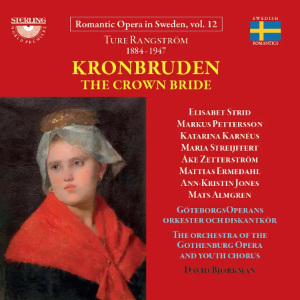
Ture Rangström (1884-1947)
Kronbruden (The Crown Bride) (1915)
Opera in four acts after August Strindberg’s drama of the same title
Mats (tenor): Markus Pettersson
Kersti (soprano): Elisabet Strid
Mother of Kersti (contralto): Maria Streijffert
Grandfather of Mats (bass): Mats Almgren
Brita, sister of Mats (mezzosoprano): Katarina Karnéus
Sheriff (baritone): Åke Zetterström
Neck (baritone): Mattias Ermedahl
Midwife (mezzosoprano): Ann-Kristin Jones
Orchestra of the Gothenburg Opera and Youth Chorus/David Björkman
rec. live concert performance, February 2017, Gothenburg Opera, Gothenburg, Sweden
Sterling CDO1136-7 [2 CDs: 137]
August Strindberg was Ture Rangström’s favorite author. Rangström wrote songs, piano music and symphonic poems inspired by the Swedish author. His first truly mature work was his Symphony No.1 from 1914, subtitled “In memoriam August Strindberg”. It is perhaps no surprise that Rangström’s next big work was an opera based on Strindberg’s play Kronbruden (The Crown Bride), although the plot he set only covers the first four acts of the six-act play. Strindberg agreed to that, provided that the composer set the four acts as written – and, with minor changes, he did exactly that.
Before we go any further, perhaps we should explain the opera’s title. The story takes place in the Dalarna region of Sweden in the latter half of the 19th century. At that time, it was customary for brides to wear a crown at their wedding as a sign of purity. Not all brides were virginal, so this could provoke embarrassment. In Kronbruden the action is precipitated by the desire of the main character, Kersti, to be a Crown Bride. The problem is that she and her lover Mats, representatives of warring families, already have a child.
I will only give a precis of the opera’s plot – it appears in two earlier MWI reviews. Suffice it to say that Mats is most concerned about reconciling the two families to their prospective marriage, while Kersti is obsessed with her desire to wear the crown if they do marry, and is willing to kill their child to do so. The Midwife takes care of that for Kersti, while the supernatural being Forskarlen warns Kersti of the consequences. When the wedding actually takes place, the crown falls from Kersti’s head into the river. While looking for the crown, the guests find the body of the child. Kersti confesses to the murder, completely stunning Mats. Kersti is now under arrest.
From this point on, there is some confusion as to the ending. Rangström’s libretto has Kersti looking untroubled for the first time in the opera. In Strindberg play’s two more acts there is a more distinct and tragic ending. Perhaps the best overall solution is that of the Swedish director Inger Åby in her 1990 TV production of the opera. There, Kersti kills herself by jumping into the mill chute, clutching the body of her dead child.
While the plot is reminiscent of various “Romeo and Juliet” operas, it is an interesting mix of Impressionism, folk music, Symbolism and the supernatural. Yet it is Rangström all through. His forcefulness and power are always present, regardless of what else is going on. As in many operas of the time, the orchestra is at least as important as the singers. That is further emphasized by Rangström’s use of short orchestral interludes between scenes, where a lot of the best music in the opera takes place. But one should not ignore the composer’s facility in writing for the voice (he composed over 250 songs and for several years made his living as a voice teacher) and his ability at creating dramatic scenes – the most notable are the wedding scene in Act 4 and the final scene of the opera.
This recording arises from two concert performances of Kronbruden at theGothenburg Operain 2017. The overall sound is a little hollow but otherwise does not interfere with enjoyment of the opera. As Kersti, Elisabet Strid is on almost continually, but she never wavers vocally and dramatically. Compared to such a character as Kersti, the role of Mats could almost melt into the background, but Markus Petterson forestalls this by making his character’s profound naiveté almost as elemental as Kersti’s willfulness.
The third major role in the opera is that of Mats’s sister Brita, Kersti’s archenemy. Katarina Karnéus is appropriately spiteful but still lets Brita have a measure of humanity, if only out of love for her brother. One must also mention Mattias Ermedahl as Forskarlen, a character who is frightening yet plaintive. The rest of the cast is sterling, if I may so describe them, and the Gothenburg Opera orchestra is up to its usual high standard. David Björkman is a frequent conductor at Gothenburg. His bond with the orchestra is plain, especially in a work with so many changes of mood as this one.
Sterling is once again to be commended for introducing non-Swedish audiences to its Romantic Opera in Sweden series. Kronbruden, perhaps the most frequently revived of Swedish operas (in Sweden), now has this fine production on disc as well. It is to be recommended not only to fans of Rangström but to anyone who likes music from the turn of the twentieth century. Hopefully, Sterling will continue the good work; perhaps we will see one of Rangström’s other two operas on disc.
William Kreindler
Previous reviews: Jim Westhead ~ Nick Barnard
Buying this recording via the link below generates revenue for MWI, which helps the site remain free
Other cast
Pastor (bass-baritone): Mats Persson
Soldier, father of Kersti (bass-baritone): Karl Peter Eriksson
Verger, grandfather of Kersti (baritone): Caspar Engdahl
Father of Mats (tenor): Ingemar Andersson
Mother of Mats (mezzosoprano): Hannah Körner
Grandmother of Mats (soprano): Åsa Thyllman
Anna, sister of Mats (soprano): Frida Engström
Lit-Karen, sister of Mats (treble): My Wegnelius Jarlstedt
Lit-Mats, brother of Mats (treble): Philip Engström
Voice of a child (soprano): Elisa Svedberg (act 2), Inez Carlsson (act 4)
Relative of Mats (tenor): Daniel Ralphsson
Relatives of Kersti (soprano, contralto, tenor): Frida Hagman, Tiina, Markkanen, Mari Lindbäck, Petter Reingardt
Male Choristers from The Chorus of The Gothenburg Opera
Tenors: Erik Enqvist, Nikolaj Giljov, Reima Killström, Olof Söderberg
Basses: Karl Johan Nordensten, Thomas Sonefors, Herbjörn Thorardson, Sven Törnell













