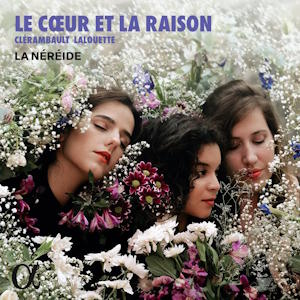
Le Coeur et la Raison
La Néréide
rec. 2024, Basilique Sainte-Marie-Madeleine, Saint-Maximin-la-Sainte-Baume, France
Texts and translations included
Reviewed as a download
Alpha Classics 1169 [76]
Every music lover knows the Ospedale della Pietà in Venice where Antonio Vivaldi was active as a music teacher. This was an institution for orphan girls and girls whose parents were too poor to care for them. Here, they received an education, of which music was an important part. There were various such institutions in Venice, and also in other countries. One of these was the Maison Royale St-Louis de Saint-Cyr – a village west of Versailles – which opened in 1686 and was designed to educate daughters of impoverished army officers and noblemen. It existed until 1793.
This institution has inspired the three ladies that constitute the ensemble La Néréide to make the recording which is the subject of this review. In the booklet Camille Allérat, Julie Roset and Ana Vieira Leite write: “[The story of] Le Coeur et la Raison (The Heart and the Mind) is the imagined life of a young girl in late 17th century France, one who is descended from a noble but penniless French family, and sent to Les Demoiselles de Saint-Cyr (…). There at the Maison Royale de Saint-Louis, under the protection of Louis XIV and Mme de Maintenon, she is very well educated, particularly in music”.
It is always nice when concert programmes or recordings aim at bringing to life historical events or institutions. Unfortunately, they often have a rather problematic relationship with the historical facts. That is no different here.
The two main works on the programme are settings of the Miserere, one of the seven penitential psalms. The composers are Louis-Nicolas Clérambault and Jean-François Lalouette respectively. Clérambault became organist and maître de musique in March 1715. In this post he succeeded Guillaume-Gabriel Nivers who had died the previous year. It is not entirely clear when he composed his Miserere; I have not found the date, and it may not be known. However, nearly all his music dates from well after 1700. If the programme wants to bring us to the late 17th century, it is very unlikely this Miserere had already been written.
In the case of Lalouette, the connection to Saint-Cyr is even more problematic. If we are to believe the biography in New Grove, he was never associated with this institution. His Miserere was performed at the Concert Spirituel in 1726, and as it was published in 1730, it could not possibly have been known in Saint-Cyr at the time on which this recording focuses.
The notes in the booklet continue thus: “Restricted all year round by the austere daily life of the school, our young lady takes part in the Mass and the hours of office, singing the works for her and her fellow-pupils Nivers and Clérambault. Yet her return to the family home for a few days a year offers her a brief period of freedom: in the worldly salons of the town, she hears the courtly airs that are most in fashion, and these melodies then become the secret witnesses of her first raptures of love”. I already mentioned the anachronism with regard to Clérambault, but here we encounter another historical inaccuracy. With reference to a book of 2007, Wikipedia mentions that “[the] students were housed at Saint-Cyr until they reached 20 and were not supposed to leave it until that age, unless in cases of dismissal, marriage or “exceptional family circumstances.”” The image of a girl’s life in Saint-Cyr that the performers want to evoke, is more a product of fantasy than based on historical facts.
That also concerns a part of the programme which consists of secular songs whose texts have been replaced by a spiritual one. “On her return to Saint-Cyr, she hums these tunes and teaches them to her friends, which meet with the disapproval of the religious authorities in charge of the school. Anxious to preserve the spiritual welfare of the girls, Father Berthod decides to rewrite the words of these popular songs, transforming vows of love into declarations of faith in God.” However, the said father (François) Berthod had no connections to Saint-Cyr: he published three books of Airs de dévotions in 1656, 1658 and 1662 – well before the foundation of the Maison Royale St-Louis de Saint-Cyr.
It is perfectly possible to perform and record music as we find it on this disc without creating a largely imaginary world. So let us turn to the music, which is quite interesting.
As mentioned, the two main works are settings of the Miserere. Clérambault’s setting has been recorded a few times before. This part of his oeuvre is little-known, as most performers focus on his important and high-quality contributions to the genre of the secular cantata. He was strongly influenced by the Italian style, and that comes to the fore in his Miserere, especially with regard to the treatment of the text and the use of harmony. The dissonances in the opening section are striking and set the tone: the three voices rub against each other – the advantage of the scoring for equal voices. There is also some variety in the scoring: most of the work is for three voices, but there are also passages for one or two voices.
In comparison, Lalouette is less adventurous with regard to harmony. The division in sections is different from that of Clérambault. I don’t have access to the score, but I have the impression that his setting includes more passages for a solo voice than Clérambault’s (but I have not counted). As far as I know this work has never been recorded before, and its inclusion here is most welcome. It is a nice work and well worth being performed; a modern performing edition would be welcome.
The performers have taken some liberties. It seems that both settings are intended for solo voices in alternation with a choir. At least in the edition of Clérambault’s setting (available on Petrucci Music Library) one can find indications of ‘choeur’. Whether these have to be interpreted as instructions or rather as suggestions is an interesting matter, but hard to decide. In the case of Lalouette I have to rely on New Grove; the work-list includes the title of the printed edition of 1730, which says “Le psalme Miserere à grand choeur et l’hymne Veni Creator à 3 voix”. Another liberty is that in Clérambault the verse ‘Docebo iniquos vias tuas’ is performed a cappella; the score has a basso continuo. I can’t figure out the reason for omitting that part.
This is the second disc of this ensemble; the first was devoted to madrigals by Luzzasco Luzzaschi (review). I was impressed by the singing of the three ladies, and overall I am happy with the way these Misereres are sung as well. They use a little more vibrato than on their previous disc, but not indiscriminately; it may well fall within what is historically tenable: vibrato as an ornament for expressive reasons. How often and when it should be applied is a matter of debate and taste. It is problematic that it sometimes is applied in ‘tutti’ passages, as then it tends to damage the ensemble. However, there is no doubt that these performances are highly expressive, and a good reflection of the intensity of the text.
The rest of the programme consists of secular songs, known in France as airs sérieux. That was a very popular genre in the second half of the 17th century and the first decades of the next. Many collections of such ‘airs’ were published; among the composers were the likes of Michel Lambert, Joseph Chabanceau de La Barre and Sébastien Le Camus – all represented here. They are mostly about love in all its aspects, very much like the madrigals and chansons of the 16th century and the cantatas of the late 17th and early 18th centuries. They could be scored for one or several voices. Most of the songs included here are for solo voice. The main exception is the one that concludes the programme, Laisse-moi soupirer, importune raison, by Michel Lambert: “Let me sigh, troublesome reason, let my tears flow freely”. I wondered about the song that opens the programme. Je ne sais pas ce que je sens by the unknown composer Du Parc (apparently no first name is known, and the liner-notes don’t give any information about the composers of the airs). The opening line – “I know not what it is I feel” – is used as a refrain, sung here by the three ladies in unison. However, at the end they follow partly their own path – is this another liberty of the performers or is it notated that way?
As mentioned, some songs are performed with new texts by the above-mentioned father François Berthod. He dedicated the first volume to the queen, and laid out his aim in the preface: “The excellent masters in this art, who have often performed their beautiful songs to the public, after having the honour to let Your Majesty hear them, have set them to a quantity of fi ne words that the most subtle minds have given them in order to compose Airs to them; But as these excellent Poets did not have religious devotion in view, giving their thoughts to worldly Love, devout Persons are prevented from singing them, and from profiting from the fine movements and lovely cadences that the Composers have given them: That has obliged me to make a conversion, changing the object of those fine words of theirs, so as to give to God what they had given to the profane.” According to a modern study of this repertoire, “Berthod’s devotional airs (…) were part of a Catholic campaign to convert female aristocrats from a life of frivolity and immorality to one of religious devotion.” They were not specifically intended for nuns, as “Church leaders believed that by singing airs de dévotion, a woman, even if married with children, would transcend worldly desire, fantasize amorous conversations with Jesus, and express her love for him “as her true husband.””
The author of the study mentions that this repertoire is “virtually ignored by scholars”. The same can be said about performers; I can’t remember ever having heard some of these adaptations. It needs to be added that probably a small part of the repertoire of airs was spiritual from the onset. This part of the repertoire – original or adapted – deserves more attention, and that makes this part of the present disc all the more interesting and important.
These airs are given excellent performances, and allow to admire the individual qualities of the three singers, among them, good diction and articulation. It is nice that they use historical pronunciation, which is still not common in this repertoire. They have been given good advice by Marc Mauillon. They are given perfect support by the three instrumentalists: Miguel Henry (lute, theorbo), Salomé Gasselin (viola da gamba) and Emmanuel Arakélian (organ). The last plays a large organ in the two Misereres, which is a meaningful bonus, and in accordance with the practice at the time.
To conclude: this is a very interesting and musically compelling survey of a part of French music from around 1700 that is partly little-known or not known at all, and overall very well performed.
Johan van Veen
www.musica-dei-donum.org
twitter.com/johanvanveen
https://bsky.app/profile/musicadeidonum.bsky.social
Buying this recording via the link below generates revenue for MWI, which helps the site remain free
Contents
Du Parc (fl c1700)
Je ne sais pas ce que je sens
Louis-Nicolas Clérambault (1676-1749)
Miserere
Jean-Baptiste Lully (1632-1687)
L’âme contente dans sa solitude
Joseph Chabanceau de La Barre (1633-1678)
Quand une âme est bien atteinte
Michel Lambert (1610-1696)
[J’aime, je suis aimée]
Jean-François Lalouette (1651-1728)
Miserere
Honoré D’Ambruis (c1660-c1702)
Lorsqu’avec une ardeur extrême
Michel Lambert
[Le pénitent dans le désert]
Sébastien Le Camus (c1610-1677)
Je m’abandonne à vous
Michel Lambert
Laisse-moi soupirer, importune raison
N.B. Titles between brackets refer to texts by François Berthod