
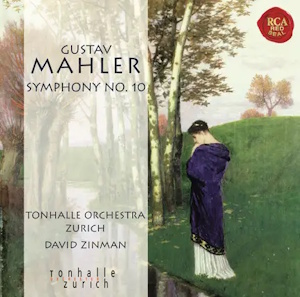
Gustav Mahler (1860-1911)
Symphony No.10 (1910-11)
(Orchestrated and completed by Clinton A. Carpenter)
Tonhalle Orchestra Zurich/David Zinman
rec. 2010, Tonhalle, Zurich, Switzerland
RCA Red Seal 88697768962 [76]
This final instalment in David Zinman’s Mahler cycle has never been reviewed on MusicWeb, but his choice of the Carpenter elaboration has inevitably drawn the same criticism as Andrew Litton’s recording. i.e. not so much for its actual execution but rather for employing a version which many critics and listeners find too lush and speculative. The gist of their objections may be summed up as “too much Carpenter and not enough Mahler”. I refer you to my review of Litton’s account for further discussion of its aptness – or lack of it – as a completion.
There is also an element of controversy regarding Zinman’s interpretative approach to the symphonies in general. While the playing of the Tonhalle is invariably praised for its conviction, commitment and finesse, some find Zinman’s cooler, more restrained manner, with its emphasis upon textural clarity, to be lacking in punch and intensity. In that regard, his affect might be compared with Michael Gielen’s, who was similarly renowned for translucence and control, but I certainly find that to be no obstacle and Gielen’s recording with the SWR is one of my favourites.
One difference lies in the sound the orchestra makes; the Tonhalle is a lighter, leaner outfit with nowhere near the dark, buzzing resonance in its cellos and basses that I prefer; the violins are decidedly thinner of timbre, too – but that lends a spectral, haunting quality to the angular main theme of the first movement with its wide, unsettling leaps. In many ways, this reminds me of Noseda’s recording – despite his playing the Cooke reconstruction – in that everything is in place but nothing much engages my interest and a lack of inspiration is apparent. To be fair, there are moments when Zinman raises the temperature such as in the build-up beginning at 14’ and I do like the contributions of the timpani – but the “primal scream” chord is very odd: loud, aggressive and abrupt, with scarcely a hint of menace, more like a petulant toddler shouting for attention than a wail of despair rising from the depths of the soul. Having said that, the conclusion to the movement is very delicate and haunting.
Perhaps in some ways Zinman’s restraint mitigates the fussiness of Carpenter’s over-orchestrated elaborations, as I find myself noticing them somewhat less than I do when listening to Litton’s recording. The first scherzo trips along a little too politely, however, and again the percussion often take centre-stage. For some reason, I find my attention wandering here. The Purgatorio, too, is something of a non-event, being very clipped and perky before suddenly turning all “Sound of Music” exactly half way through. That is partly owing to Carpenter’s sudden layering on of orchestral textures but it is also due to an inconsistency in the conducting. The opening to the second scherzo is likewise low-key and perfunctory – almost half-hearted compared with more searing, violent deliveries; yet again, its impact is further compromised by the fussy arrangement where too much is going on and the stark violence of Mahler’s intent is tempered. For instance, the climax at 8:28, so stark and striking in other arrangements, sounds like a circus act flourish with its silly cymbals – a banal, anticlimactic effect too often repeated towards the end of the movement.
As if to thumb its nose at my mean criticisms, the drum-strokes linking the fourth and fifth movements are perfect: dull, deadly and distant, just as I think they should sound. That isn’t going to rescue the whole recording but in fact there is much more warmth and emotion in the finale than in the preceding movements but the vulgarity of the overbearing percussion at key moments tends to undermine the requisite intensity. The playing over the last ten minutes is excellent but more drum rolls and thick brass chords positively scupper any sense of numinosity – the drum thwack and roll accompanying the final leap of the strings is absurdly kitsch.
All in all, I find this to be an erratic, rather frustrating account – which may be as much a reflection upon the performing version chosen as its execution, but I don’t think Zinman’s coolness helps.
Ralph Moore
Buying this recording via the link below generates revenue for MWI, which helps the site remain free














Dear Ralph Moore, great, enlightening series of reviews on Mahler’s Symphony No.10! I have many of these recordings and share your opinions largely. In particular I admire the Wyn Morris recording, also Ormandy and both of the Rattle recordings.
Warm regards, Julian Azar from Germany
Many thanks, Julian; I am glad you found my survey useful and of interest,
This has been a very illuminating survey of the Mahler 10 recordings, a piece which has always fasciated me. I remember back in about 1980, Simon Rattle filmed a documentary about the 10th for, I think BBC2 followed by a complete performance of the symphony. It has stuck with me ever since. If there are any Mahlerians out there who doubt the piece and Dave Hurwitz is one of them, please give it a try in one of the Cooke version recordings, Rattle and Chailly being my choices. For any serious music collectors, the Mahler 10 must be heard as it ends in a radiant, overwhelming climax unlike anything else in music. Thank you Ralph for the work you have put into these fascinating reviews.
Thank you, Colin; the reason why I embarked on that survey was that the piece somehow engaged me more profoundly than I had expected and I just kept exploring the options. I do not find Mr Hurwitz to be a very reliable authority on much, to be honest…