
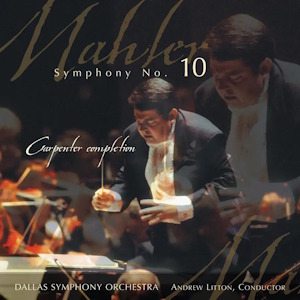
Gustav Mahler (1860-1911)
Symphony No.10 (1910-11, orchestrated and completed by Clinton A. Carpenter)
Dallas Symphony Orchestra/Andrew Litton
rec. 2001, McDermott Hall, Dallas, USA
Delos DE3295 [79]
The normally temperate Tony Duggan was really quite forceful when in his 2003 review he opined of this recording, “Carpenter’s is not an edition of the Tenth Symphony I could ever live with or feel I could recommend to anyone else to live with either.” Obviously such a verdict is intriguing; it had been long since I had listened to this completion and having already covered so many issues of various realisations of the Tenth, I could not resist revisiting it to test TD’s verdict after so many years. The basis of his objection lay in the degree to which Carpenter intervened and invented: “To put it bluntly, for me there is far too much Carpenter in here.”
The comparative virulence of TD’s objections prompted me to initiate some debate on our Message Board in 2024 by posting this: ‘I was surprised to read…how much the late, respected Mahler guru Tony Duggan disliked this recording, in that while I concede that the scoring is very lush and perhaps a degree over-elaborated, I thoroughly enjoy it and am happy to hear it as a supplement or alternative to the more widely played, recorded and celebrated Deryck Cooke version. I certainly do not share his view that “Litton’s conducting of Carpenter’s scoring comes over as saccharine and sickly” or that the arrangement “distorts Mahler’s voice”. To be fair TD finishes by declaring “But these are the opinions of just one person, one Mahlerite with some experience. I hope that another review of this recording can appear here on Music Web to give another opinion.” I would be interested to know if others share his aversion or enjoy it as I do.’
Among the responses, was this from Marc Bridle: “I think when Tony says that that the Carpenter distorts Mahler’s voice he is probably right. Carpenter – like Samale/Mazzuca – over orchestrates, but he also uses music from the early symphonies which other arrangers have not. The Carpenter not only distorts Mahler’s voice; it distorts the 10th.”
All of which set me up for reacquaintance with what is evidently a controversial recording. This was the last version I listened to after reviewing a dozen, so I, too, was as saturated as Carpenter’s score. I understand the objection that Carpenter over-elaborated music written precisely when Mahler was embracing a starker, sparer, more “modern” style; the sound-world he replicates harks back to the Resurrection and Third symphonies rather than alluding to the pared-down idiom of Das Lied von der Erde. Nonetheless, if you can come to terms with its retrospective and essentially anachronistic approach, there are things to enjoy in a sort of guilty pleasure way. There are however, many oddities: what on earth is the drum roll beginning at 6:57 doing there, rumbling away under the Big Tune which needs no such underlining? Why all that doubling, those curlicues, filigrees and counter-melodies when the music is already embryonically perfect and in no need of such slathering? (What was Szell’s bon mot? “I cannot pour chocolate sauce over asparagus” – but Carpenter did.) The downward-sweeping shriek on the strings at 13:58 is pure Mantovani. I readily admit that especially having just previously listened to the starkest arrangement of them all by Wheeler, coming to this was like entering a sauna after an ice bath – the wrong way round – and having now been thus conditioned and better educated, I enjoyed it far less this time around than when last I encountered it. Even the great dissonance of the Adagio sounds coagulated instead of bleakly terrifying.
At the start of the first scherzo, I am immediately irritated by the chattering oboe, twittering flute, plinking xylophone and overbearing percussion; it’s all too much too soon, when Mahler’s music can bear the burden without all that unnecessary frippery. The constant twiddling is merely distracting and often sounds like a bad parody of the nature music in the First Symphony. There is more of the same in the Purgatorio – lots of flute noodling and excessive crash-bang-wallop. I suppose the second scherzo, being the most deliberately chaotic movement, can take the merry-go-round-the-orchestra approach, complete with harp arpeggios, but it’s still a bit of a mess.
Hallelujah! The bass drum strokes opening the fifth movement are the best on any of the dozen recordings I know: just the right sound: dull, distant, ominous, much the same as the drum beats when in The Lord of the Rings: The Fellowship of the Ring Pippin accidently pushes the suit of armour into the well and alerts the orcs and the Balrog to the presence of the fellowship in Khazad-dûm. This is the movement that can best withstand the Carpenter treatment but again, the directness of the emotional odyssey is compromised by the constant, hyperactive re-jigging of orchestrational colour. The percussive explosion accompanying the piercing trumpet call at 10:45 at the reprise of the “doom chord” is actually faintly ridiculous. The last five minutes of soaring strings are really rather good, as there is somewhat less gilding of the lily – or what there is, is more tasteful – except Carpenter could not resist reinforcing the final upward leap of the strings with yet another drum roll.
In short, reacquaintance with this recording after so much listening has obliged me to modify – if not completely withdraw – my approbation and has converted me almost wholly to TD’s opinions, in that I now feel that I know better and cannot accept that Mahler would ever have contemplated or sanctioned such indignities as Carpenter inflicted on the draft score – except that I do find it … perversely interesting? Yes. Satisfactory as a performing version? Hardly, when there are so many better alternatives. If you are curious, listen to it on YouTube.
Ralph Moore
Other reviews: Terry Barfoot Tony Duggan
Buying this recording via the link below generates revenue for MWI, which helps the site remain free














