
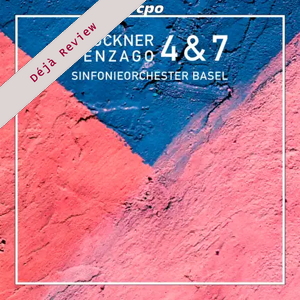
Déjà Review: this review was first published in November 2011 and the recording is still available.
Anton Bruckner (1824-1896)
Symphony No.4 in E flat (last version of 1879/1880)
Symphony No.7 in E (1881-1883)
Sinfonieorchester Basel / Mario Venzago
rec. 2010, Casino Basel, Musiksaal, Basel, Switzerland
cpo 777 615-2 [2 CDs: 126]
In 1993 the Swiss conductor Mario Venzago gave a performance of Bruckner’s 3rd Symphony with the now-defunct Milan RAI SO that impressed me mightily for its intuitive grandeur. He found the secret of letting the music breathe. So it is splendid news that he is now setting down a complete Bruckner symphony cycle.
The records come with lengthy notes explaining that this will be a Bruckner cycle like no other. I tend to be suspicious of performances that arrive with a 5-page manifesto attached. If people can’t hear what the conductor is driving at just by listening, it’s useless trying to brow-beat them into believing they’ve heard something they haven’t. In the present case, however, the performances are so awesomely magnificent that I did find it of some interest – afterwards – to read about his intentions. Somewhat puzzlingly, I seem to have been impressed and moved at times for reasons other than those for which I am apparently supposed to have been impressed and moved. On the whole I wish Venzago had just stuck to conducting.
Venzago’s Bruckner is surely here to stay. We will have time to analyze it in detail at leisure. So let me just list a few of the things that strike me.
Texture: Venzago’s curriculum reveals that he has spent a good deal of time unravelling contemporary works of the post-Nono variety. Maybe it is thanks to this that his textures have unfailing luminosity and clarity. Every instrument has its individual colour and voice and they all mingle without congealing into a generalized mass. Credit also belongs to the sound engineers – the producer is named as Andreas Werner – who have ensured that this all reaches us as it should.
Articulation, phrasing and attack: Great care is taken to give the dance-based sections their proper lilt. Particularly revelatory is Venzago’s pacing of the secondary material in the finale of Symphony no. 4. The phrasing suggests the influence of modern Historically Informed Practice. The first note of the theme that opens the Seventh Symphony, for example, is given a long expressive bulge, and then separated from the rising arpeggio that follows. This may sound dogmatic on paper and in some hands probably would be so. If it is not so here, I think this is due to Venzago’s colouring, pacing, and above all attack. Each Brucknerian period arises from silence and falls into silence. This means that the way a new period is attacked is fundamental. It is evident that Venzago has given a lot of thought to this. A new idea may slide in hesitantly, as at the beginning of the Fourth Symphony’s slow movement. Or listen to the depth of timbre as the drone bass in the trio of the same work’s third movement is sunk into. The sound is not directly attacked but taken by stealth and then allowed to swell out, like a human voice. The strongest sforzatos are never banged out with a straight, hard-hitting attack. Starting from a rounded attack, the sound is allowed to well out of the orchestra.
Tempi and tempo relationships: In the past conductors tended to be rhapsodic with Bruckner, speeding up in crescendos and slowing down in diminuendos. This was superseded by the “structural” approach which meant, at its most reductive, sticking blindly to whatever tempo you set at the beginning of the movement. If whole sections sound wrong at this tempo, this passes for “integrity”. It is certainly an easier approach to manage. A metronome could do it as well as a human conductor, perhaps better. Venzago analyzes the best tempo for each Brucknerian period, so that it is duly solemn, lilting, dancing, trudging or whatever. He does not make hysterical accelerandos within these periods. The single periods within a long movement may not always go at exactly the same tempo, however. The art of bringing this off lies in timing the pauses between sections and, again, using the right attack for the new section so that it convinces as logically following on from the previous one.
Silence, space and mountain heights: This is less easy to analyze and may be only my personal reaction. These performances all seem to take place at an altitude where the air is clearer, the vistas longer. In the end it is the music’s silences that prevail. The art of creating this impression presumably lies in a combination of the technical features I’ve tried to describe above. Though I suppose another conductor might mix the same features in such a way as to create a quite different effect.
Many years ago a critic in Gramophone – who I shall not name, though I suppose the review could be hunted down on their site if you really wanted to – discussed a set of Bruckner’s Fifth and Sixth Symphonies played by a provincial German orchestra under a little-known German conductor. The critic had tart words (I’m quoting from memory but this was the gist) about ill-equipped bands setting forth in the Brucknerian ocean with their flimsy little rafts. He noted that the organ sonorities of the Fifth brought a degree of unanimity missing from the more complex rhythms of the Sixth. And, in a final lash of the pen, he commented that the notes were dedicated, not to the music, but to the “self-effacing genius of Günther Wand”. A few years later the Wand-wagon was in full swing, the critic in question one of its most august occupants.
I mention this as a prelude to sticking my neck out equally. At the risk of making a fool of myself in the opposite sense, I suggest Venzago’s Bruckner may be for the 2020s as iconic as Wand’s was for the 1990s.
Christopher Howell
Buying this recording via the link below generates revenue for MWI, which helps the site remain free














Iconic? I do not agree.
Iconoclastic, in a negative sense – yes.
My eyebrows went up when I reread that old review. As far as this first issue of the cycle is concerned, I believed what I wrote and stand by it. Something went wrong, however. Subsequent volumes became increasingly off the mark and Venzago’s Bruckner certainly hasn’t achieved the status I foresaw for it back then. This does not affect the fact that this first instalment was (I believe) very fine. Please note that I did not write a one-word review (“iconic”) and maybe a refutation of it deserves more than one word too (“iconoclastic”). May we know what it is you so dislike about these two performances in particular? Tempi? Phrasing? Textures?
A third view:
Contemporary reviews are often rewarding precisely because they invite us to re-hear recordings without the “benefit” (i.e., distortion) of hindsight.
Many people, I know, inherently object to playing Bruckner as if he were Schubert. I used to feel that way myself. In the old days, Schuricht played Bruckner as Schubert (a 1950s concept of Schubert, not Venzago’s 2020s concept). For a long time I couldn’t make head or tail of it, but eventually I learned to enjoy it and value the very fact that it’s different. (Conversely, Knappertsbusch played Schubert as if he were Bruckner. I enjoy and value that too.)
The trouble I’ve felt with most of Venzago’s Bruckner is–not that it’s played like Schubert, but that it’s imposed on the music from the outside, without any impression of inwardness. If you listen to the start of Venzago’s Bruckner 8, and then listen to the start of Schuricht’s–oh, what a difference! The approach may be equally iconoclastic, equally “crazy”, but there’s so much more heart, so much more soul in every bar!
But then if I listen to the start of Venzago’s Bruckner 7… I don’t have the same problem. Here, surely, IS “inwardness” (though not Knappertsbusch’s kind). If he could do it here, why couldn’t he do it at the start of 8? I don’t understand.
So, on the whole, yes, I side with this review.
And one other thought keeps niggling in the back of my mind. For many years I couldn’t appreciate Schuricht’s Bruckner, couldn’t even make sense of it. What if I eventually feel the same about Venzago?? I don’t think it’s very likely, but it’s conceivable. And for that reason, I’ve never discarded my Venzagos, and I do return to them from time to time… without great hopes, however.
But I hope some other conductor will make a full-scale attempt at a Schubertian Bruckner set.
I’m not sure if Schuricht’s Schubertian Bruckner was iconoclastic or simply a late representative of a tradition of swift-flowing non-metaphysical Bruckner that was normal in his youth. Since Bruckner was not much recorded before the 1960s, it is hard to get any clear idea of this, though a complete cycle under Volkmar Andreae exists if you can find it and, in slightly more recent memory there are a few performances around from Carl Melles, whose timing for the entire 6th symphony is virtually identical to Celibidache’s for just the first two movements. I touched on this a few years ago – https://www.musicweb-international.com/classrev/2018/Jan/Bruckner_sy6_article_CH.pdf – as well as in my review of EMI’s Schuricht box – https://www.musicweb-international.com/classrev/2013/Mar13/Schuricht_6233792.htm – though there would be room for further investigation.
Interesting as it may be to examine past methods of Bruckner interpretation, it is also interesting to note that Bruckner was “discovered” as a great composer, as opposed to a minor contemporary of Brahms and heir of Schubert with a certain following in his native Austria, only when conductors slowed him down to reveal a metaphysical element that had gone unnoticed before, and which late 20th century audiences evidently needed, though the handful of Schuricht recordings does show that the old approach had its own validity.
To corroborate your observations of how Bruckner was performed and recorded in the 1960s, Chris, before the “metaphysical” approach prevailed, I would point to this set reviewed by Nick Barnard: https://www.musicweb-international.com/classrev/2014/Jul14/Bruckner_sys_94686.htm in which Rögner and co. never hang about.
Thank you so much for these comments. These are fascinating matters… may I pursue them a little further? It seems to me that we have three quite distinct issues here:
1. Tempo: I suspect that “fast” and “slow” Bruckner performances have coexisted ever since the dawn of recording. Certainly “slow” performances flourished–perhaps even predominated, on record–at least as far back as the early 1940s. If we feel that “slow” performances came later, that may be because the postwar campaign to persuade the world of Bruckner’s greatness focussed exclusively on the “slow” side of the continuum. The LP boxes that presented Bruckner in the same format as Mozart, Beethoven, Brahms, etc., were of Jochum, Haitink, Karajan, Furtwängler, etc., rather than the likes of Andreae. Robert Simpson, who probably had more influence on this subject in the English-speaking world than anyone else, also strongly supported “slow” Bruckner (and imitated it in his own symphonies).
2. To me personally, “metaphysicality” seems something quite different: my ears hear the fast 1953 Andreae (e.g.) as decidedly more “metaphysical” than the slow 1960s+ Haitink. (I concede, however, that I probably wouldn’t recognize metaphysics if they bit me.)
3. But what perplexed me about Schuricht was neither speed nor non-metaphysicality but something else, which I’d approximately term style. Andreae, for instance, never puzzled me, and returning to the start of 8, which I cited above, I can hear why. In Andreae, the opening woodwind figures sound hushed, awed, and when the orchestral fortissimos begin, they have the stability and solidity of a great cathedral organ. Nothing there to startle me. But in Schuricht, the woodwind figures are bright and songful, and the fortissimos sound dramatic rather than stable–perhaps even the tiniest bit like film music (no, that’s going much too far). I felt a bit as if Beethoven’s Ninth was being played like Pop Goes the Weasel. I couldn’t understand what the conductor was thinking–or even whether he had any thought in his head at all.
4. When I borrowed the word “iconoclastic” above, I wasn’t measuring Schuricht against his predecessors. I used the word in parallel with “crazy”, and you can’t possibly have understood me to be measuring his sanity against his predecessors’! No, I was simply describing my own reaction, and using highly coloured words to mock at my own bewilderment.
5. It’s ironic, too, that a request for Vendango’s Bruckner 4 & 7 to be heard in isolation, purely on its own merits (if any), should have triggered a survey of the whole history of Bruckner performance. Still, I find the subject so fascinating that, as you can see, I haven’t been able to resist it!