
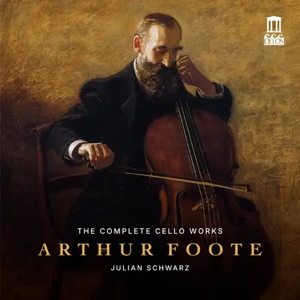
Arthur Foote (1853-1937)
The Complete Cello Works
Three Pieces, op. 1 (1881)
Aubade, op. 77 (1912)
Scherzo, op. 22 (1890)
Cello Sonata in E minor, op. 78 (1912-18)
Cello Concerto in G minor, op. 33 (1887-93)
Julian Schwarz (cello)
Marika Bournaki (piano)
Buffalo Philharmonic Orchestra/Gerard Schwarz
rec. 2024, Goodson Chapel Recital Hall, Shenandoah Conservatory, USA (chamber works); live, 23/24 March 2024, Kleinhans Music Hall, Buffalo, USA (concerto)
First recording: Concerto
Reviewed as lossless download
Delos DE3619 [70]
Arthur Foote was a member of the “Boston Six”, along with George Whitefield Chadwick, Amy Beach, Edward MacDowell, John Knowles Paine, and Horatio Parker. Foote is regarded as the first American composer of lasting significance to have received his musical education in his native country. Nevertheless, his music is clearly influenced by 19th century European styles, and is dominated by chamber music. His cello music was rescued in the 1970s by Douglas Moore, who edited the original manuscripts of the four pieces for cello and piano, and recorded them for the Musical Heritage Society. To the best of my knowledge, they haven’t been reissued. He also performed the Cello Concerto in 1981, not heard since its premiere season.
The big selling point for this new release is the first commercial recording of the Cello Concerto; I presume this means that an unreleased recording of Moore’s 1981 version exists. It was first performed in 1894, though Foote had spent the previous six years writing it. Those with a very keen knowledge of cello concertos will know that 1894 was the year that Victor Herbert’s E minor concerto was first performed. It was Herbert’s concerto that inspired Dvořák to write his, performed the following year. It’s therefore not surprising that Foote’s got rather lost in the dust. In the booklet notes Julian Schwarz states that “one can clearly hear the four-note motive of Dvořák’s own Cello Concerto in the opening measures”, and there is definitely some similarity. I don’t know whether this means to imply that either Foote or Dvořák borrowed from the other, but the chronology of the two works would suggest that it is just a coincidence. Foote’s concerto was premiered at the end of November 1894 in Chicago, after Dvořák began writing his, and the Bohemian’s only visit to Chicago was the year before. Yes, it is possible that Dvořák saw a score of Foote’s midway through writing his, but it does seem to stretch the bounds of plausibility that one of the most prominent composers on the planet would then borrow from a relatively minor one and expect no one to comment when his was performed just a few months later.
Even allowing for the popularity of the Dvořák, quite why Foote’s should have been so completely ignored becomes a mystery on listening, as it is a fine work in the best tradition of late 19th century Germanic Romanticism. The first movement is charged with drama and passion, though possibly a little too episodic to be totally successful. The elegiac Andante con moto is the highlight, and its seven minutes are over too quickly. The final movement is intended as a showpiece for the soloist’s virtuosity, and as a consequence, is less interesting musically, but nonetheless exciting. It must have been a thrill for Schwarz pére et fils to have performed this together in Buffalo, and all concerned present Foote’s forgotten creation in the best possible light.
The four works for cello and piano are placed first on the recording, which is sensible programming, as they are certainly smaller fry than the concerto. That isn’t to say that they aren’t enjoyable and satisfying in their own right. As far as I can tell, none has more than a couple of other recordings, and not that easy to source, so their inclusion is almost as valuable as that of the concerto. The Brahmsian Cello Sonata, which despite Foote living for two more decades seems to be one of his last compositions, is the most impressive. At over twenty minutes, it is a substantial creation, with many of the characteristics of the concerto. Of the others, which are essentially independent miniatures, the Scherzo is the standout, with its infectious rhythms and lovely central Trio section.
I had not heard Julian Schwarz before this, and I have been very impressed by his playing; the sound of his Gagliano is glorious (no surprise). Canadian pianist Marika Bournaki is another name new to me, and equally worthy of high praise. The sound quality is very good in both the studio chamber work recordings, and the live performance of the concerto – the audience was essentially silent. The booklet notes, contributed by Schwarz, are very informative.
This is a very valuable and musically satisfying release, obviously headlined by the Concerto, but the chamber works are far more than just fillers.
David Barker
Buying this recording via the link below generates revenue for MWI, which helps the site remain free













