
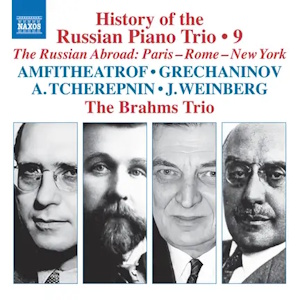
History of the Russian Piano Trio 9
Alexander Grechaninov (1864-1956)
Piano Trio No. 2 in G major, Op. 128 (1930/31)
Alexander Tcherepnin (1899-1977)
Piano Trio, Op. 34 (1925)
Daniele Amfitheatrof (1901-1983)
Piano Trio ‘A May’ (1932)
Jacob Weinberg (1879-1956)
Piano Trio on Hebrew Themes, Op. 28 (publ. 1943)
The Brahms Trio
rec. 2024, Large Hall of the Moscow Conservatory, Russia
First recordings: Amfitheatrof, Weinberg
Reviewed as lossless download
Naxos 8.574690 [76]
The album’s subtitle “The Russian Abroad: Paris – Rome – New York” carries on from the Berlin theme of Volume 8 (review). As I noted with that volume, the subtitle on the front of the booklet is not matched with that on the back. Again the back cover shows “The Silver Age and Art Nouveau”, which in this case is even less accurate, as four works were written between the two wars, long after the two named ages were over.
Pedantry over, this series has gone into some fairly obscure places in recent volumes, with two first recordings here including, as far as I can tell, the first recording of a concert hall piece by the prolific film composer Daniele Amfitheatrof. MWI published a biography of Amfitheatrof back in 2001, so please look there if you’d like a comprehensive account of his life. The Grechaninov and Tcherepnin trios are hardly mainstream either with just three and two other recordings, respectively.
Alexander Grechaninov was one of the last Romantic Russian composers, though you wouldn’t know it from this late work, written in Paris. Unfortunately, one skill his teacher, Sergei Taneyev, couldn’t pass on to him was the gift of melody, because (in my humble opinion), Taneyev knew little about it himself. Thus this trio, across its twenty minute span, has nothing that I would describe as vaguely memorable as a melody. There is a lot of heavy-handed writing and playing that totally failed to engage me. I reviewed an earlier volume in this Naxos series, featuring the Arensky trios, and was underwhelmed by The Brahms Trio. More recently, their playing on Volume 8 impressed me more, but this is back to “the bad old days”. I have two other recordings of this in my collection (I have to wonder why): the Bekova Sisters (Chandos) and The Moscow Rachmaninov Trio (Hyperion). Each of them is a couple of minutes faster than The Brahms Trio, and make listening to the piece slightly less of a trial.
The remaining three composers were blank canvases for me; I’d not heard a single note of any of them, I’d never even heard of Amfitheatrof. Tcherepnin’s musical language shows some influences of Prokofiev and Stravinsky in its astringency, and might normally be something I would not listen to. However, it has two advantages here: firstly, it’s only eight minutes long, and secondly, it comes after the Grechaninov. It doesn’t take itself too seriously, so neither should the listener. I found myself quite enjoying it.
The booklet notes don’t explain what the subtitle ‘A May’ of Amfitheatrof’s Trio means. It is certainly far more Romantic than Grechaninov’s, but does feature more pounding piano – the piano tuner must have been on speed dial – even in the otherwise quite attractive slow movement. The overheated first movement is described in the booklet as reminiscent of Puccini and Mascagni, not an association that occurred to me. I thought the third movement showed promise because the piano wasn’t being pounded into submission initially but after about three minutes of the nine, the hammering began. As one might expect from a filmscore composer, there were some rich melodies, but overall, the work lacked subtlety.
Reading the biographical information on Jacob Weinberg – not a relation of the better known Mieczysław – made me groan inwardly: he was another Taneyev student! In the best traditions of his teacher, whose own Trio, at well over forty minutes, is one of the longest in the repertoire, Weinberg’s is the most substantial on this album, though mercifully only twenty-four minutes. It is also probably the best, though the brevity of Tcherepnin’s does have its appeal. It is quite light-hearted, with a Scherzo featuring a perpetuum mobile for the violin, and melodies from Bizet (tick) and Schubert (no, missed these) mixed in with Hebrew themes. The final movement, comprising variations on an Ashkenazi lullaby, just about manages to sustain interest across its eleven minute span, but again we get the hammered piano and some very screechy violin.
As you will have gathered, I wasn’t impressed by much of the music, nor by the performances, especially the consistently heavy-handed piano. Perhaps this is a flaw in the recording, having the instrument too closely miked or too prominent in the balance. Either way, it was very tiring and very unappealing. The booklet notes, which are very informative and contributed by pianist Natalia Rubenstein, identify lots of influences, which would have been clear to her when performing the works, but many passed me by; I fear that there may have been a lack of focus at times on my part.
Can I say this was a disappointment when it was reaching so far into obscurity? Naxos and The Brahms Trio are to be congratulated for bringing the Amfitheatrof and Weinberg to the catalogue, but I feel that the curiosity value far exceeds the musical quality.
David Barker
Buying this recording via the link below generates revenue for MWI, which helps the site remain free














Not for the Taneyev-dislikers, I gather!
This is a thoughtful & entertaining review, but I thought there was something slightly more to be said for the last 2 works. I was unsurprised to learn that Amfitheatrof (great name, by the way) was a film composer, even though I’d never heard of him before — there’s just something golden-age Hollywood about it. Weinberg, too, makes dramatic use of all those fun modes you get in Hebrew music.
Yes, in all 4 works the left hand of the piano sort of pounds a bit, but these trios are particularly good for wallowing, and that’s the effect you get. I think many listeners associate Russian composers with a love of deep bass sounds anyway.