
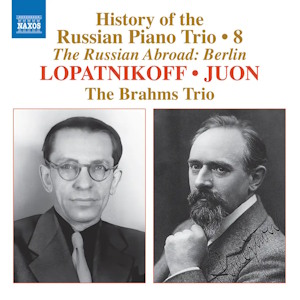
Nikolai Lopatnikoff (1903-1976)
Piano Trio in A minor, op. 23 (1932)
Paul Juon (1872-1940)
Suite in C major, op. 89 (1932)
Piano Trio in A minor, op. 17 (1901)
The Brahms Trio
rec. 2021/22, Large Hall of the Moscow Conservatory
Reviewed as lossless download
History of the Russian Piano Trio Volume 8
Naxos 8.574689 [72]
The secondary title of this release on the front cover of the booklet is The Russian Abroad: Berlin, which is appropriate as all three works on this recording were written by composers born in Russia, and living at the time in Berlin. If, however, you look at the back cover, there is no mention of Berlin, but rather The Silver Age and Art Nouveau Era, which is a rather tenuous choice. Yes, Juon’s Trio was written in the Art Nouveau period, generally accepted to be from the 1880s to the start of the first World War, but the other two works certainly weren’t (Art Deco really). I had to do some searching to determine what defined the “Silver Age” in music: it was a period in Russian music from the late 19th century until just after the end of World War I. Again it is only the Juon Trio that fits into this era, leaving one to wonder why someone thought this subtitle was suitable (more about that below).
Nikolai Lopatnikoff fled revolutionary Russia with his family in 1917, and spent a decade or so in Berlin during the 1930s, when his Trio was composed. However, the majority of his career in music was in the USA. The booklet notes mention that the main theme in the Trio’s first movement references Taneyev’s Piano Trio. It’s a long while since I listened to it, and on revisiting, I could pick some resemblance, but what I did hear, very strongly and repeatedly, was a fragment of one of the main melodies from Rimsky-Korsakov’s Scheherazade. Is it actually important? Probably not. Lopatnikoff’s Trio is enjoyable in its own right, and absolutely nothing like Scheherazade or Taneyev’s Trio. It is unquestionably of its era, but not radical in its harmonies, levels of dissonance or rhythms. It borrows from a number of styles including jazz, whilst retaining a sense of Russian tradition. One never knows what is coming next. The slow movement is quite lovely, and will undoubtedly remind listeners of Ravels’ great trio. The final movement immediately brought Shostakovich’s great yet-to-be-written trio to mind. This is its first recording, and it is a quite a discovery.
Paul Juon spent more than thirty years in Berlin, studying, composing and teaching music. His Suite was written in the same year as the Lopatnikoff trio, but is a world away. Indeed, if you didn’t know of his Russian origins – his name does seems French – and hadn’t seen the cover of this album, you might assume that he was a follower of Debussy and Ravel, because there is very much an impressionistic feel to this work. I hadn’t heard the work before – this is only its third recording – and, as with the Lopatnikoff, have been delighted to make its acquaintance. None of the movements last more than four minutes, and the different styles and emotions are very entertaining. The two slow movements are quite gorgeous, and the three fast movements, dances of one form or another, range from graceful to Rite of Spring chaos.
Placing Juon’s Trio, written three decades before the Suite, at the end of the programme isn’t ideal. It is late-Romantic in style, angst-ridden in places, meandering in others, and all three movements are definitely over-extended. There are some enjoyable moments, but it does put somewhat of a dampener on what has come before.
I reviewed Volume 4 in this series (Arensky and Taneyev) back in 2017, and was ambivalent about The Brahms Trio, finding their Arensky readings to be lacking. My colleagues who have reviewed Volume 7 and Volume 10 were more impressed, and here I can share their opinions. The booklet notes are informative, but I feel their credibility is rather diminished by describing the Juon Suite, written in 1932, as “a masterful picture of the musical world of the Art Nouveau era”.
This has been an enjoyable voyage of discovery, with the Lopatnikoff and Juon Suite outstanding, and the latter’s Trio interesting in showing the advance made by him across his career. Those interested in the piano trio of the 20th century, and those who have been collecting this series, should certainly investigate this release.
David Barker
Buying this recording via the link below generates revenue for MWI, which helps the site remain free













