
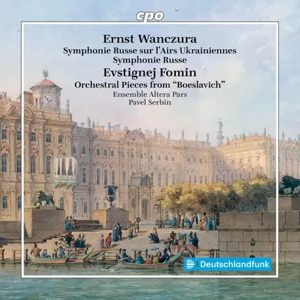
Evstignej Fomin (1761-1800)
Instrumental and Dance Music from the opera Novgorodskij bogatyr’ Boeslavich (1786)
Ernst Wanczura (1746-1802)
Symphonie Ukrainienne in C major, Wz. III/9.2 (1790 version)
Symphonie Russe in D major, Wz. III/10/2 (1785 version)
Ensemble Altera Pars / Pavel Serbin
rec. 2025, Deutschlandfunk Kammermusiksaal, Cologne, Germany
cpo 555 741-2 [69]
Yet more unknown music from the cpo label, this time from the “terra incognita… in the music of Russia in the second half of the 18th century”. Fomin and Wanczura could be anyone’s local law firm, but in fact they did indeed know each other well as composers and are recognised as contributing to a Ccentral European / Russian national musical style. Both have written quite prolifically, and both included operas composed to librettos by Catherine the Great.
A native of St Petersburg, Evstignej Fomin studied music in Italy and, returning to Russia in 1785, taught at the St Petersburg theatrical school and composed around 30 operas. Novogorodskiy bogatïr’ Boyeslavich (Boyeslavich, Champion of Novgorod) to a libretto by Catherine II was performed in 1786 but was subsequently never revived. The plot of the opera revolves around a young prince who has to achieve success either through wit and wisdom or incredible feats of one kind or another. What we have here is a selection from around 20 ballet numbers and entr’actes following an opening Sinfonia, all restored from surviving instrumental parts. These are all very fine pieces designed to be integral to the drama, or to characterise each change of scene as clarified though stage directions in the libretto. Everything is lively and richly entertaining. There is liberal use of named folk songs and a wide variety of orchestral colours and effects.
The programme of this recording uses Fomin’s stage music as an opening and intermezzo between two symphonies by Ernst Wanczura. He is described in Pavel Serbin’s booklet notes as an “eccentric Bohemian keyboard genius”, who after retiring from his youthful career the Austrian army was apparently forced out of Austria and into St Petersburg “due to conflicts he got into, [and] thanks to his satirical jokes”. Aside from composing operas and ballets, Wanczura printed six orchestral symphonies Op. 1 and Op. 2 at his own expense, and both of the symphonies recorded here are based on contemporary keyboard reductions and orchestral parts unearthed from dusty archives. Aside from this unconventional and seemingly unprecedented publishing history, both of these symphonies are “a special kind of potpourri, in which original songs are used as sonata theme or rondo refrains”. This accounts for the nicknames applied to each work, but without the need for intense research or knowledge of such materials it is nice to know where the lyrical charm for each movement comes from. These are symphonies comparable with those of Haydn in some ways, while taking their own route into existence as entertainments designed to delight listeners who would no doubt have recognised the songs woven into each piece.
As contemporaries and compatriots, the works of these composers contrast and complement each other. Fomin’s stage pieces work very well as concert music and Wanczura’s symphonies project their own kind of pastoral theatricality. Very well recorded, the characterful playing of Ensemble Altera Pars has a refined period-instrument quality which presents these composers in the best possible light and making this disc something of an off-the-beaten-track treasure.
Dominy Clements
Buying this recording via the link below generates revenue for MWI, which helps the site remain free














Just a minor correction: ‘Wanczura’ (Vančura is correct, a common enough Czech/Bohemian surname) does have a Wikipedia page, albeit in Ukrainian{
https://uk.wikipedia.org/wiki/%D0%95%D1%80%D0%BD%D0%B5%D1%81%D1%82_%D0%92%D0%B0%D0%BD%D0%B6%D1%83%D1%80%D0%B0
It is quite detailed (more so than the Russian version, which is the only alternative), and translating is straightforward these days, and reasonably accurate.
Not sure where CPO got the grammatical monstrosity “sur l’Airs Ukrainiennes” from.
Apparently “Wanczura” is an older German/Polish-style spelling of the Czech surname but as you say, there is certainly no excuse for the mangled French of the title of the piece which the composer published in 1790 as the correct “Sinfonie russe, composée d’airs ukrainiens”.