
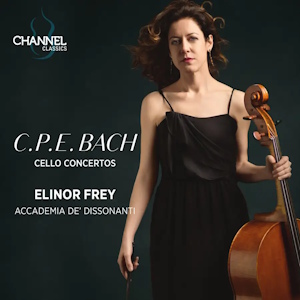
Carl Philipp Emanuel Bach (1714-1788)
Cello Concerto No. 1 in A minor, Wq. 170 (H432) (1750)
Cello Concerto No. 2 in B flat major, Wq. 171 (H436) (1751)
Cello Concerto No. 3 in A major, Wq. 172 (H439) (1753)
Accademia de’ Dissonanti/Elinor Frey (cello)
rec. 2025, Isabel Bader Theatre, Kingston, Canada
Channel Classics CCS50426 [67]
I think I first came across Canadian-American cellist Elinor Frey with her Berlin Sonatas album on the Passacaille label (review). This was way back in 2015 and she has of course made many recordings since. The Berlin connection has some significance here, as Carl Philipp Emanuel Bach built his highly successful career as a keyboard player and composer for nearly 30 years there. These Cello Concertos represent the increasing popularity of this instrument during this time, catching up with the more prevalent violin and keyboards, and gradually taking over from the viola da gamba.
The booklet notes for this recording tell us that these concertos “were likely performed at one of the private academies or music societies popular in Berlin at the time. Mostly held during weekends, these concerts could last three hours or more and presented a wide range of works, from symphonies to solos. Bach’s concertos exhibit hallmarks of both the ‘Galant’ and the ‘Empfindsamer stil’ (the sensitive style), calling for various changes in dynamic, both abrupt and subtle, at the service of elegant melodies and expressive fantasy.”
C.P.E. Bach’s concertos are seen as forming a link between the Baroque ritornello format pioneered by Vivaldi and Mozart’s Classica, in which these structures become modified through the introduction and development of sonata form. This ‘transitional period’ status has acted as a detriment to numerous composers and much music of the mid 18th century, but with their strikingly dramatic originality and blend of turbulence and tenderness, these concertos have generated their own following and deservedly so.
The players of the Accademia de’ Dissonanti are not listed by name, but if the photos are anything to go by, this as a string ensemble is pretty much the minimum you can imagine playing this music effectively, with only nine players plus harpsichord from what I can see. The quality of the musicianship here does however make this sound like a larger ensemble, and there is a nice amount of low harmonic foundation captured from the single double bass. That particularly striking opening Allegro assai in the Cello Concerto in A minor sets the tone, with plenty of rhythmic impact and accuracy of ensemble. Expression in the slow movements is equally delivered with an underlying steely strength, with that rather special Largo con sordini central movement in the Cello Concerto in A major maintaining narrative power within a stately and sustained tempo.
Elinor Frey’s playing is of course very good. The texts around this release indicate that she draws on ornamentation and analysis derived from the music of the composer and his contemporaries, attempting a reconstruction of instrumental practice in Bach’s time. Rather than only reproducing the notes written in the score, there is a certain amount of individual creativity introduced which listeners may or may not warm too in these performances. Frey for instance introduces the bending of certain notes or portamento slides within phrases, and her way of “personalizing a performance” will inevitably evoke an equally personal response in the listener. This isn’t a deal breaker for me, though it initially made me think ‘oops’ as much as it did ‘ooh’.
There is a fair bit of competition in this repertoire. Christophe Coin has been acclaimed for his recording with the Orquesta barroca de Sevilla on the Passacaille label (review), and there is cellist Truls Mørk with Les Violons du Roy on Virgin Classics (review) which is softer-edged than Elinor Frey, though might be a consideration if you prefer modern instruments. Julian Steckel with the Stuttgarter Kammerorchester on Hänssler Classic (review) has more extremes of tempo, that first movement of the Concerto in A minor undercutting Frey by a good two minutes. This is a symptom of quicker tempi in general though with fine performances in lovely sound.
Soloist Nicolas Altstaedt with Arcangelo directed by Jonathan Cohen on the Hyperion label (review) is very good indeed, with richer orchestral textures than the more pared-down sound of Accademia de’ Dissonanti; more concert-hall in perspective than the closer-miked chamber music “private academies or music societies” presence of this Channel Classics recording.
This is the kind of repertoire you can collect and enjoy in all of its myriad versions, and you can certainly add Elinor Frey as a prized part of this collection. If it will be your first choice will depend on personal taste, but do take a listen – this is impressive stuff.
Dominy Clements
Previous review: David Barker
Buying this recording via the link below generates revenue for MWI, which helps the site remain free













