
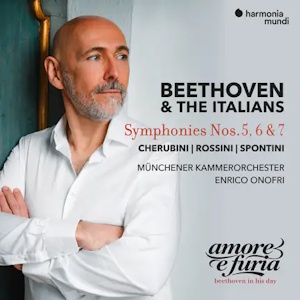
Beethoven & the Italians
Münchener Kammerorchester/Enrico Onofri
rec. 2025, Bavaria Musikstudios, Munich, Germany
Reviewed as lossless download
Harmonia Mundi HMM902443.45 [176]
Does the world need a new recording of Beethoven’s Fifth, Sixth or Seventh? Harmonia Mundi would seem to think so, and indeed, there is another recording on the label due for release three weeks after this one with the Fifth and Seventh again, conducted by Laurence Equilbey (which I am also reviewing). I have no idea how many recordings of each already exist, and even the seemingly inexhaustible Mike Herman shied away from creating a discography of Beethoven’s symphonies.
The conceit behind this release is a supposed connection between Beethoven and the three Italian opera composers, Cherubini, Spontini and Rossini. There is no doubt that Beethoven admired the former and met the latter, but I’m not convinced that the connection is that strong. Nor was I persuaded by Enrico Onofri’s fanciful piece of fiction about Beethoven and Cherubini – A tale – ‘Quasi una fantasia’ – which occupies seven pages of the booklet (in reality it is twenty-two pages in the three languages).
The Münchener Kammerorchester (MKO) is not generally an authentic instrument ensemble, but I’m pretty sure the horns used here were valveless. They definitely employ an historically informed approach, and this is reinforced here given their guest director is Baroque violinist Enrico Onofri. So if you are averse to Beethoven stripped back, look away now.
The famous opening to the Fifth is the most abrupt and harsh I’ve ever heard or wish to hear. There is no holding of the fourth note of the phrase, it is simply cut off and the notes repeated (and cut off again). The whole first movement feels rushed, harsh and frankly I couldn’t wait for it to end. At 6:53, it is a little quicker than most but not exceptionally so – it just sounds like it. The Andante con moto is much better, indeed some of it is really quite lovely with some delightful colouring, but the timpani is too prominent. The third movement shows up the lack of numbers in the orchestra, as there isn’t enough weight in the strings. The triumphant fanfares that open the last movement get the opposite treatment to the four note motto at the start, in that they are rich, slow and sustained; perhaps it is intended to show the difference between struggle and triumph. The underpowered strings are again terribly exposed in the last few pages, so the triumphal conclusion is robbed of some of its glory. So I’m left rather nonplussed and not sure what to think about the overall performance.
I am, however, in no doubt about what to think about the first movement of the Pastoral, but our editors would disapprove of such language, so I will leave you to insert an adjective appropriate to your manner of speech: it was %$#^%*&@ awful. My first impression was that it was too fast, but as with the first movement of the Fifth, some quick comparisons showed that not to be so. My next thought was that it was too relentless, and there’s no doubt that this is an issue, but not all of it. Finally, the problem fully identified itself: the surges and drop-offs in volume were giving me motion sickness; it was as though Beethoven was experiencing his “awakening of joy” on the boat with Mendelssohn going out to Fingal’s Cave. The second movement was better, but only because it couldn’t be worse. This time it was the rhythms that were stop-start, but there were some good passages as well. The peasant dance was definitely lively, but heavy-handed, the brass and low strings too prominent in places. It was almost as though it was a caricature, ideal perhaps for Fantasia. At this point the adjective I’d been searching for since the opening of the Fifth surfaced: exaggerated. Rhythms, dynamics, tempos, indeed just about everything is exaggerated; is it to make the performances different to all the other Beethoven out there, I wondered. I waited in trepidation for the storm to arrive, but perversely, it was a little dull, perhaps because what had come before it was so over the top. The beautiful “Cheerful and thankful feelings” began well, but was spoilt by braying horns. There is a “bonus” extra track: a first recording of an alternative final few bars of the second movement that Beethoven briefly considered – 38 seconds for the real Beethoven obsessive. I realise that in the digital era, the ordering of tracks is not as important as it was in the era of LPs, but to separate the full symphony from this small tidbit with the Guillaume Tell Overture is rather odd.
After my experiences with the Fifth and Sixth, I almost felt like skipping the Seventh, but it proved to be enjoyable and not exaggerated, and I don’t think that was simply because I’d gotten used to Onofri’s style. I watched a performance of Mozart’s Haffner Symphony by the orchestra with Onofri from about four years ago and it was very good, and more importantly, “normal”, which makes the anything but normal Beethoven Fifth and Sixth here even more puzzling.
And so to the Italians. While I have commented on the three Beethoven symphonies as a group, they are interspersed on the album with the four works by Cherubini, Spontini and Rossini. Apart from my exposure to The Lone Ranger and William Tell on TV in the 1960s, I have no background with any of these works or, in the case of Spontini, the composer.
What can I say about the Guillaume Tell Overture? The performance is splendidly energetic as any performance of it must be. String weight is again an issue in the big climaxes, but the wind and brass sections do a very fine job. I would have liked the last chord to be sustained, not chopped off, but that does seem to be an Onofri trait.
Cherubini’s overture from Médée alternates between noisy and quiet, but lacks much in the way of memorable melody. His symphony sounds more like early to middle Haydn than you would expect for a work composed in 1815, only in the final movement did a stylistic connection to Beethoven emerge. In both works, Onofri and the MKO impart a great deal of energy into the performance, and make them more interesting than other recordings I sampled (overture: Marriner; symphony: Chailly). Nevertheless, I’m not viewing the discovery of Cherubini as a lasting legacy of this recording.
The overture from Spontini’s 1819 opera Olimpie is placed intelligently after Beethoven’s Fifth because I can certainly hear the occasional connection, though there are also hints of Rossini’s Barber of Seville, which makes for an entertaining, if somewhat odd, mix. I don’t have any of the reservations with the performance that I had with the Fifth.
My doubts about some of the performance decisions should not be read as criticism of the orchestra, which plays its heart out, maintaining excellent ensemble throughout, and features some fine solo work. I have already mentioned Onofri’s short story that occupies so much of the booklet, though it should be acknowledged that not much space need be allocated to the Beethoven symphonies. The sound has plenty of detail, but on numerous occasions, I felt that the percussion section was given too much prominence. Whether this was a decision by Maestro Onofri or the sound engineer, I obviously have no idea.
Wisely, Harmonia Mundi have priced the three-disc set at not much more than a single disc, but that wisdom disappears for download purchasers, who must pay 50% more than the CDs for the standard 16-bit lossless files.
How to summarise this? Clearly, there was much here I didn’t like, the Pastoral most obviously. Yet, I will be keeping it on my hard drive because of the Seventh, the Spontini and Rossini. If I haven’t entirely deterred you, or indeed because you are intrigued by my comments on the Fifth and Sixth, please take advantage of the modern world of streaming and have a listen. You may find yourself entirely at odds with my opinions.
David Barker
Buying this recording via the link below generates revenue for MWI, which helps the site remain free
Contents
Luigi Cherubini (1760-1842)
Médée Overture
Ludwig van Beethoven (1770-1827)
Symphony No.5 in C minor Op. 67
Gaspare Spontini (1774-1851)
Olimpie Overture
Ludwig van Beethoven
Symphony No.6 ‘Pastoral’ in F major Op. 68
Gioachino Rossini (1792-1868)
Guillaume Tell Overture
Ludwig van Beethoven
Symphony No.6 – II. Szene am Bach. Andante molto moto (alternate finale – first recording)
Symphony No.7 in A major Op. 92
Luigi Cherubini
Symphony in D major














Presto has just made this their Recording of the Week. Clearly they liked it a lot more than I did.
I guess this is a Marmite album, as my reactions were exactly the opposite of David’s! I thought they were the most exciting and illuminating performances of these symphonies that I’d heard in a long time, and I especially appreciated the Pastoral, and the way the final thanksgiving movement came across as another dance—a sarabande, perhaps?—a more formal dance of order balancing the ‘rude mechanicals’ of the Peasants’ Merrymaking. And I found the Italian two-way connections fascinating.
I think I fall closer to David than to Robert. I really wanted to like this album, because I do think that Beethoven’s interest in Italian opera is overlooked. It was people like Spontini and Cherubini who, I think one could argue, fused high classical music to the melodramatic aesthetics of early Romanticism in a way that paves the way for Beethoven. I can sort of hear it in those two composers– I actually thought the Olimpie overture and Cherubini’s Symphony in D were fun and well-executed here. On the other hand, I did have to ask myself if I just didn’t like the Pastoral any more while listening to this recording… when I checked with a different performance, it turns out I still do. Which is good.
I like that you hit on the word “exaggerated.” You’re not wrong at all. But I think that’s what I like about it. It’s entirely possible that this interpretation won’t wear well over time, and I’ll end up back in the arms of Zinman or even one of the many flawed Karajans, but for now I’m enjoying the drama.