
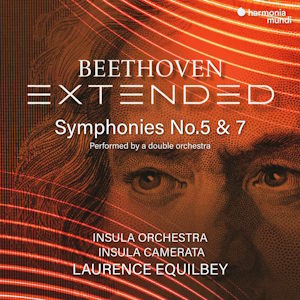
Ludwig van Beethoven (1770-1827)
Beethoven Extended
Symphony No.5 in C minor Op. 67 (arr. double orchestra Laurence Equilbey)
Symphony No.7 in A major Op. 92 (arr. double orchestra Laurence Equilbey)
Insula orchestra, Insula camerata/Laurence Equilbey
rec. 2025/26, Auditorium Patrick Devedjian, La Seine Musicale, Boulogne-Billancourt, France
Reviewed as lossless download
Harmonia Mundi HMM902418 [71]
This is the second release on the Harmonia Mundi within three weeks to include Beethoven’s Fifth and Seventh symphonies, the other being the Munich Chamber Orchestra’s three-disc set Beethoven & The Italians with Enrico Onofri. was less than enamoured by its Fifth; the Seventh was much better (review)..
Firstly, let me explain what the presence of “extended” in the album’s title and the “arr. double orchestra Laurence Equilbey” in the header means. Laurence Equilbey, an experienced HIP specialist and founder of the ensembles playing here, has gone back to the historical record for her traversal of the Beethoven symphonies and focussed on the idea of two orchestras playing music of the new (19th) century. As orchestras grew in size, the amount of sound generated tended to obscure the detail. This led to the development of what the notes call a “double orchestra”, essentially two groups – solo and ripieno – where the latter would only play in the louder sections. This is the “difference” that this new recording wishes to present; pardon my ignorance, but I thought this is what a conductor did normally, and didn’t really justify the designation of “arranged by”. Many is the time I have seen the back desks of the strings not playing certain passages, so how does this differ?
It is not clear whether the Insula orchestra (the lower case is their choice, not my typo) which numbers around fifty is the solo group and the camerata, an ensemble of thirty young players, the ripieno. Regardless of how the division has been made, it does mean that at full strength, the orchestra is substantially bigger than a chamber orchestra, such the Scottish CO in its Beethoven cycle with Sir Charles Mackerras (Hyperion) or the COE with Nikolaus Harnoncourt (Teldec). These are my references (Mackerras in the Fifth and Harnoncourt in the Seventh), despite the smaller sized ensembles and not using period instruments, because my belief is that the result is what matters, not the process or the tools.
The timings show Equilbey to be a little faster than Mackerras in all four movements, but slower than Harnoncourt except in the third movement.
| Equilbey 5 | Mackerras 5 | Equilbey 7 | Harnoncourt 7 | |
| I | 7:03 | 7:04 | 14:14 | 14:11 |
| II | 8:27 | 8:44 | 8:18 | 8:11 |
| III | 4:47 | 4:55 | 9:03 | 9:29 |
| IV | 10:22 | 10:42 | 8:45 | 8:19 |
| Total | 30:42 | 31:26 | 40:22 | 40:11 |
In the Fifth, it is soon apparent that Equilbey’s greater numbers in the strings do not equate to a greater sound; I presume this is the consequence of gut strings. The depth of string sound conjured up by Mackerras is quite remarkable, and very stirring in a way that Equilbey is not. In fact, that is a comment that I feel applies equally well across all eight movements: Equilbey and her double orchestra produce performances that are perfectly adequate, but not distinctive, and certainly not thrilling in the way of some of their competitors, notably my two comparisons.
Having given you my conclusion, it seems pointless to analyse both performances in detail, so let me give you a few examples which show Equilbey’s readings to be well behind my comparisons. In the Fifth, Equilbey’s Andante con moto has less of the con moto, with something of a stop-start rhythm in places that I don’t believe works. She starts the final movement very fast – Presto rather than Allegro – which sacrifices some of the grandeur and feels rushed, and she maintains a fairly quick pace throughout, which means there is less contrast at the end. Mackerras is quite exceptional here, taking his time to build up the tempo, meaning that when he hits the last few pages, it is so stirring. In the Seventh, Equilbey is almost half a minute faster in the Presto but seems no faster than Harnoncourt, whose clever dynamic variations supply an extra boost of vitality. The finale can be one of the most thrilling movements in all of the repertoire, but Equilbey’s doesn’t really catch fire until the last minute or so. Mind you I could say the same about the Mackerras, but not the Harnoncourt, which is quite electrifying.
The double orchestra experiment does not, for me, produce anything particularly impressive, interesting or innovative, and in some places, seems to be more of a drawback. In the third movement of the Seventh, as the big crescendo arrives, I heard what I assume was the addition of the ripieno group, and the volume becomes very loud suddenly, whereas for Harnoncourt, it is more gradual and far more effective.
The Insula ensembles may be playing period instruments, but there is no sense of thinness or rawness, the string timbres quite excellent. The horns, which I assume are natural, are so much better – by which I mean less blaring – than those on the Munich set mentioned above. The booklet notes concentrate unsurprisingly on the argument for the double orchestra approach.
There are a lot of extraneous (non-musical) noises here; the booklet doesn’t indicate that they are live performances, but I heard coughs, gulps, sighs, exclamations, bow clicks and some sounds I couldn’t identify. While they aren’t loud, they are distracting; in the opening four note motto of the Fifth, there is a very discernible clicking which I assume is a bow striking something it shouldn’t have, and a big gulp from someone at the very end of the same symphony. You might imagine this means the miking is very close, producing a very detailed sound, but it isn’t particularly so.
This experiment, if I can call it that, doesn’t seem to have yielded much in the way of benefits for the music, or even a distinctive sound, and I can’t see myself returning to this recording when there are so many other versions that are far superior.
David Barker
Buying this recording via the link below generates revenue for MWI, which helps the site remain free














