
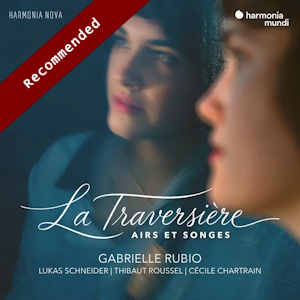
La Traversière – Airs et Songes
Gabrielle Rubio (transverse flute)
Lukas Schneider (viola da gamba), Thibaut Roussel (theorbo, guitar), Cécile Chartrain (harpsichord)
rec. 2025, Les Modillons, Vindelle, France
Reviewed as a download
Harmonia Mundi HMN915425 [74]
The transverse flute is one of the oldest instruments in Western music. For a long time, it was almost exclusively played in ensemble. Consort music, for instance, could not only be played by an ensemble of viols or recorders but also by flutes which in the Renaissance were built in different ranges, comparable with those of the recorder. The latter remained the favoured instrument in most regions in Europe until the early 18th century. In the second half of the 17th century some transformations in the construction of the flute took place, especially in France. Whereas previously it was mainly used as a military instrument, it started to play a role in chamber music. It became especially popular in the early decades of the 18th century which saw the emergence of playing music at the homes of the aristocracy and the upper bourgeoisie.
The publication of a treatise on playing the flute by Jacques Martin Hotteterre ‘le Romain’ in 1707 attests to its growing popularity. Further evidence is to be found in the number of collections of music for one or several flutes which came from the press. Some of these are for various instruments, to the choice of the performers. It was quite usual to see on the title pages several instruments being mentioned as alternatives: the recorder, the flute, the oboe, the violin and the viola da gamba. However, some composers also published music specifically intended for the transverse flute. The main composers of such music were members of the Philidor family, Michel Pignolet de Montéclair and Michel de La Barre.
In the course of time, the transverse flute was further developed, and the music written for it was influenced by the Italian style, which became increasingly popular during the 18th century. The disc under review offers a survey of music for the transverse flute by two generations of composers, which document these developments. To that end, Gabrielle Rubio plays two different instruments: one is a copy of a flute of Jean Hotteterre, the other is based on a flute by Pierre-Gabriel Buffardin.
If one wants to hear the differences in style and sound, one should first listen to the five pieces by Michel de La Barre in tracks 14 to 18, and then to the Sonata in D minor by Michel Blavet. The pieces by La Barre are very characteristic of French traditional music under Louis XIV. The first is a prélude, a genre that was very common and often used, according to the meaning of the title, to prepare for what comes. It is followed by three dances with titles. Character pieces were very popular in France from the late 17th century onwards. It is notable that the large majority of François Couperin’s harpsichord pieces, published in four books, belongs among this category. The fifth piece is a chaconne, another highly popular genre, which – alongside the passacaille – appeared in every opera (mostly towards the end) and in many instrumental works. This piece includes some traces of the Italian style.
The latter manifests itself more clearly in Michel Blavet’s sonata. All the five pieces have Italian titles, whether dances or tempo indications (or both): andante, allemanda (allegro), gavotta (moderato), sarabanda (largo), allegro. Only the first and the third also have an additional title in French, indicating that these are character pieces. Blavet’s sonata is also technically more brilliant than the pieces by La Barre, reflecting the influence of the Italian style.
The pieces by La Barre and Blavet are specifically intended for transverse flute. With the exception of the chaconne, those by La Barre are taken from his Op. 4, the first printed edition of music for the flute in France. The other composers mostly published their music for any instrument in the treble range. The Suite in G from the Op. 2 by Jacques-Martin Hotteterre ‘le Romain’ is an example. The title page says that these pieces are for transverse flute and other instruments. The Suite in G consists of six character pieces: five dances and a rondeau. The third is a courante, which is followed by a double. This was the typical French technique of adding ornamentation to the original, which was especially used in harpsichord music. The last movement is called L’Italienne. The suite is preceded by a prelude from a collection, whose title – L’Art de Préluder sur la flûte traversière – indicates a pedagogical purpose.
Joseph Bodin de Boismortier could be called the ‘French Telemann’: like his German counterpart he wrote most of his music for amateurs. Many collections are for instruments to the choice of the performer(s), but the Op. 19, from which here the Sonata in A minor is taken, is specifically intended for the transverse flute. This collection was published in 1727; it is telling that all four movements have titles in Italian. The Italian style comes especially to the fore in the fast movements.
The above-mentioned Jacques-Martin Hotteterre was one from a large musical dynasty. Another dynasty was the Philidor family. Pierre was an oboist who became a member of the Chambre du Roy, were Marin Marais and François Couperin were among his colleagues. His Op. 1 is one of three collections of suites for a treble instrument and basso continuo and suites for two transverse flutes without accompaniment. The Suite No. 4 in A minor refers to the countryside: the third movement is an air en musette, and the last is called Paysanne. Gabrielle Rubio plays them on the petite flûte. The penultimate movement is a sicilienne, with a pastoral character.
Gabrielle Rubio makes her recording debut with this album. She could hardly have made a better start in what promises to be a successful career. The programme as such is not very adventurous, in that it includes works by well-known composers, who frequently appear on recordings of French baroque music. However, the way it has been put together reflects the stylistic developments within French music in general and in music for the transverse flute in particular. These are emphasized by the use of two different instruments.
The disc’s title refers to vocal music: “airs et songes”. That makes sense. Thomas Leconte, in his liner-notes, refers to Hotteterre who in his treatise “underlines the importance of the vocal dimension in playing, above all the necessity of imitating the eloquent declamation of the voice.” That is exactly what we get here, through phrasing, articulation and subtle dynamic inflections. I also enjoyed the playing of the basso continuo. A piece based on a basso ostinato, like a chaconne, is often exciting, but that very much depends on how the bass is played. Listen to the chaconne by La Barre; the bass has an irresistible ‘swing’, which makes it hard to keep your feet still.
This is an impressive recording of a compelling programme and a special recommendation is well deserved.
Johan van Veen
http://www.musica-dei-donum.org
https://twitter.com/johanvanveen
https://bsky.app/profile/musicadeidonum.bsky.social
Buying this recording via the link below generates revenue for MWI, which helps the site remain free
Contents
Jacques-Martin Hotteterre ‘le Romain’ (1673-1763)
Prélude in D [op. 7]
Suite in G, op. 2,3
Joseph Bodin de Boismortier (1689-1755)
Suite in B minor, op. 35,5:
prélude
Michel Blavet (1700-1768)
Sonata in D minor, op. 2,2
Michel de La Barre (c1675-1745)
Suite in G, op. 4,2:
prélude
allemande La Signora
sarabande L’Aînée
gigue L’Écossoise
Suite No. 9 in G ‘L’inconnue’:
chaconne
Joseph Bodin de Boismortier
Suite in E minor, op. 35,1:
prélude
Sonata in A minor, op. 19,6
Pierre Danican Philidor (1681-1731)
Suite in A minor, op. 1,4
François Couperin (1668-1733), arr. Michel Blavet
Les Bergeries (arr for transverse flute and viola da gamba)













