
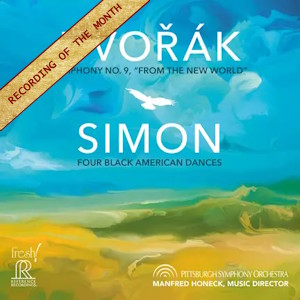
Antonín Dvořák (1841-1904)
Symphony No. 9 Op. 95 “From the New World” (1893)
Carlos Simon (b. 1986)
Four Black American Dances
Pittsburgh Symphony Orchestra / Manfred Honeck
rec. live, 14-16 February 2025, Heinz Hall for the Performing Arts, Pittsburgh, USA
Reference Recordings FR769 SACD [59]
Reference Recordings has over the last few years produced a veritable stream of highly recommendable recordings of live performances of core symphonies in the Heinz Hall: Bruckner’s Seventh symphony, Brahms’ Fourth, and Tchaikovsky’s Fifth. In addition, just recently, they released Mahler’s Fifth in a performance by Sir Donald Runnicles and the Grand Teton Music Festival Orchestra, recorded in Walk Festival Hall, Wyoming. All these releases have all received numerous accolades from me and my colleagues on this site. They are characterised by extraordinarily deep, rich, vivid sound and performances to match, by what is surely America’s current premiere conductor-orchestra partnership.
I was recently very impressed by Nathalie Stutzmann’s recording of the “New World” in Atlanta (review). That was coupled with Dvořák American Suite; here, Honeck has partnered it somewhat more adventurously with a new work (at least, newish – premiered in Boston by Andris Nelsons in 2023). Honeck’s timings are very similar to Stutzmann’s – he takes the first movement repeat – although the two inner movements are played in slightly more leisurely fashion, and impressed though I was by Stutzmann’s account, this one achieves new heights of expression and beauty of playing. The first movement is grand, tender and thrilling by turns, investing this warhorse with new impact and certainly rivalling Fricsay for energy while far exceeding his recording in terms of sonics.
The sumptuousness of tone achieved by the Pittsburgh SO rivals anything I have heard from modern orchestras in recent times and Honeck’s willingness to linger over the manifold beauties of Dvořák’s score without dragging or courting sentimentality lends them every opportunity to display their lyrical prowess. I have heard plenty of performances which capture the drama of this music but few which so completely embrace its many passages of rustic charm; the mystery of the opening is perfectly captured and the ensuing storm is really stirring; the cor anglais solo opening the famous Largo maintains a noble simplicity and the sense of repose throughout the movement is hypnotic; the gentle lilt of the central slow sections of the Molto vivace third movement is simply captivating in its simple eloquence – then the brass call to arms concluding the movement is really arresting. Honeck pushes on with hardly a break into the finale and positively wrings every drop of excitement out of it, especially in the violent, dissonant chorale which precedes the soft, transcendent close. This is a performance which eschews any sense of calculation but which paradoxically evinces the most careful and nuanced of preparation in the precision of its use of dynamics and variation of tonal colour.
The live composite sound is so full that we occasionally get a little too much of the conductor’s heavy breathing and exhortative grunts but that’s a small price to pay for such a life-enhancing experience.
The four dances by Carlos Simon make a neat, highly enjoyable and indeed apt postlude, capitalising on the gospel music link with Dvořák. The first dance is jazzy, garish and syncopated, often indebted to Copland, and great fun. The lush, soaring abandon of the second waltz surely nods towards Ravel as a model. The little “Tap” entertains royally; both it and the finale, “Holy Dance”, whisper Gershwin laced with Stravinsky. The latter is a brass-blaring riot, with wah-wah trombones and clanking chime bars – and if I keep alluding to other composers, it is because there is something both intrinsically American about Simon’s idiom but also that which proclaims them as developments grounded in an established classical music tradition.
Quite detailed but wholly digestible notes by both Honeck and Simon respectively provide helpful listener guidance. Honeck in particular explains and justifies some adjustments he has made to enhance various effects and interpretative subtleties which explain the extraordinary varieties of colour and emotion. This is a performance which enables us to hear the symphony anew.
What an excellent recording this is, reminding us that this is a great work, and enough to revive the jaded palate of the most blasé of listeners. The fact that it is supplemented with such a pleasing “filler” is all bonus. It will undoubtedly be one of my Recordings of the Year.
Ralph Moore
Buying this recording via the link below generates revenue for MWI, which helps the site remain free














Good news for Honeck-Pittsburgh fans: It seems they recorded the Bruckner 8th in February 2026 at Heinz Hall in Pittsburgh. Based on past experience, this recording could possibly be expected for release in mid 2027. If it’s even half as good as their previous Bruckner recordings, then it will likely be magnificent.