
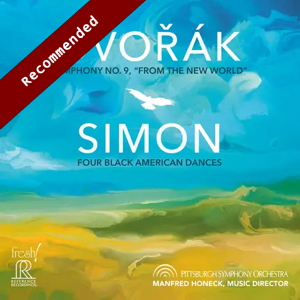
Antonín Dvořák (1841-1904)
Symphony No. 9 Op. 95 “From the New World” (1893)
Carlos Simon (b. 1986)
Four Black American Dances
Pittsburgh Symphony Orchestra / Manfred Honeck
rec. live, 14-16 February 2025, Heinz Hall for the Performing Arts, Pittsburgh, USA
Reference Recordings FR769 SACD [59]
Such has been the popularity of this disc since it was released, that I believe that physical copies of the SACD have been in short supply; as a consequence, I only received a copy very recently. Having listened to the disc, I can understand why it has been in such demand.
Manfred Honeck has a reputation for taking even the most familiar repertoire items and going back to first principles, taking nothing for granted. I’m sure other conductors do the same but Honeck gives us insight into his thinking about the performance of the music by writing detailed notes in the booklet, explaining some of the interpretative decisions he’s taken. Often, these relate to what might seem to be minor points of detail. However, when you read his thinking and then listen to the results everything becomes clear and you realise the depth of thought that has gone into preparing the performance. In listening to this Dvořák performance, I found it really helpful to cross-reference it to Honeck’s essay. I should hasten to add that nothing in this approach is mere pedantry; on the contrary, it’s one of the great achievements of this performance that Honeck and his orchestra give us an account of a familiar – too familiar? – masterpiece that consistently sounds fresh and spontaneous.
An immediate and favourable impression is made at the start of the Adagio introduction to the first movement. Honeck adopts a spacious tempo and the Pittsburgh strings produce a lovely, yearning sound. The allegro molto (from 1:57) is very spirited and there’s a most attractive freshness to the music-making. One detail which made me a little thoughtful occurs at the passage where a secondary theme is introduced gently by the flutes (from 4:01). Here, Honeck’s speed is very relaxed indeed, as is the case on the two subsequent occasions that this material recurs. Over time, I came to like what I was hearing but on first acquaintance I felt the speed was just a little too relaxed. Throughout the movement, the playing of the Pittsburgh orchestra is absolutely superb and full of life. An abundance of detail registers, for which we have to thank not just the conductor and players but also the engineers. Referring to the coda (from 11:11), Honeck says the passage “is highly energetic and, in my view, allows no restraint – neither dynamically nor rhythmically”. That’s just how it sounds in this performance.
I learned much from reading Honeck’s booklet essay. One detail which I’d never previously registered is that in this symphony the tuba player has a mere eight bars to play; four during the little brass chorale at the start of the Largo and another four when the chorale reappears towards the end. Honeck tells us that he wanted the famous cor anglais melody to be “shaped very simply”. The PSO’s cor anglais player, Ian Woodworth executes that wish to the letter; the tune is delivered in an unaffected fashion and as a result it is gently eloquent. Just as beguiling is the beautifully hushed string accompaniment. There follows a memorable rendition of this lovely movement. As in the previous movement one can only admire the very natural-sounding attention to detail. As the movement draws to its close the episode which is scored for reduced numbers of strings is played with great inwardness and tenderness (from 10:12).
The Scherzo is a delight. Honeck reminds us that Dvořák stated that the scherzo material was inspired by the scene of the Indian feast in Longfellow’s Hiawatha and, specifically, the singing and dancing. Yet Honeck goes on to assert that the Trio “is of an exclusively Bohemian character”. As I listened, I reflected that not just this movement but the symphony as a whole melds, on the one hand, Dvořák’s delight at the American influences to which he became exposed during his time in the USA and, on the other, his deep-seated nostalgia for his homeland. I don’t think it’s too fanciful to think that in this performance we benefit from the cross-fertilisation of a conductor steeped in the Central European tradition working so constructively with an American orchestra. There’s fire and verve in the Scherzo and then in the Trio Honeck relaxes delightfully – and note the care with which he gets the woodwinds and, indeed, the orchestra as a whole, to phrase in the Trio. The result is a delectable performance of the movement. At the start of the finale, the brass theme is announced proudly, heralding a stirring account of the movement. Yet the second theme, unfolded by the clarinet (1:49) is pensive and haunting. As the movement progressed, I greatly admired the light and shade with which Honeck and his players invest the music; dynamics and accents are consistently made to count and as a result the performance is genuinely exciting. There’s great intensity between 8:43 and 9:31 and then the big brass-dominated outcry just before the end (10:10) makes a huge impression. Honeck suggests that these pages “can emotionally be perceived as pain: Dvořák far away from his beloved homeland”. That perceptive comment allowed something to fall into place for me after decades of listening to this symphony. I’ve always been slightly puzzled that Dvořák unexpectedly concludes this symphony not at full blast but with a diminuendo woodwind chord. However, if you concur with Honeck’s comment about the pain of separation – and it’s a highly persuasive argument – then the somewhat ambiguous and restrained final chord makes sense.
This is a terrific and thoughtful performance of the ‘New World’. As I suggested earlier, it’s a great achievement to take a familiar – dare I say hackneyed – pillar of the symphonic repertoire and deliver it with such freshness that it comes up as if new-minted. Moreover, without any unwarranted point-making, Manfred Honeck makes one think again about a work which one has heard so many times before. I loved every minute of this performance.
One hundred and thirty years separate the Dvořák symphony and Carlos Simon’s Four Black American Dances; the former bears the title “From the New World” while the latter is emphatically of the New World. Although, obviously, I was very keen to hear Manfred Honeck and the PSO perform the symphony, I’ve been excited about this disc ever since I learned that it includes also the Simon work in what I believe is its premiere recording. The Dances were commissioned by the Boston Symphony Orchestra who premiered the piece, under their Music Director, Andris Nelsons in February 2023. A few months later, Nelsons and the orchestra visited the BBC Proms and they gave the European premiere of the work at a terrific concert which I had the good fortune to attend and review for Seen and Heard International. I made an off-air recording of the concert at the time but even so the chance to hear it on this disc was not to be missed. A couple of years ago I had the opportunity to hear more of Carlos Simon’s orchestral output when I reviewed a disc on which the National Symphony Orchestra and Gianandrea Noseda presented four of his pieces. The music impressed me and I hoped that reacquaintance with Four Black American Dances would be a stimulating experience: I was not disappointed.
In this four-movement score Simon takes inspiration from some of the dances which, as he explains in the booklet, have always been and continue to be an integral part of the Black American communities. He reminds us that “[t]here have been hundreds, perhaps thousands of dances created over the span of American history that have originated from the social climate of American slavery, Reconstruction and Jim Crow. This piece is an orchestral study of the music that is associated with the Ring Shout, Waltz, Tap Dance and Holy Dance”. Though Simon references such injustices as slavery and Jim Crow this is not a work of protest – though such would have been justified – instead, it’s an often-exuberant celebration of Black American tradition and culture.
Right at the start of Ring Shout, we hear – not for the last time in the work – sassy brass playing; I love the braying trumpets at 0:36. This movement is an ecstatic dance. The music requires terrific verve, dynamism and rhythmic precision; that’s exactly how the PSO deliver it. A little later on (from 1:57) there are ear-catching violin and trumpet solos. Often, the rhythmic drive in Simon’s music is relentless. The present performance has irrepressible energy. In his notes, Simon relates that for a very long time Cotillion balls were the exclusive preserve of white American society; it was only in the 1930s that such balls finally become part of the Black communities too. At such balls, waltzes were “the dance of choice”. Simon’s take on the Waltz is rather unusual; the music sounds as if the waltz form is being refracted through a mirror of time; it’s fascinating.
Tap Dance is the briefest of the movements. In it, Simon gets the side drummer to strike the rim of his drum to emulate the sound of tap-dancing shoes. The movement is short, fast and furious. Hereabouts – and in Ring Shout also – I thought I could detect echoes of the exuberant crowd scenes in Porgy and Bess. All the stops are pulled out in Holy Dance. Here. Simon is celebrating the “exuberant, outward expressions of worship” in the Protestant Christian churches. The music is really exciting and unbuttoned; it gives a virtuoso work-out to all departments of the orchestra, not least the large percussion section. The trombones are an important presence throughout but listen to them at 3:23 where Simon gives them a vibrato-rich ‘wah-wah’ episode; it’s absolutely terrific.
Four Black American Dances is a thrilling, celebratory work. I’m delighted that a commercial recording is available so that a wider audience can enjoy it. Happily, its debut on disc comes in the form of a tremendous, vital performance by Honeck and the PSO. I’m always wary of saying that only an American orchestra can do justice to some of the music of the USA but I don’t think there can be much doubt that here the PSO delivers Carlos Simon’s piece with a panache and pizzazz that non-American orchestras would be challenged to match.
On this SACD we have two highly contrasting orchestral pieces in stellar performances. I’m delighted to report that the recorded sound not only does full justice to the performances but enhances them. The recordings were made at concerts in the PSO’s home hall in Pittsburgh. The technical side of things was in the hands of a team from Soundmirror Inc., namely producer Dirk Sobotka and engineer Mark Donahue. I’ve regularly admired Soundmirror’s recordings in the past but on this occasion I think thy have surpassed themselves. The sound is, quite simply, stunning; there’s presence, impact, a marvellous dynamic range and an abundance of detail. Sonically, it is one of the most vivid and successful orchestral recordings that has come my way in a long time.
When, in a couple of months’ time, we are invited to nominate our Recordings of the Year, this superb disc will be an inked-in certainty for my list.
John Quinn
Previous review: Ralph Moore (Recording of the Month)
Buying this recording via the link below generates revenue for MWI, which helps the site remain free













