
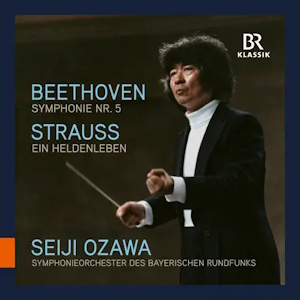
Ludwig van Beethoven (1770-1827)
Symphony No. 5 in C minor, Op. 67
Richard Strauss (1864-1949)
Ein Heldenleben, Op. 40
Ernö Sebestyén (violin)
Symphonie-Orchester des Bayerischen Rundfunks/Seiji Ozawa
rec. live 17 & 18 January 1990, Philharmonie im Gasteig, Munich
First release
BR Klassik 900238 [76]
Here is an audience-pleasing coupling from live concerts with a fine orchestra conducted by Seiji Ozawa in his middle-aged prime. However, I am not sure who will buy this issue which is essentially from the BRSO’s back-catalogue. Its main interest lies in the fact that Ozawa conducted them only twice, in the 1983 concert of Beethoven’s Egmont Overture and the First Piano Concerto with Martha Argerich, already released on as BR-Klassik CD 900701 back in 2009, and here in 1990.
To be honest, I have little to say about the Beethoven; the whole performance is in well-balanced, digital sound, featuring nicely prominent percussion, plenty of bass heft and smooth, sonorous strings. The first movement is a firm, fast and driven; the slow movement is nobly executed without undue rush or ponderousness; the pseudo-scherzo – so-called because it is first too grand, stately and serious, then macabre, to be otherwise – is neatly gauged with some pleasing pianissimo playing before the great C-major blaze of the finale. It is all wholly satisfying.
For all that I usually love his work and Strauss’ egocentric tone poem, I was less than complimentary about Ozawa’s 1981 recording of Ein Heldenleben in Boston, so was keen to see if he had done better here in Munich nearly a decade later. I don’t know if it is because the BRSO were more attuned to the Strauss idiom but this certainly sounds freer and more released without quite creating the tension and generating special frisson I experience with Karajan. However, it is a big, lush, plush performance; the critics chatter and natter bitchily, concertmaster Ernö Sebestyén plays the violin solos very elegantly, if in rather too restrained a manner for me, the battlefield trumpets are neatly distanced, climaxes are powerful with excellent horn playing, especially towards the end of track 8, Des Helden Walstatt, despite a slight parping – but it is all a bit…homogenised? Perhaps I am being too picky but I wonder whether this is a classic case of the best being the enemy of the good. Ozawa manages the lyrical passages sensitively, as in “The Hero’s Works of Peace”, but I would like a little more visceral excitement elsewhere.
Ralph Moore
Buying this recording via the link below generates revenue for MWI, which helps the site remain free













