
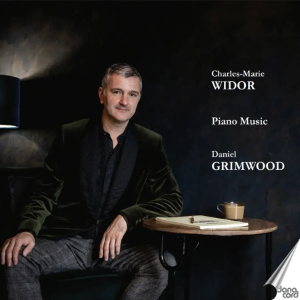
Charles-Marie Widor (1844-1937)
Variations sur un Thème original Op.29 (1892)
Carnaval Op.61, original version (1889)
Cinq Pièces Op.71 (c.1895)
Nocturne from Conte d’Avril Op.64 (1885)
Toccata from Organ Symphony No.5 Op.42 No.1 (1879, arr. Widor)
Daniel Grimwood (piano)
rec. 2025, Sir Jack Lyons Concert Hall, University of York, UK
Danacord DACOCD1008 [77]
Flautists, organists and fans of Hyperion’s Romantic Piano Concerto series may disagree but to the general public Charles-Marie Widor likely remains a one-hit wonder. That will doubtless not change given said one-hit’s presence at weddings galore; Widor’s famous Toccata even appeared at my own wedding, though admittedly that was because the choir begged our organist to play it after we had made our exit. In reality, Widor was a prolific composer. In addition to his many organ works, there are four operas, three symphonies, nine concertante works (for piano, violin, cello, harp, voice and organ, naturally), songs, chamber works and music for piano solo.
Piano pieces form a decent-size body of work, from those published in 1867 right through to pieces written in 1910.They appeared in seven well researched and edited volumes (Crescendo Music Publications), but they are virtually unknown. Widor himself remarked to pianist Isidor Philipp that later editions, collecting together various opus numbers, were published in an effort to appeal to “the pianists who hardly spoil me with too much attention”. One hopes that this sparkling release will change the situation just a little.
Daniel Grimwood begins with the Variations on an original theme,a revised version of Widor’s op.1 from 1867, Concert Variations on an original theme. The variations differ little at first. It is not until the fifth variation that Widor ditches the big left-hand chords and cascading right-hand scale passages for a much more subtle off-beat gigue. The interlocking octaves of the furious coda are also redistributed to give a more interestingly textured sound, which leads to the grand conclusion in the major key. The other variations, light-hearted, show Widor’s appreciation of baroque dances and counterpoint. I particularly love the quicksilver vivace third variation with its quick contrary motion triplets, excellently played here.
Widor’s Carnaval may owe something of a debt to Schumann but he tends to linger over the dances and characters a little longer. The portrait of Francesca, as languid and sensuous as she is an unknown, is longer than any of Schumann’s scenes. Zanetto has a dreamy and delicate little mazurka, while Rosita is shown in a lilting and thoughtful waltz with hints of Schumann in the second theme. There are plenty of fast dances too. The Viennoise and the Bohémienne dance a polka each, halting and energetic respectively. Poland and Hungary are represented by national dances, a grand but brief polonaise and a sterner Hongroise with the buzz of the cimbalom. Virtuosity aplenty inhabits much of the writing, not least the humorous, capering Timbales et Trompettes that opens the piece in a welter of excitement. The vigorous Bal masqué reminded me of a precursor to La danse d’Olaf by Riccardo Pick-Mangiagali: it is as virtuosic in its own right.
Widor wrote the five pieces op.71 around 1895 but they did not appear in print until 1903 in a collection of waltzes; oddly enough, some of the companion pieces in that collection were not in fact waltzes. They were published in 1923 in the form that Grimwood plays them. A valse gaie kicks off proceedings in sparkling style, as frothy and delightful as one could hope for. The short valse triste that follows is more nostalgic than sad. Kermesse carillonnante, a miniature tone poem in waltz form, is a wonderful conglomeration of bell effects; kermesse means church mass usually with celebration at its heart, and this brilliant concert waltz captures that scene marvellously. Valse oubliée is another slow waltz, more mournful than the earlier valse triste but with a sweet contrasting section that channels Schubert. The collection ends with Après la fête. This slow waltz inhabits that dreamy state when you wind down after an eventful party, mixed with a couple of brief faster sections that may suggest fleeting memories of the evening’s festivities.
The recital closes with two transcriptions. Flautists will recognise the first, the nocturne from Widor’s incidental music to August Dorchain’s play Conte d’Avril. This is a piano version of the outer sections of the gorgeous romance from the suite for flute and piano written in 1884; it makes for a gorgeous piano solo. Grimwood finishes with the famous Toccata but in a transcription for piano by the composer himself in what appears to be a first recording. This fleet and exciting performance recreates a lot of the magic of the original, even if some of those sustained organ notes that you feel in your bones are absent.
I enjoyed this album immensely. Grimwood is an engaging pianist, fearless and dashing but with a gift for melodic playing. His love of these forgotten corners of the repertoire rings boldly in his performances which then speak that much more strongly for the quality of the music he is playing. I was occasionally reminded of Saint-Saëns in this repertoire. Those who wish that particular Frenchman had written more for piano can do no better than attend to this attractive, brilliant and idiomatically crafted music. I hope that Grimwood and others delve deeper into Widor’s piano output.
Rob Challinor
Other review: John France
Buying this recording via the link below generates revenue for MWI, which helps the site remain free














It was interesting to compare this disc with the recently-released Vierne Piano Music album (by Michael Schoch). I was really won over by both of them, and, taken with Franck’s great but still slightly-underrated piano music, I have to say that I think the whole “Cavaillé-Coll” French organ school could really write for piano as well. They don’t all sound the same as each other, either, which I find interesting. Vierne is much more emotionally expressive, Franck, of course, has his updated-Bach approach, Widor is a lot more fun and playful.
Who’d be next to rediscover, I wonder? Guilmant?