
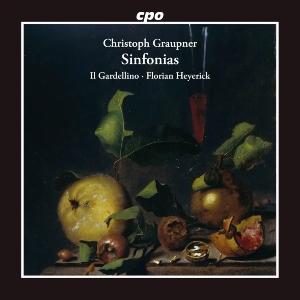
Christoph Graupner (1683-1760)
Sinfonias
Il Gardellino/Florian Heyerick
rec. 2021-24, Studio Steurbaut, Ghent; Onze -Lieve-Vrouw-Hemelkerk, Mariekerke; Miry Concertzaal, Gent and CC, Merelbeke-Melle, Belgium
Reviewed as download
cpo 555 779-2 [144]
A contemporary of J.S. Bach, Telemann and Handel, Christoph Graupner’s music has inevitably been overshadowed despite the prolific nature and undoubted quality of his output. This very recording is evidence of this state of affairs, with some of these Sinfonias being recorded and indeed played at all for the first time in recent years. Graupner’s story is tied in with Johann Sebastian Bach’s taking the post of Leipzig Thomaskantor in 1723 as the result of the Landgrave Ernst Ludwig of Hesse-Darmstadt’s refusal to allow Graupner, his court conductor, to take this post by persuading him to stay with an increase in salary. The Thomaskantor job had been offered to Graupner after it had been turned down by Telemann for similar reasons, and we see again how the power of money has ever shaped history and the arts down the ages.
These Sinfonias and numerous other musical treasures have been preserved for centuries in the Darmstadt chapel archives, and the music recorded here represents Graupner’s interest in the then new ‘Classical’ style, breaking away from rhetorical cantatas and Italian or French concerto genres. There are no fewer than 112 sinfonias by Graupner, and the lack of markings or corrections on scores and parts pose the question as to whether these works were performed at all in their day and, as Florian Heyerick’s booklet notes point out, the origins of “Graupner’s substantial symphonic project remains a fascinating enigma.”
Heyerick’s text points out that these works have to be considered “unripe and without influence on development of the genre” due to their archived obscurity, and further sums up the qualities in and effect of this music’s “disarming spontaneity, broad palette of colours and moods, moments of wild, driving energy alongside tender subtle passages, and an uninterrupted torrent of creativity that sweeps the listener up on a rollercoaster ride.” Listening to this collection at a single sitting does indeed give the impression of an artist offered a blank canvas on which to work with uninhibited energy. Graupner gathers the influences at his disposal, including elements such as Sturm und Drang contrasting with the tenderness of Empfindsamkeit, that Italianate style that permeated the work of early Classical composers such as Stamitz and C.P.E. Bach, with that familiar fast-slow-fast pattern and major-minor-major sequence of keys – that or suite forms with multiple movements. This is a blend of accepted tradition combined with a theatricality that involves lots of festive energy from the timpani, and the more ‘avant-garde’ chromatic writing that provides us with the fingerprints of Graupner’s personal touch.
There are too many fascinating moments to list in this recording, but early on we are treated to the Poco allegro central movement of the Sinfonia in D major, GWV 528 in which Graupner uses the timpani as a melodic instrument, something we students were always told to avoid in orchestration lessons. Timpani fans can revel in even more elaborate such effects in GWV 566 which has no fewer than six drums, only one note short of a whole scale. This programme has been put together to “provide a balanced summary of the instrumentation, form and tonality in Graupner’s symphonic legacy.” Each work has its own inner contrasts, but the chamber-music feel of GWV 577 with its viola d’amore forms its own oasis of calm amongst all of the fanfare.
This has been nicely recorded and is reasonably consistent in sound quality despite being sourced with a variety of instrumental combinations and at numerous venues. Expertly performed, this is a well full of treats for lovers of unusual baroque period music, and I hope these musicians return to plunder more from this archive.
Dominy Clements
Contents
Sinfonia in D Major, GWV 528
Sinfonia in E Major, GWV 562
Sinfonia in F Major, GWV 566
Entrata per la Musica di Tavola in G major, GWV 453
Sinfonia in F Major, GWV 577
Sinfonia in D Major, GWV 545
Sinfonia in D Major, GWV 529
Sinfonia in D Major, GWV 555
Sinfonia in G Major, GWV 601
Sinfonia in G Major, GWV 604
Sinfonia in C Minor, GWV 411
Buying this recording via the link below generates revenue for MWI, which helps the site remain free














Dominy– I wish I’d read your review before listening to the album, because you explain why these works sound so unusual. Your point about the timpani clicked for me, I knew there was something I don’t normally hear, but I couldn’t place what exactly was going on there!
I think the Graupner Sinfonias would make kind of a fun pairing with the CPE Bach Hamburg Symphonies, which were also the products of ‘unusual creative freedom’. I love the Hamburg Symphonies, and I enjoyed these very much as well– I guess the various landgraves and whatnot should have given their composers blank canvases more often!
The first movement of the first sinfonia (gwv 528) gives almost beethovenian vibes. Such a dancy music, perfect for the younger generation of listeners who might be a little be bored from constant slow-fast-slow and your usual really moderate suites. Delivers!