
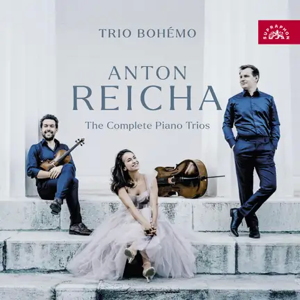
Anton Reicha (1770-1836)
The Complete Piano Trios
Trios Concertants 1-6 (publ. 1824)
Trio Bohémo
No recording details provided
Reviewed as lossless download
Supraphon SU43632 [154]
Bohemian-born Anton Reicha was an exact contemporary of Beethoven, and indeed, the two were friends. They met in the Bonn court orchestra and continued their connection in Vienna. Reicha is best known today for his wind quintets – twenty-five of them – and for his pupils, Liszt, Berlioz and César Franck.
He only wrote six piano trios, and they were published as a set whilst he was residing in Paris where he spent the last twenty-eight years of his life. No booklet was supplied with my review download, so I don’t know whether these were written in 1824 as a group, or whether they may have been composed over a number of years. As far as I can tell, this is not only the first time the entire set has been recorded together, but also that it is the first recording for Trios 4-6. Supraphon already has a recording of Nos 1-3 in its catalogue, by the Guarneri Trio Prague (SU40572). I have this recording in my collection, but it is quite some time since I’d listened to it.
My initial reaction, after listening to Trios 1 and 2, was that this was pleasant, rather busy music, closer to Mozart than Beethoven, but not especially memorable. Trio 2, the only one in a minor key, has a little more depth than No. 1, but features quite a lot of repetition. Some have proposed that Reicha’s music foreshadowed a number of 20th century developments, including minimalism, but for me, this repetition is more a lack of imagination.
Trio 3 begins promisingly with a graceful Lento, but once it switches to an Allegro, we are back in “busy” mode. The Minuetto which follows is the best movement from the first three works, with a gentle rocking theme shared among the three instruments. The Andante slow movement is quite lovely, but the final movement returns to the common pattern of activity rather than invention. Listening to the first three trios certainly explained why I hadn’t listened to the earlier recording for some time.
Trio 4, therefore, came rather out of the blue: it is an absolute belter, one of the best “new” trios I’ve heard in ages. While it shares the same characteristics as the other five, there is greater depth, and more interesting melodies and rhythms. Trios 5 and 6 were not at this level, but were still a cut above 1 and 2. This was not a matter of suddenly “getting” Reicha, as listening to Trio 1 again didn’t improve my opinion of it. It did make me wonder if Trios 1 and 2 in particular might have been early works; they certainly don’t sound as though they had been written by someone who would have known Beethoven’s later trios.
My colleague Stephen Barber reviewed Trio Bohémo’s debut release – Smetana and Schubert – and was very impressed with them; I certainly agree with that assessment. They adopt faster tempos than Guarneri Trio Prague in Trios 1 & 3, which is to the music’s benefit. These are not profound works, requiring intense and dramatic readings; their playful, occasionally witty and pleasing, if superficial, nature should be to the fore, and Trio Bohémo does this very well. As mentioned, no booklet was supplied, but I see that one is available if you purchase the download from Presto. The sound quality is very good, with natural separation of the instruments, and miking that is not too close.
It is very good that all six trios have now been recorded, and in such good performances, especially as we are now able to hear the splendid Trio 4. However, it is surrounded by a lot of music that is pleasant, but no more.
David Barker
Buying this recording via the link below generates revenue for MWI, which helps the site remain free













