
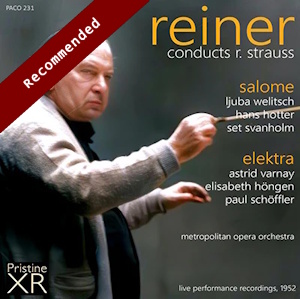
Richard Strauss (1864-1949)
Salome
Salome – Ljuba Welitsch (soprano)
Jochanaan – Hans Hotter (bass-baritone)
Herodes – Set Svanholm (tenor)
Herodias – Elisabeth Höngen (mezzo-soprano)
Elektra
Elektra – Astrid Varnay (soprano)
Chrysothemis – Walburga Wegner (soprano)
Clytemnestra – Elisabeth Höngen (mezzo-soprano)
Orest – Paul Schöffler (baritone)
Aegisth – Set Svanholm (tenor)
Metropolitan Opera Chorus & Orchestra/Fritz Reiner
rec. live, broadcast 19 January (Salome) & 23 February (Elektra) 1952, Metropolitan Opera, New York City, USA
XR Remastered Ambient stereo
Pristine Audio PACO231 [3 CDs: 193]
This Strauss double feature from Pristine Audio shows the strength of talent that was available to the Metropolitan Opera in 1952. Here we have two of Strauss’ most popular works being staged about a month apart with casts of outstanding vocal quality. It leaves one feeling sad that a golden age of singing exists only in the past. The outstanding qualities of these two operas as conducted by Fritz Reiner really demonstrates just how disappointing the two most recent releases of these two operas on Chandos are, despite all the splendors of modern stereo engineering. Having heard this so near to the modern sets I will never bother with the Chandos Elektra and Salome again, but I am convinced that I will be returning regularly to this splendid Pristine release.
In 1952 at the Met, Salome was was actually performed on a double bill with Gianni Schicchi as the opener (they also did this in 1949 and 1958 before abandoning the practice). One can hardly imagine a more uncongenial pairing in one evening.
Salome begins with the virile heldentenor sound of Brian Sullivan as Narraboth and he is partnered strongly by the deeply distinctive voice of Hertha Glaz, whose Page makes one sit up and take notice of this small role for once. Even the less inspired scene with the Jews arguing about the Messiah is masterfully managed, with clear, strong voices and with not a single wobble to be found among the five singers.
Hans Hotter‘s Jochanaan is well sung throughout. He is in punchy voice with plenty of forceful tone and furious attack. It strikes me that this role doesn’t show his vocal gifts off as well as does the Dutchman or Wotan, both of which seem to inspire him to inject more personality into his singing than he does here. Still, one would be most grateful to encounter a Jochanaan of this quality on stage today. Certainly he masterfully conveys the single-minded fanaticism of the Prophet.
Ljuba Welitsch is among the most famous Salome’s of the 20th century and for good reason. Her portrayal of the spoiled Judean princess is absolutely riveting. From her very first phrase she embodies a kind of tempestuous animal magnetism which shines through her singing and makes this performance truly noteworthy. Her silvered sound has just enough resin at the edges of her voice to capture every vocal facet of Salome, from the kittenish teen to the wildness of her later scenes. In her pleas to kiss the Prophet’s mouth she is perhaps a touch less ecstatically frenzied than she was in the 1949 Metropolitan performance (once available on a Melodram CD set), also with Reiner. However, here we have evidence of a great, magnetic singer who is still at the top of her game. A couple of times in the overall heatedness of her performance her pitch strays slightly (often in the mid to lower voice) but this is a small loss in the face of her truly grand portrayal.
Set Svanholm’s Herod is no whining, wheedling character tenor’s portrayal of the mad King, but a solid and convincing depiction sung with soaring heldentenor tones that show a deeply flawed individual who is still clearly in charge. As his mental faculties begin to erode he comes across as a still authoritative figure. Elisabeth Höngen made her Metropolitan debut as Herodias that season and she shows superb command of the role. The higher notes are taken full voice and not skimmed in any way.
Reiner is in absolute command of the score. His reading is notable for its transparency and direct sense of purpose. His orchestra is brought through the musical journey eschewing emphasis on the oriental lushness of Strauss’ opera. Rather he drives forward in clear-headed manner. One example is the orchestral flourish that opens Salome’s final solo scene with the head of John the Baptist. Here, the orchestra sounds spiky and prickly rather than overly symphonic or romanticized. The little trumpet figures which emerge to overtake the main waltz tempo during the Dance of the Seven Veils arrive with a sense of being unerringly correct.
Pristine is usually up front about where they obtain their transfers but for this issue they have glossed over that entirely. No matter; the sound of this is spectacularly clean and present. The Met broadcast engineers in most cases have balanced the live recording really well. The bass drum thunders vividly and the cymbal clashes don’t have any harsh edginess to them, and the tuba has a decently harsh bite while the bassoon snarls fantastically in the solo just prior to Herod’s entrance.
In Elektra, which occurred just over a month later, Reiner is confronted with a much more angular and monumental score than that of Salome. Here, there is no lush scene painting to get lost in; Reiner’s lucidity with the orchestra prevails, and here, too, the sound of the transfer that Pristine uses is as stunning as that for Salome.
The opening scene with the serving maids is finely done with some amazingly secure voices, notwithstanding a young Lucine Amara, who is miscast as a rather unidiomatic singer for the youngest serving maid. The Overseer is given an authoritative, vocally assured performance by the legendary comprimario singer, Thelma Votipka.
Elektra is given a striking performance by Astrid Varnay who had fully grown into the role by this point. Her singing is secure, with a dark and powerful vibrancy of emission which places her among the finest interpreters of Elektra. Her subtle, slightly fermented tone is very distinctive which helps to differentiate her from Walburga Wegner’s Chrystothemis in the final duet. There are occasional tonal lapses but this is a truly accomplished portrayal of Elektra.
Wegner, in her single season at the Metropolitan, sang only this role and Eva in Die Meistersinger. Her lighter floating timbre is in strict contrast to Varnay’s much heavier sounding voice. She also took on the role of Salome in Rudolf Moralt’s complete recording, and in both she sounds to my ears more like a high mezzo in the manner of Waltraud Meier to whose voice Wegner bears a slight vocal similarity.
Elisabeth Höngen’s Clytemnestra doesn’t make nearly as vivid an impression on this listener as she did with Herodias; perhaps she was having an off day. It also sounds to me as if some other cast member executes the offstage screams during Clytemnestra’s murder as the vocal quality doesn’t seem to match up at all.
Paul Schöffler is strong-voiced, clear-sounding Oreste. He sings confidently in a role that doesn’t offer much opportunity to display interpretive subtleties. Like Höngen, Set Svanholm makes less of an impression mainly because Aegisth doesn’t get much stage time. Still, the Swedish tenor’s voice rings out with clarion force for the short time that he is on stage.
In both operas Pristine has refreshed the sonics with detail and presence. The XR sound process which Pristine uses seems for once to fade into the background and is far less noticeable than it has been on many of their previous issues. Some listeners may feel that this is exactly as it should be. The disc changeover for Salome comes at an awkward point, just before the orchestra’s final downward flourish which concludes the Dance of the Seven Veils. Overall, having heard the two operas I feel Pristine has done music lovers a most valuable service in making these splendid examples of Straussian excellence from the Metropolitan Opera available for Straussophiles once again.
Mike Parr
Availability: Pristine AudioPrevious review: Ralph Moore
Other cast
Salome
Narraboth – Brian Sullivan (tenor)
Ein Page – Hertha Glaz (mezzo-soprano)
Erster Nazarener – Alois Pernerstorfer (bass-baritone)
Zweiter Nazarener – Emery Darcy (tenor)
Erster Soldat – Norman Scott (bass)
Zweiter Soldat – Luben Vichey (bass)
Ein Cappadocier – Osie Hawkins (baritone)
Ein Sklave – Paula Lenchner(-Schmidt) (soprano)
Erster Jude – Gabor Carelli (tenor)
Zweiter Jude – Thomas Hayward (tenor)
Dritter Jude – Alessio De Paolis (tenor)
Vierter Jude – Paul Franke (tenor)
Fünfter Jude – Gerhard Pechner (baritone)
Elektra
Ein alter Diener – Lubomir Vichegonov (bass)
Ein junger Diener – Paul Franke (tenor)
Die Schleppträgerin – Paula Lenchner(-Schmidt) (soprano)
Die Vertraute – Jean Madeira (contralto)
Der Pfleger des Orest – Alois Pernerstorfer (bass-baritone)
Die Aufseherin – Thelma Votipka (soprano)
1. Magd – Martha Lipton (mezzo-soprano)
2. Magd – Hertha Glaz (mezzo-soprano)
3. Magd – Lucine Amara (soprano)
4. Magd – Mildred Miller (mezzo-soprano)
5. Magd – Genevieve Warner (soprano)













