
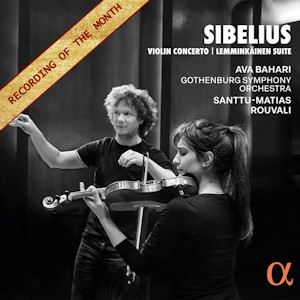
Jean Sibelius (1865-1957)
Violin Concerto in D minor, Op. 47 (1905)
Lemminkäinen Suite, Op. 22 (1896)
Ava Bahari (violin)
Gothenburg Symphony Orchestra/Santtu-Matias Rouvali
rec. 2024/25, Gothenburg Symphony Hall, Sweden
Alpha Classics 1215 [81]
Paris-based Alpha Classics is one of the busiest, most active classical labels around today and is responsible for issuing a really impressive series of Sibelius recordings with the Gothenburg SO conducted by Santtu-Matias Rouvali, most of which I have enthusiastically reviewed. This is the latest in that sequence.
Swedish violinist-in-residence Ava Bahari is up against some formidable competition when it comes to recordings of Sibelius’ violin concerto. I discuss many of them in my review of James Ehnes recent account, a version which my colleague William Hedley (review) liked more than I, as I felt there was something of a mismatch between conductor and soloist. There are also many celebrated recordings of the four Lemminkäinen Legends, such as that by Leif Segerstam in Helsinki. Nonetheless, this new recording need fear no comparison.
In my review of Ehnes’ recording, I made something of a meal of comparing the timings of the individual movements of seven versions but need only say that Bahari’s are very much middle-of-the-pack with no eccentricities. Nor do I sense any lack of congruity between conductor and violinist here; Bahari’s dark, very slightly wiry tone is ideal for setting the requisite mood of yearning but she also soars sweetly, as if in supplication, and when the orchestra launches into the angry second theme, she finds real bite and snap for the developmental cadenza – and her intonation is superb. Rouvali’s accompaniment is discreet without being bland; most of the time he gives his soloist the spotlight but has his low strings growl and his brass blare menacingly before the reprise of that wonderful opening melody and its always surprising conclusion, first serene then stormy, exquisitely played.
The Adagio breathes both tender resignation and quiet determination; again, I admire the sonority of Bahari’s instrument, matched by the depth of sound from the lower strings when they intone their challenge around three minutes into the movement before the central double-stopped passage for soloist. The balance between her and the orchestra here is perfect; it is as if each is exhorting the other and the result is supremely satisfying.
The finale is thrilling; Rouvali and the sound engineers again ideally gauge the balance between the soloist and the thundering timpani and the violin positively skips over adversity, through the syncopated rhythms and glassy sul ponticello interludes, to triumph. This is what happens when artists are collaborating in harmony; it is music-making at its best.
How different is the driven, epic mood of the first Lemminkäinen legend – yet still so recognisably Sibelian. This is fascinating, complex music; the depiction of the lusty hero is given a really energised delivery by an orchestra on top form. Yet again, I must praise the skill of the sound engineering here; there is so much going on at any point in this music, it is so densely scored, yet individual instrumental lines emerge cleanly.
The Swan of Tuonela is of course the most famous number here and it receives a highly atmospheric performance – not “floaty” and ethereal but dark, brooding and melancholy, as befits the depiction of the bird which floats on the Finnish mythological equivalent of the Greek Styx – the river of the dead – and for me recalls Rachmaninov’s equally masterly Isle of the Dead. A very slightly faster tempo than is customary underlines that sense of threat – but who is the accomplished cor anglais soloist? The credits in the booklet do not say; I wonder if it is Carolina Grimme, one of the three oboists, who, we are told, plays only in the suite.
The two movements narrating the hero’s demise and resurrection are vividly executed with palpably intense concentration; there is a Wagnerian momentum to the opening of Lemminkäinen in Tuonela akin to the start of Die Walküre, which is played on a grand scale – and kudos to the timpanists throughout. The eery, shimmering passage beginning at 9:24 is especially striking and macabre, building to a frighteningly stark and powerful climax. Lemminkäinen’s Return features the scurrying flurries of notes on the lower strings that we recognise as a Sibelian trope and it builds inexorably to another rousing, pounding conclusion; Sibelius was just so good at surprising endings which leave the listener breathless and Rouvali and co. know exactly what to do with this music.
This is a great pairing providing over eighty minutes of Sibelius at his best; Rouvali here sustains the standard of his Sibelius series which, once complete, will surely be collected in a highly desirable box set.
Ralph Moore
Buying this recording via the link below generates revenue for MWI, which helps the site remain free
Lemminkäinen Suite:I. Lemminkäinen and the Maidens of the Island
II. The Swan of Tuonela
III. Lemminkäinen in Tuonela
IV. Lemminkäinen’s Return













