
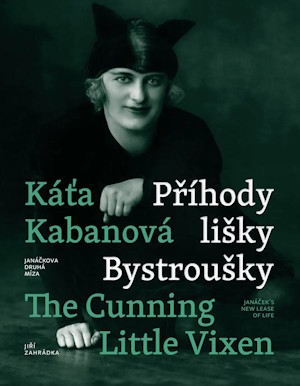
Káťa Kabanová and The Cunning Little Vixen: Janáček’s new lease of life
by Jiří Zahrádka
Published 2026
542 pages, hardback
ISBN 9788027527793
Moravské Zemské Muzeum
This is the latest volume in Jiří Zahrádka’s examination of Janáček’s major operas (review ~ review), a project that should finish in 2028, the centenary of his unexpected death, from pneumonia. As I’ve written before, Zahrádka is curator of the Janáček archive of the Department of Music History at the Moravian Museum, and an associate professor at the Department of Musicology, Faculty of Arts, Masaryk University. He has been active as a critical editor of the most recent editions of the composer’s works and has published widely. His approach to the two operas in this volume is historiographical and wide-ranging and the text is dual language, Czech in the left column, English in the right. In a previous review I left it to the end to point out that the translator is Graeme Dibble but in this review I will point it out here as – and this applies to many translations, not least fiction – his name is printed, semi-invisibly, along with the publication data. If I have a gentle criticism, it’s that his name should be much more prominent as should that of Barbara Zemčík, who is responsible for the book’s magnificent layout.
Káťa Kabanová and The Cunning Little Vixen are the first two operas of the composer’s last decade and both share dramaturgical cohesion and musical unity, elements that Zahrádka is well placed to explore. This period was the time when the Czechoslovak state was established, after the collapse of the Austro-Hungarian empire and Janáček, who was enjoying a certain cachet after the performances of Jenůfa in Prague, was positioned, despite his age, to develop his idiosyncratic operatic ideas still further. Before delving into the subject proper, Zahrádka introduces The Diary of One Who Disappeared, the song cycle that the composer conceived in semi-staged terms, and which thus makes it relevant in the operatic context of these volumes. The cycle was also conceived in biographical terms as the Gypsy Girl was indissolubly linked with Kamila Stösslová, whom Janáček had met a few years earlier in 1917 in the Moravian resort town of Luhačovice. It was his student, Břetislav Bakala, who rescued the score from the composer’s famous painted chest of scores and ensured the première. He recalled that the composer wanted the tenor to sit by a small table on a darkened stage, standing only in dialogue with the Gypsy Girl, thus to convey the confessional and dramatic reality of their exchanges. Max Brod, one of the most important of the composer’s friends, not only as a translator but as a perceptive and forward-thinking critic, heard the premiere and termed The Diary ‘in itself a small opera’. Janáček was even asked to orchestrate the work, a project that ended with his death.
He had strongly artistic Russophile leanings and was next drawn to Alexandr Ostrovsky’s play The Storm, with its strong story and realist context. Those interested in his affinity with nineteenth-century Russian literature will find an admirable summary here. He adapted the play himself and you can see his crossings-out and additions in the surviving reproductions of the text printed in this volume. His adaptation was considerable, substantially altering the drama, but keeping the action taut. Ever Romantic, though brittle with it, he saw a performance of Madama Butterfly in Brno in December 1919, instantly making connections between Butterfly and Kamila, elements that were strongly to inform the direction of the opera. This typically took several revisions to reach completion, and even the title was settled very late. He considered The Storm, Kateřina and even Jekateřina – something of a Janáčekian joke, as Jenůfa was enjoying a long run. There are tables that delineate the 1920 and 1921 revised versions of Káťa Kabanová and the specific differences between them and, indeed, Ostrovsky’s play.
Despite the success of Jenůfa and as so often, Prague – which hadn’t forgotten the Brouček fiasco – was lukewarm about taking on the premiere of Káťa Kabanová so Janáček offered it to Brno where he was humbleness itself in correcting the score for the conductor František Neumann who, incidentally, shared his surname with Kamila Stösslová (her maiden name was Kamila Neumannová). The opera’s première was attended by Max Brod who proceeded to write numerous reports for the various German-language papers for which he wrote in Prague. A man of a similar mind was the musicologist Vladimír Helfert who wrote a memorable review on 26 November 1921 which focused on the work’s ‘elemental verve combined with a rapidity of musical ideas, a powerful and unstoppable dynamic momentum, while the musical ideas are aphoristic as it were, keenly and suddenly bursting from a hot spring.’
The translation of the text into German naturally fell to Brod and divergences from the original Czech text, small disparities from the composer’s dramatic meaning, now began to insinuate themselves in the translating process – something that happened even more strongly in The Cunning Little Vixen. That said, the Brno premiere disappointed Janáček who hoped that a Prague performance would be better. He invited the country’s President, Tomáš Garrigue Masaryk, to the premiere, but the President was a Smetana man and declined. So did Kamila and even his wife Zdenka stayed at home in Brno. The photographs that document the Prague production includes the stage scenery and the singers in their costumes are beautifully reproduced on pages 141-143.
The perceptive composer Boleslav Vomácka wrote that ‘Káťa Kabanová is a thoroughly modern work and unique within world literature. The content relates to modern man’s most pressing and current interest – an interest in mankind…The originality of invention in form is matched by the originality of the musical approaches…’ but he was a lone voice, with the dogmatically hierarchical Nejedlý again asserting the ‘true’ lineage of Czech opera, which in his formulation went Smetana-Fibich-Foerster-Ostrčil. Amongst the many photographic glories of this volume is the two-page full cast photographs of the Prague production with each character identified by name. Largely because of the partial success of Jenůfa in Germany, Káťa Kabanová was performed in Cologne, conducted by Otto Klemperer, though it was poorly received. A Berlin production followed in 1926 and a few photographs are preserved in this volume but the conductor, Fritz Zweig, from surviving timings, seems to have erred on the side of caution. It’s notable that German critics were much more receptive to Janáček’s orchestral writing though they remained stubbornly allergic to his vocal setting. Of other sparse performances before the composer’s death probably the most notable was by Wiliam (then Hans Wilhelm) Steinberg at the New German Theatre in Prague who seems to have done what Erich Kleiber did for Jenůfa, which is to deliver an idiomatic, thoroughly convincing reading. That he understood the opera’s tragic lyricism and small-scale intimacy is a tribute to Steinberg’s theatrical acumen but mainly, of course, to the composer’s vision.
Liška Bystrouška (Vixen Sharp Ears) which was to becomeThe Cunning Little Vixen was a serialized novel written by Rudolf Těsnohlídek accompanying drawings by Stanislav Lolek. It appeared in the Brno journal Lidové noviny during 1920, which is where the composer first saw it, and was published in book form the following year. All the drawings are reprinted on pages 244 to 261. The opera, a ‘forest idyll’, was informed by a number of influences, amongst them the composer’s admiration for Rabindranath Tagore, who visited Prague in 1921 and left a lasting impression on Czech intellectual life. Tagore’s humanism fused with the composer’s pantheistic inclinations to develop a hymn to the cycle of human and animal life.
As so often with Janáček’s manuscripts, that for The Cunning Little Vixen no longer exists in full, though there are 700 surviving pages. Though he made preparatory work in mid-1921, he began his writing properly in January 1922. Incidentally, Zahrádka tells us that the completed full copy of the score was stolen in the mid-60s in Prague during preparations for a recording. I suppose that this can only have been for Bohumil Gregor’s recording of 1972 but in any case the stolen score was offered for sale in the 1980s but has never been seen since. Of all the operatic productions, this one has the most glorious reproductions. The stage designer Eduard Milén’s sketches for the costume design are reproduced in colour and occupy eight pages and are followed by two full pages of stage designs. There are also archive photographs of the leading singers in costume. The composer was insistent that the designs were realistic not mere props and he was an attentive presence at the final rehearsals. The work was well received in Brno at its November 1924 premiere, but Prague proved indifferent, as ever. At least Max Brod was at his perceptive best in the pages of the Prager Tagblatt and, even more so in the Prager Abendblatt when he was among the few that heard Bakala play through the opera for potential publishers in Prague. Bakala, naturally, had a wasted journey. No one was interested.
Brod’s translation of the text into German was jeopardised by the death of his closest friend, Franz Kafka, in June 1924 and when he began work on it, he modified the Czech text, subjecting it to a fundamental revision, losing, it’s asserted here, the essential naturalness of the original. Meanwhile Prague finally consented to mount a production with costumes and stage design the work of Josef Čapek, the designs of which you can find on pages 376-389; once again these are gloriously reproduced and in full colour. The composer didn’t like the direction of Ferdinand Pujman, however, and Janáček’s lifelong nemesis Nejedlý then gleefully called him ‘primitive’ sixteen times in an article. Fritz Busch showed cursory interest in a German production and its première there was in Mainz in 1927.
For an opera in which one third features no singing and which celebrates ballet, pantomime and orchestral interlude, The Cunning Little Vixen offers a perfect symbiosis of theatre, ideas, words and music. This is the perfect entrée to its humanist idyll, though it’s one tinged, as Max Brod saw, with the ‘unavoidable evil’ that always returns, cyclically, despite our best attempts to banish it.
Once again, the volume is virtually blemish-free, I only noticed one slip, on page 16, where ‘ageing conductor’ should read ‘ageing composer’. Otherwise, it offers compendious historiographical information with timelines, lists of productions, a glossary of selected individuals and full footnotes.
Jonathan Woolf
Buying this recording via the link below generates revenue for MWI, which helps the site remain free














