
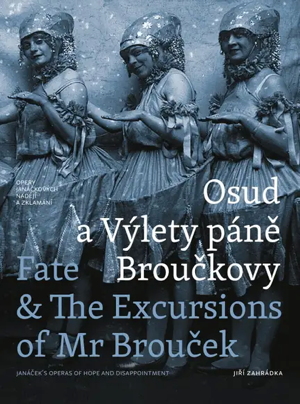
Fate and The Excursions of Mr Brouček
Janáček’s Operas of Hope and Disappointment
by Jiří Zahrádka
Published 2023
502 pages, hardback
ISBN 9788027517893
Moravské Zemské Muzeum
The second volume in this series of studies of Janáček’s operas is again the product of Jiří Zahrádka, curator of the Janáček archive of the Department of Music History at the Moravian Museum, and an associate professor at the Department of Musicology, Faculty of Arts, Masaryk University. He has been active as a critical editor of the most recent editions of the composer’s works and has published widely. Zahrádka wrote his book on Jenůfa intending it to be a standalone project but it generated a life of its own and the volumes are published to reflect the chronological composition of the works in question and are scheduled to end in 2028, the centenary of the composer’s death. Zahrádka published the critical edition of The Excursions of Mr Brouček for Universal Edition and in 2012 Bärenreiter’s critical edition of Osud. Again, as in his earlier volume, his approach is historiographical and he seeks to eliminate errors that attach like barnacles to the hull of Janáček scholarship.
This volume is devoted to two of his most intractable operas. I won’t say ‘unstageable’ because they have been staged. I saw the English National Opera performance of Osud (hereinafter ‘Fate’) in its British première in 1984 when it formed part of a double-bill with Weill’s Mahagonny Songspiel. From memory, Lionel Friend conducted. The Excursions of Mr Brouček saw premieres in Britain in 1979, again at ENO, and in the USA in 1981. There have been productions at Grange Park Opera and Opera North in recent years but concert performances are more usual. Thankfully, a very recent National Theatre Brno production directed by Robert Carsen and featuring Nicky Spence has been seen, though in decidedly modernised form. All in all, however, the book’s subtitle, Janáček’s Operas of Hope and Disappointment, remains apt.
Disappointments they may have been for the composer, but they are significant staging points from Jenůfa to his mature operas. The genesis of Fate (1903-06) seems to have been a love story from her youth told to the composer by Camilla Urválková whilst they were staying in the spa of Luhačovice. Though their affair petered out, it lasted from 1903-09 and led to severe tensions in Janáček’s marriage. Their letters reflect a kind of heightened stylisation – she called herself ‘Tatyana’ (reflecting the influence of Pushkin) – and this seeped into the work’s libretto into which notated speech, of course, plays a significant part. One chapter reprints the composer’s ‘My Luhačovice’ which is littered with speech notation and another reflects upon the influence of Charpentier’s Louise on the composer, an element that ran strongly through the earlier volume. This includes an extract from Janáček’s own text, ‘Musical forms’ from 1915-19, in which he asserts that ‘Only three composers have written operas using natural human speech rather than formal speech…Mussorgsky: Boris Gudunov, Charpentier: Louise, Janáček: Jenůfa.’
Charpentier’s influence extended beyond the use of speech rhythms and included real sounds in the score – the sewing machine, a striking clock, the bell of a knife grinder, a barrel organ – though the difference was that Charpentier’s music remained ‘beautiful’, whereas Janáček always prized truthfulness over beauty, with the result that on occasion – and I happen to feel this most especially in Mr Brouček – declamatory vocalism becomes too dominant. In the years after the First World War, he even went so far as to repudiate Charpentier’s use of rapidly alternating leitmotifs, calling them ‘shallow. A mosaic.’
The librettist of Fate was a family friend, Fedora Bartošová, a teacher and poet. The subject of Janáček and his librettists is a vexed one and would make a compelling, if wearying book in itself (maybe there is one) so exacting was the composer and so frequent his demands for rewrites and greater fidelity. He even wrote to the Prague Institute for the Insane asking for instances of speech melodies by an inmate plagued by money concerns which would have been used for a character in the opera. Not surprisingly they couldn’t help, any more than could a similar institute in Brno. Sometimes he could take things too far in his mania for authenticity. Fortunately, Bartošová left behind some entertaining and revealing reminiscences which are included in this book along with reproductions of some of her manuscripts of various scenes from the opera with the composer’s notes. After the prose libretto for Jenůfa, Janáček asked for a libretto in verse – in iambic tetrameter, no less – which stood against his aesthetic for realist opera but possibly reflected the prevailing influence on him of Tchaikovsky’s Eugene Onegin. It’s instructive, again, to reflect on how influenced he was by so small a number of operas.
His unease over structure led at one point to his suggesting that the first and last acts should be swapped but exact analysis of the various forms through which the opera went are difficult to reconstruct as, as in the case of Jenůfa, no autograph of Fate exists. He certainly knew that a Brno première would be problematic, given the understaffed nature of its opera orchestra and the reluctance of some singers to take on roles so he tried Prague but procrastination at the new Vinohrady Theatre, a respectable house rather than a big one, duly followed. These delays were then followed by legal problems – at this stage in his career Janáček and the Law were never far apart (another useful subject for a monograph) and by 1913, a decade after he had first begun work on Fate, engaged singers refused to sing their parts in case it damaged their voices.
He was fated never to hear Fate performed. It was broadcast in Brno in 1934 on what would have been his 80th birthday. It was first seen on stage in 1958 in Brno but in an adapted form. Its complicated subject matter, the oddity of its text, and its running time of around 80 minutes necessitating a double-bill, all counted against it. Recordings have helped to advance audience sympathy for a quixotic, curious but compelling opera which I still remember from all those years ago.
If you thought Fate caused colossal problems, things became even more complicated with The Excursions of Mr Brouček, the sole example of the absurdist impulse in his work. With Fate finished in 1906 he looked around for a literary text and even went as far in 1907 as reconsidering Gabriela Preissová’s The Farm Mistress which had already been set by Josef Bohuslav Foerster, as Eva. As readers of the earlier volume will know he’d already considered and dismissed this before starting work on what would become Jenůfa and it wasn’t like Janáček to look backwards; if anyone faced forward it was Janáček, so this signifies a certain insecurity of direction. However, a new opportunity presented itself when a leading Czech writer, Svatopluk Čech, author of The True Excursion of Mr Brouček to the Moon, died in February 1908. Back in 1888 the composer had been in touch with Čech asking for permission to reprint parts of his novel in Janáček’s Brno journal, Hudební listy so he was clearly familiar – or had been familiar – with the text. And he wasn’t the first. Janáček’s musical nemesis Karel Kovařovic had already set it in 1894. The text offers numerous opportunities to tilt at the pomposity of Prague intellectuals and it’s almost unique to find Janáček setting a comedy. Say what you will about his operatic genius, his works are not a barrel of laughs.
The problem with the opera turned out to be a workable libretto which took nine years to iron out. The book’s accompanying illustrations were important to the composer, who stuck closely to Čech’s text. Then there was another problem. The stimulus of Čech’s death meant that a contemporary of the composer, Karel Moor, whom Janáček liked, also set it, albeit as an operetta – shades of the controversy a few years later in England when both Elgar and Cyril Rootham set For the Fallen. Moor’s version appeared in 1910 and Janáček pursued his operatic vision, remaining exacting, to put it mildly, on the succession of librettists who had a hand in the work. The librettists (some aggrieved by the process) are several and varied and it’s quite confusing to follow the work’s gradual development so readers will be thankful for the appendices at the back of the book which include a glossary of selected individuals and a rather frightening graph of the various sources for the opera.
At some point the composer realised the work was, like Fate, too short so he expanded it to include The Excursions of Mr Brouček to the 15th Century. In addition to length there was also, by this point (1917), incipient political reasons to do so – the dissolution of the Austro-Hungarian Empire was only a year off – but the composer’s practical problem was how to unify the two disparate texts. In comparison with Part 1, the second part of the work saw harmonious relationships with his librettist. However, as ever, a first production proved problematic. Though he’d touted the work as ‘a burlesque opera’ to Kovařovic in Prague, the city’s National Theatre was not ready for it – there were problems with the sets and the singability (or otherwise) of the roles, and Kovařovic was in increasingly poor health. Casts were invariably semi-mutinous whenever a Janáček opera was being prepared in these years. ‘Slap Janáček’ was often heard when the work was finally rehearsed in early 1920. The premiere was in April, and you should on no account miss the evocative photographs of the stage sets on pages 334-336 or Josef Čapek’s coloured illustrations of his costume and stage designs for the later Brno production on pages 380-81.
The opera’s reception was lukewarm at best. The Brno première, of Part 1 only, came in 1926 and after the composer’s death came the first radio broadcast in 1936 of the complete opera using the original 1917 version. For all its kinship with the slapstick post-war age, for sharp intercutting that could almost be cinematic, and for its cabaret-burlesque elements with appropriate debunking of intellectualism, the opera never caught on. Fortunately, recordings have helped plug that gap. For the ultimate in ‘back-stage’ appreciation you should read the appendices which include the recollections of his major collaborator in the writing of the opera, Viktor Dyk, and also those of the (aggrieved) librettist Jiří Mahen.
I admired Zahrádka’s cheeky wordplay on the name Osud or Fate in a couple of his chapter headings (sample: ‘Osudové setkání’ translated as ‘A Fateful Encounter’). Once again this is a dual-language book, on each page Czech in the left margin and English in the right. His text has been beautifully rendered into English by Graeme Dibble who also, with Suzanne Dibble, translated the earlier volume. I wish their names were more prominent in both volumes and I wish I had had the foresight to commend their splendid translation in the Jenůfa volume.
This book offers expansive but not exhausting historiographic analysis of the genesis of both these problematic operas. As well as being beautifully produced with wonderfully clear photographic and other reproductions on almost every page, the text is clear and most attractive. The book is a sturdy hardback uniform with the previous volume and every Janáčekian should have a copy.
Jonathan Woolf
Buying this book via the link below generates revenue for MWI, which helps the site remain free














