
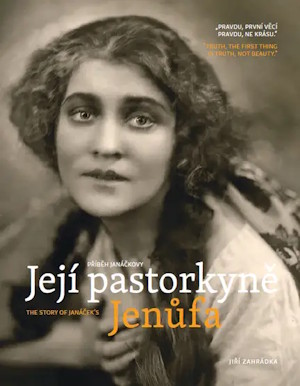
The Story of Janáček’s Jenůfa
by Jiří Zahrádka
Published 2021
365 pages, hardback
ISBN 9788070285541
Moravské Zemské Muzeum
This is the first in a series of three monumental studies of Janáček’s operas written by Jiří Zahrádka, curator of the Janáček archive of the Department of Music History at the Moravian Museum, and an associate professor at the Department of Musicology, Faculty of Arts, Masaryk University. He has been active as a critical editor of the most recent editions of the composer’s works and has published widely. The volume under review was published in 2021 and I will also be reviewing the companion books, one of which was published this year, which cover Osud (Fate), The Excursions of Mr Brouček, The Cunning Little Vixen and Káťa Kabanová. I assume a forthcoming volume will cover From the House of the Dead and The Makropulos Affair in time for the centenary of the composer’s death, which falls in 2028. Each is dual language, with Czech in the left-hand column and English in the right.
It’s appropriate that Jenůfa, which is better-known in Europe as Její pastorkyně (Her Step-Daughter), has a volume to itself as it’s Janáček’s most performed opera and represents the axis point of his development as a composer. Reading these volumes alongside John Tyrrell’s two-volume biography of the composer will provide a comprehensive vantage point from which to discover pretty much everything about Janáček and his compositions and it’s appropriate that in his introduction Zahrádka sends his personal thanks both to Tyrrell and Charles Mackerras, who had both died before the publication of this volume.
For a composer whose direct experience of opera in Brno was rather limited, and who was tethered to local choral and other musical societies, and to life as a music critic, it’s remarkable that he developed so idiosyncratic and nationalistic a compositional style almost in defiance of accepted norms. One of the things Zahrádka (and Tyrrell) make clear, though, is the direct influence on him of certain operas and the long gestation period necessary for him to reformulate them in his own striking idiom. These include Mascagni’s Cavalleria rusticana, which Janáček first saw in 1892, and Tchaikovsky’s Queen of Spades, which he saw four years later, but the most pivotal work was Charpentier’s Louise, which premiered in 1900, and which Janáček saw in Prague in 1903. It’s striking that he went to such lengths to confuse the issue of Jenůfa’s composition date and directly to assert that it pre-dated Louise. It did not. It can now be dated to the years 1900-03 and was published in 1904, notwithstanding his own assertion of a composition date around 1897.
Part of the evasion was surely nationalistic, a desire to promote his own Moravian brand of speech-patterned drama, and part was personal – he wished to be seen as an instigator not a follower. And, in fact, there was a much closer competitor composer, one who shared, if only briefly, a drive towards realism in opera – Josef Bohuslav Foerster. Both composers had an admiration for the theatrical works of playwright Gabriela Preissová. Janáček had seen her play Her Step-Daughter in 1901 but it was Foerster who won her permission to compose The Farm Mistress, which became the opera Eva, and which premiered in 1899.
Janáček destroyed the autograph of the opera in 1910, so reconstruction of his precise creative processes is inevitably hampered. Its genesis also overlapped the death of his beloved daughter, Olga, so perhaps this too served to add another layer of complexity to the genesis of the opera and to his feelings about it. She asked him to play it through to her on the piano whilst on her deathbed which he is said to have done, even on the very day she died in 1903 at the age of 20. He placed the opera’s last page in her coffin, according to an onlooker.
The story of the opera’s rejection by Prague’s National Theatre is told coolly but sympathetically, and this sympathy extends to Karel Kovařovic, its director, harassed and over-worked and under pressure to study new Czech works. Kovařovic, now only known for his opera The Dogheads, is something of a bête noir amongst Janáček admirers. Janáček was some years his senior and, in his capacity as a Brno critic, had reviewed derisively Kovařovic’s operas. The mutual antagonism persisted but in fairness to the Prague director, early performances of Jenůfa, one of which he saw in Brno, were shambolic with an understaffed orchestra and a cast reluctant to sing a work whose idiom was so unusual to them. Performances improved once the singers mastered their roles, but orchestral forces remained quixotically sparse – Janáček asks for three flutes in the opera but at one performance there were no flutes at all – and performances continued to be erratic, with the Brno orchestra often numbering a mere twenty players. One intriguing episode concerns Mahler, whom Janáček invited to Brno to hear the work. Mahler was too busy in Vienna, though he did ask for a German language vocal score, which didn’t yet exist.
As well as being a so-called provincial trying to gain acceptance from Prague, Janáček had to cope with the doctrinaire and politicised judgements of anti-separatists who viewed Moravian individuality with disquiet and disapproval. These views were exemplified by the Smetana adherent Zdeněk Nejedlý, who contrasted Jenůfa with Foerster’s Eva and found it ‘old fashioned and primitive’, decrying its favouring speech-melody setting and advancing the primacy of voices. It was to be twelve years before the score, significantly amended, was to reach the Czech capital with Kovařovic aligning it along his own compositional principles. It was published with these alterations included – alterations Janáček disowned after Kovařovic’s death.
The importance of Max Brod in relation to the German-language translation, not least the Universal Edition of the piano-vocal score, is duly acknowledged (the publisher released the full score in 1918) and there is also a brief, tantalising and relevant appearance from Franz Kafka: ‘‘I received Jenůfa. Reading it is music. The text and the music have brought out what is essential. But you have transferred it into German like a giant. How you made the repetitions breathe with life…’’ he wrote to Brod in 1917, finishing though with the question ‘‘Shouldn’t there be an explanation for the meaning of ‘Kostelnička’?’’ It seems, though, that Kafka never heard the opera or indeed any of the composer’s music – there would have been very limited opportunity for anyone to hear it in Prague during these years.
The spreading international success of the opera began with the Vienna production of February 1918 though this ran into political problems, one critic accusing it of being ‘a provocation against German Vienna’. This should be seen in the context of the imminent dissolution of the whole Austro-Hungarian edifice at a time when Imperial Vienna vainly sought to batten down calls for Czech and Slovak autonomy. Otto Klemperer conducted it in Cologne just a few days after the Armistice. However, it was the Berlin production in 1924, presided over by Erich Kleiber, rehearsals and performances of which Janáček attended, that was pivotal for future German performances. His admiration for Kleiber, who had studied in Prague and conducted the Prague German Opera, was boundless. Later that year, a run at the Metropolitan in New York under Artur Bodanzky with the Moravian Maria Jeritza (born Jedlitzková) in the title role, was cooly received.
There is much to savour in the composer’s uneasy professional relationship with Preissová and specifically over the financial rights issues owing to her for Jenůfa. There are also references to the first radio broadcast of the opera made in Brno and the tantalising 1929 silent film with Gabriela Horvátová, who’d sung in the 1916 Prague premiere. Might it survive?
There are very few typos. I only noticed ‘Rose’, for Rosa Newmarch and, for currency fiends, the use of the British ‘shilling’ rather than the correct (Austrian) schilling.
The book is in 11 x 8-inch format and is profusely and beautifully illustrated. There are photographic reproductions on almost every page and some are full-length, whether letters, the composer’s written sketches, concert programmes, stage designs (some in colour), photographic portraits – the one of the first conductor of the opera, Cyril Metoděj Hrazdira, is particularly wonderful – or cast members. The sequence of preserved photographs of the cast of the Prague production in costume occupies nine pages and is something special – evocative and resonant, as well as preserving photographic evidence of the detailing of specific costumes worn.
Details of the revisions of the opera are forensic and yet easy to follow. Income earned by the composer for the opera is tabulated and there are full cast lists of nine important productions from 1904 to 1928, the year of Janáček’s death, as well as brief details of many more – location, conductor, director – across the continent from Lvov in 1926 to Antwerp the following year and from Prostějov in 1916 to Dortmund in 1928.
Twenty years ago, the National Theatre in Prague published a book on The Bartered Bride which presented a Czech-language text celebrating the photographic heritage of significant productions of the opera from 1866 to 2004. Jiří Zahrádka has done something both more specialised and yet more important here, focusing on the genesis and development of Janáček’s first great opera, charting its difficult birthing pains, documenting its various revisions, editions and translations, and introducing the reader to the various tensions – personal, ethnic and political – that at first hindered its acceptance in the wider world. Now it’s the most performed of all Czech operas and Janáček has overtaken Smetana and Dvořák as the most popular Czech operatic composer. This competitively priced book fully embodies the composer’s own realist moto; ‘Truth, the first thing is truth, not beauty.’ Though its production is a thing of beauty too.
Jonathan Woolf
Buying this book via the link below generates revenue for MWI, which helps the site remain free















”Now it’s the most performed of all Czech operas”
Not according to Operabase. It’s nowhere to be found in their top 50 most performed in the world. Rusalka sits at number 35.
Surely that is regarding the popularity of all operas, Kevin, not just the Czech ones? It is probably true that “Rusalka” still rules but I suspect that “Jenufa” has had more recent performances and my colleague JW is merely repeating the claim made in the book. Most data-bases we can access on the Internet seem to indicate that the top five Czech operas as performed in recent decades worldwide are as follows: 1.Smetana: The Bartered Bride (often scheduled in German-speaking festivals and in the homeland); 2. Dvořák: Rusalka, then these three by Janáček: 3.Jenůfa; 4. The Cunning Little Vixen; 5. Káťa Kabanová.
I can’t say that surprises me but I speak as someone who heretically doesn’t actually much like the famous Czech operas (sorry); which is why I have never done a survey of any of them .