
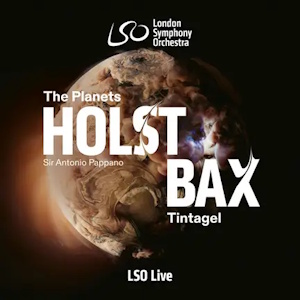
Gustav Holst
The Planets
Arnold Bax
Tintagel
London Symphony Orchestra/Sir Antonio Pappano
rec. 12 September 2024 (Planets) and 15 December 2024 (Tintagel), Barbican Hall, London
Hybrid SACD
LSO Live LSO0904 [69]
With repertoire staples like The Planets, it’s not always clear that a new recording justifies itself, especially when an orchestra like the London Symphony Orchestra has already recorded it multiple times including, with the composer himself in 1926. I’m not 100% convinced that this one fully justifies itself, but there’s nevertheless a lot to enjoy in it.
The best thing about is Antonio Pappano. The Planets plays excellently to his manifest theatrical gifts, and right from the very start you can sense him leaning into the work’s dramatic contrasts. The dreadful opening tread of Mars has a fantastically palpable hard-bitten edge that doesn’t let up, and the rest is built persuasively onto that, growing inexorably without losing colour and orchestral power. Even at the biggest climaxes, everything is cleanly delineated and precisely articulated, and there is a similar edge to Jupiter. Its opening isn’t just bubbling chatter, it has serious teeth, and swagger, too, when required. However, this melts into persuasive nobility when it’s needed for the big hymn tune, and the strings rise to that magnificently.
One commentator has argued that Pappano conceives The Planets more symphonically than as a collection of movements. I’m not entirely sure I buy that but, because of the similar feeling of Mars and Jupiter, there’s a case for seeing the first four movements as a semi-symphony. If Mars and Jupiter are its outer movements then Mercury fits into it as a quicksilver scherzo, and Venus serves as a luminescent contrast, with sensitive playing and some delicately beautiful solos.
The last three movements hang together like a trilogy, too, bookended by the grave mystery of Saturn and Neptune. The former, with its remorseless tread, is full of terrifying colour that sweetens into something beatific at the end, and its coda features some of the most lyrical double bass playing you’ll hear. There is then an unusual poignancy to Neptune, a touch of sadness alongside the resolute wonder and awe, and Pappano shapes it in a sway that the music gradually swells out as though filling infinite space. Tenebrae make for very high-class choral support in the final pages, though the final fade-out feels somewhat curt. In between, there is honky-tonk puppetry and terrific technical wizardry in a Uranus that becomes overgrown and gargantuan without ever descending into parody. Unfortunately, you can hardly hear the organ, but that might be a Barbican thing.
Bax’s marvellous Tintagel features similar drama and colour, with heroic horns, unstoppable sea-swell in the basses, and marvellous, sweeping violin tone at the upper end.
So this disc doesn’t replace Boult with the LPO, nor more recent planetary marvels from Dutoit in Montreal or Rattle in Berlin, but it’s a satisfying listen, and worth hearing for Pappano’s theatrical vigour.
Simon Thompson
Other review: John Quinn
Buying this recording via the link below generates revenue for MWI, which helps the site remain free













