
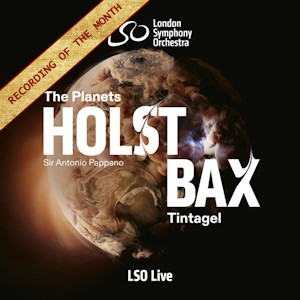
Gustav Holst (1874-1934)
The Planets, Op 32 (1914-17)
Sir Arnold Bax (1883-1953)
Tintagel (1917-19)
Tenebrae
London Symphony Orchestra/Sir Antonio Pappano
rec. live, 12 September, 2024 (Planets), 15 December, 2024 (Tintagel)
LSO Live LSO0904 SACD [70]
Sir Antonio Pappano and the LSO have been committing to disc quite a lot of British music of late. There’s the so far excellent Vaughan Williams symphony cycle, which is evolving over time, and I’ve heard from several sources that Elgar’s The Dream of Gerontius will be recorded at performance in the Barbican in April. This latest release brings live accounts of important orchestral works by two other English composers.
The principal offering is Holst’s The Planets. Although it’s a work I know very well, I realised as I started my listening that I haven’t heard it for a while. This new Pappano version, therefore, came very fresh, about which I was glad. ‘Mars, the Bringer of War’ made a strong, positive impression on me. Right from the start, I noted measured, menacing energy. The performance is tense and powerfully projected. It’s also taut; the rhythms are crisply defined. This is a terrific start to the work as a whole. I was just as struck by the translucent beauty with which Pappano and his orchestra portray ‘Venus, the Bringer of Peace’. In this movement, the playing is highly sophisticated; every nuance of Holst’s scoring comes across. There are many fine solos to admire, not least from the leader, Benjamin Gilmore. This is an outstanding account of ‘Venus’ and it offers, as the composer surely intended, a wonderful contrast to the brutality of ‘Mars’. ‘Mercury, the Winged Messenger’ fairly scampers along; the music is as fleet as you like. Pappano and the LSO ensure that we experience the deftest of scherzos.
‘Jupiter, the Bringer of Jollity’ is depicted with robust and cheerful bonhomie. I very much welcomed the fine flow that Pappano imparts to the justly famous Big Tune. Some conductors seem to feel obliged to invest the tune with too much gravitas; Pappano, however, ensures that the melody has good momentum. ‘Saturn, the Bringer of Old Age’ may raise one or two eyebrows because Pappano adopts quite a measured tempo. I have at least six versions of The Planets in my collection and when I’d finished listening for the first time to Pappano’s performance I took a look; all of them take roughly between 8:00 and 9:30, whereas Pappano’s account plays for 10:30. I thought that his patient, measured basic speed works extremely well. At the outset, he and the LSO bring out the mysterious, gaunt majesty in Holst’s music. Gradually, Pappano builds to the immense chords at the movement’s climax and then the music recedes into the hushed intensity with which we began. In the closing pages, the listener gets a real sense of the planet maintaining its distant orbit and forbidding mystery. In his perceptive notes, Stephen Johnson refers to the “sinister, sometimes brutal humour” of ‘Uranus, the Magician. The present performance lives up to that description. Here, at the height of the movement I wondered if the recorded sound was just a bit too immediate, though oddly that hadn’t previously crossed my mind. Finally, we’re taken to the unique soundworld of ‘Neptune, the Mystic’. Not for the first time as I listened to this startlingly original music, I wondered if Vaughan Williams had the sound of his old friend’s portrayal of this planet in his mind when he composed the last movement of his Sixth symphony. Pappano leads a performance that generates a wonderful, rarified atmosphere; the LSO’s playing is superbly controlled and very subtle. The offstage chorus is provided by the sopranos and altos of Tenebrae – twelve voices in each section. Their distant, ethereal voices are ideally balanced until, eventually, they fade away from our consciousness.
The Planets is such a familiar work nowadays that I worry that we might come to take it for granted, forgetting how radical and original both the music and the scoring of these seven pieces was at the time that Holst composed the work. What imagination he possessed! This outstanding performance by Pappano and the LSO has rekindled my profound admiration for this masterpiece.
As a substantial bonus, Pappano conducts Bax’s tone poem Tintagel. This comes from a concert given three months after the Holst. The highly atmospheric rendition of the majestic opening grabs the listener’s attention and thereafter the performance continues to be compelling. I love the ardour with which the LSO plays Bax’s sweeping string lines, while the brass are noble throughout. In the central quick section, the playing is suitably volatile. This is a version of Bax’s great score that is passionate and also rich in atmosphere. Indeed, I can’t readily recall hearing a performance that’s as red-blooded as this one since Sir John Barbirolli’s memorable EMI recording, made in 1965, also with the LSO. The closing five minutes or so are superb and as I listened it struck me that Pappano, a noted Verdi and Puccini conductor, was imparting a sense of Italianate operatic ardour to the music. I loved this.
This is a terrific disc. Pappano’s account of The Planets is the most exciting and distinguished that I’ve heard in a long time, while the compelling performance of Tintagel is anything but a filler.
I listened to the stereo layer of this hybrid SACD and was impressed with the results. The Classic Sound are the regular engineering partnership for LSO Live. They have provided a recording which has all the impact and clarity that one could desire.
This disc is a winner.
John Quinn
Other review: Simon Thompson
Buying this recording via the link below generates revenue for MWI, which helps the site remain free













