
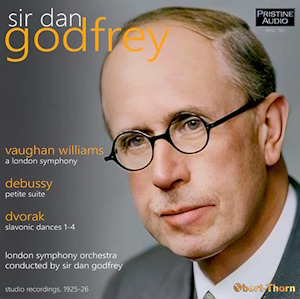
Ralph Vaughan Williams (1872-1958)
A London Symphony (Symphony No.2) (1920 version)
Claude Debussy (1862-1918)
Petite Suite (1886-1889, orch. Büsser 1907)
Antonín Dvořák (1841-1904)
Slavonic Dances, Op.46 Nos.1-4 (1878)
London Symphony Orchestra/Sir Dan Godfrey
rec. 1925-1926, Columbia Studios, London, UK
Pristine Audio PASC761 [72]
I was brought up in Torbay, long after the Torquay Municipal Orchestra and Ernest Goss had faded away (Let’s hope that one day the TMO/Goss 78s (from 1944) of the Holbrooke Fourth Symphony will be retrieved and issued on CD). To the subject … the Bournemouth Symphony Orchestra was part of the landscape in Devon … if intermittently. They certainly featured in Exeter University’s Great Hall series. I recall one of my earliest orchestral concerts there: Berglund conducting the BSO in Brahms’ Violin Concerto (György Pauk) and Sibelius 5. It was only when I went to study in Bristol in the early 1970s that they figured more strongly. By then, they were being conducted by the likes of Paavo Berglund, George Hurst and Volker Wangenheim; the latter – hardly mentioned at all these days – in Mahler and Bruckner symphonies. The orchestra itself was founded, to all intents and purposes, by Sir Dan Godfrey (1868 –1939). Godfrey’s time with the BSO has been documented in a superb book by Stephen Lloyd and before him in a more general volume by Geoffrey Miller.
Pristine now furnish us with some century-old recordings of Dan Godfrey and this is not their first entry. The mono sound is inevitably constrained but is very listenable; the inspirational work of Producer and Audio Restoration Engineer, Mark Obert-Thorn.
What we hear is the 1920 version of the Vaughan Williams Symphony No. 2, as dedicated to VW’s friend, George Butterworth who, only four years earlier, had been killed in the Great War. What this performance conveys to this listener is Godfrey inculcating a sense of meticulously crafted precision. Everything is tautly and impressively regimented. Even so, this clipped approach yields freshly peculiar emotional surges (II, 3:20) and the tight regularity of tempo in the Scherzo imparts a blast of fresh air reminiscent of Frank Bridge’s “Story of my soul” (from the two Jefferies poems). Allow for a stiff strut (1:34) in the finale and forgive the inspissated ‘chimes’ at 7:30. They seem deadened … as if determined not to be sensuous. Godfrey, the precisian, is the very antipode of, say, Barbirolli. Even so, the dynamics are impressive for a century-old recording which lets us hear what the composer would have heard in those far off days.
It’s interesting to note (courtesy of Mark Obert-Thorn) that Godfrey and the LSO recorded an acoustic version of the Overture The Wasps in November 1923 and that it even enjoyed a catalogue number L1534 although it was never released. Where is it?
The Debussy (orch. Büsser) displays a more responsive flexibility and accommodates a strolling relaxation, a fairground roundabout and a Menuet that seems to cast envious glances at Prokofiev’s Classical. There’s a gravitational pull towards rigid tempi in the final Ballet, but it’s life-enhancing all the same. The four Dvořák Slavonic Dances lack the pliable flow and snap of a Talich or a Kubelik; still less a Sejna. We must allow Godfrey his “autre temps autre moeurs”.
This is fascinating stuff and an absorbing listening experience.
Rob Barnett
Previous review: Jonathan Woolf
Availability: Pristine Classical












