
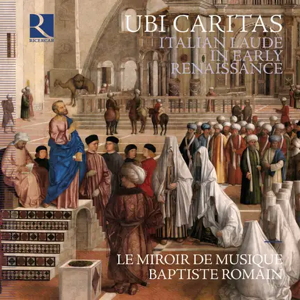
Ubi Caritas
Italian Laude in the Early Renaissance (c.1420-1520)
Le Miroir de Musique / Baptiste Romaine
rec. 2024, Church of Saint-Léger, France
Ricercar RIC486 [71]
We should first ask what a ‘Lauda’ is. There are about 150 songs in the vernacular from Italy that we can call ‘Lauda spirtuali’ that is “spiritual praises”. There are examples from as early as 1250, but the form continued well into the sixteenth century; some were published by Petrucci and some in Venice, whilst others can be found in various manuscript collections all of which are clearly given in the booklet.
To quote the fascinating booklet essay by Baptiste Romain himself, ‘In the fifteenth century the lauda enjoyed a renewed popularity’ Two poets especially contributed: Feo Belcari and Leonardo Giustinian, both humanists who often developed the idea of ‘intense explorations of the Passion’. Musically ‘the success of the lauda is due to the use of homorhythmic textures’ which of course enable the texts to be clearly heard. This was against the fashion of the time in the rest of Europe but it’s interesting that some lauda can be ‘contrafacta’ versions of well-known secular songs from the Franco-Flemish school. Two examples reconstructed here are Con gran fervor, Gesú, ti vo cercando’ (I seek you with fervour, Jesus) which uses the music of the popoular ‘J’ay pris amours’ said to have been composed by Johannes Ghiselin, and Nessun piacere ho sanza te (Without you Jesus, I have no joy) which is based on ‘Mon seul plesir’ which is attributed to the Englishman John Bedyngham (d.c.1460) whose work can be found on continental manuscripts. The last track, however, is by Josquin O mater dei et hominus which, although in Latin, still is informed by the lauda tradition.
The sources come through a small collection of manuscripts and printed material as mentioned above. The oldest music comes from Venice of the 1420s and 1450s, including Sancta Maria, regina celurum. Later, two collections were published in Venice in 1507 and 1508 and Petrucci made sure that they contained works by a certain Innocentius Dammonis. These are basically simple homophonic works which were suitable for the city’s convents. But Petrucci also included music by Italian court composers such as the Milanese lutenist Joanambrosia Dalza. Another source is a manuscript known as the Codex Grey, now in Cape Town, which alongside vocal works, such as the Good Friday meditation Convertime o signore, has instrumental fantasies using the lauda melodies. An example here is Vidi impium superexaltatum. One other source worth mentioning is manuscript 165 in Udine from which we hear O tempo giocundissimo (O most blessed time).
Le Miroir de Musique have made at least a dozen albums of music of this period and can be relied upon to create an authentic atmosphere and have a scholarly approach, both of which seem to be characteristic. I’m not sure about the use of bells on a few tracks, but the twelve musicians use the standard gothic harp, lutes and viols, pipe and tabor and we have a varied set of five voices. Adding to the variety, several pieces are played instrumentally and some have instrumental introductions.
At the end of his essay Romain writes ‘Between fervour and musical inventiveness, the vision of a living tradition emerges, where art and spirituality were one’. That does indeed sum up the music on this CD, which is always interesting, sometimes serious, and often subtly exquisite and enchanting. All texts are given and well translated.
Gary Higginson
Buying this recording via the link below generates revenue for MWI, which helps the site remain free
Contents
Johannes de Quadris ( c.1410-1457) Cum autem venissem ad locum
Anon: Quam autem venissem
Anon: Laudato sia Dio (Dindirindin)
Anon: Vidi impium superexaltatum (instrumental)
Anon: O tempo giocundissimo
Anon: Vergene bella gratiosa e pura (instrumental)
Innocentius Dammonis (fl.c.1510) Amor Jesù divino
Anon: Con gran fervour, Gesù ti vo cercando (J’ay pris amours)
Anon: Nam edunt de micis (instrumental)
Anon: Sopr’ogni stella bella (Creature la plus belle)
Anon: Sancta Maria regina caelorum
Anon: Se gratia per gratia (instrumental)
Anon: Convertino e signore
John Bedyngham (d.c1460) Nessun piacere ho sanza te
Bartolomeo Brollo (d.1450) Pulcra, speciosa et decora
Domenico da Piacenza (c.1400-1470) Rostiboli giocoso (instrumental)
Anon: I’sento’l buon Gesú del core
Innocentius Dammonis Peccatori, percé seti
Joanambrosio Dalza (flc.1508) Patentia ognum me dice
Anon: O Dio ch’a fatto il ciel (instrumental)
Josquin de Pres (c.1450-1521) O mater dei et hominis













